Active work on the design and manufacture of new, modern armored railcars for the Red Army began after the establishment of the Red Army’s Mechanization and Motorization Department (UMM) at the end of 1929. In early 1930, UMM representatives inspected armored train units with a view to their modernization. Regarding armored railcars, the head of the UMM’s technical department, G. Bokis, stated on March 19, 1930, that there was no standard model of armored railcar in the Red Army units, that the available machines were of varied designs (mostly Matvals) and did not meet technical requirements, and that it was urgent to design a standard model of light armored railcars armed with machine guns and heavy armored railcars armed with cannons.
The project called for new light armored railcars designed to ensure unimpeded movement for armored trains. To minimize their vulnerability, they were to be small, with 7 to 8 mm of armor, a speed of at least 50 versts per hour (53.34 km/h) in both directions, good observation capabilities, and armed with two Maxim machine guns allowing 360° firing with minimal blind spots and the ability to fire anti-aircraft.
For heavy railcars, the planned armament was two Maxim machine guns and a 76 mm Mod. 1913 or Mod. 1927 gun. Pending their development, it was proposed to use Garford self-propelled guns withdrawn from service with modified armor while new heavy railcars were being designed.
The D-37 railcar:
Despite this report, the development of new railcars did not begin until a year and a half later under the supervision of Nikolai Dyrenkov. In May 1931, the design of the D-37 railcar, powered by a Ford AA engine, began. The first trials, scheduled for January 1932, ultimately took place only in March 1932, revealing numerous technical flaws.
The D-37 weighed 8,050 kg and had a welded armored superstructure with thicknesses of 12 mm (front, rear, and sides), 8 mm (upper sloped faces), 6 mm (roof), and 4 mm (lower sloped faces). The upper and lower hulls were bolted together. The crew consisted of six men. Two doors (one on each side) provided access, and there were four vision ports (two front and two rear). The engine was a 40 hp Ford AA with a four-speed gearbox. The maximum speed was 75 km/h. Two 85-liter fuel tanks provided a range of 500 km. The turret, armed with a 37mm Hotchkiss cannon and a DT machine gun, came from the D-13 armored car. Two more DT machine guns were mounted in the hull on ball mounts. At the rear of the hull was a coaxial anti-aircraft mount for Maxim machine guns, closed by a double-hinged hatch. When firing, the hatch was swung to the sides and the machine guns were raised. The ammunition consisted of 200 37mm shells, 18 boxes for Maxim machine guns (500 rounds each, 9,000 total) – 6 in the side racks, 12 at the rear of the hull – and 90 discs for DT machine guns (5,670 rounds). After testing, Dyrenkov suggested strengthening the armament by installing a new turret armed with a 76.2mm cannon (modified D-38 turret). Permission was granted, but he did not have time to complete the modification because his design office was closed on December 1, 1932. The work was finished by another design office under the direction of N. Gulenko. In March 1933, the D-37 was tested with the new turret armed with the 76.2mm gun. The results showed that the vehicle was overweight, the crew could not work properly, and the gun mount design was flawed. Consequently, another modification was made.
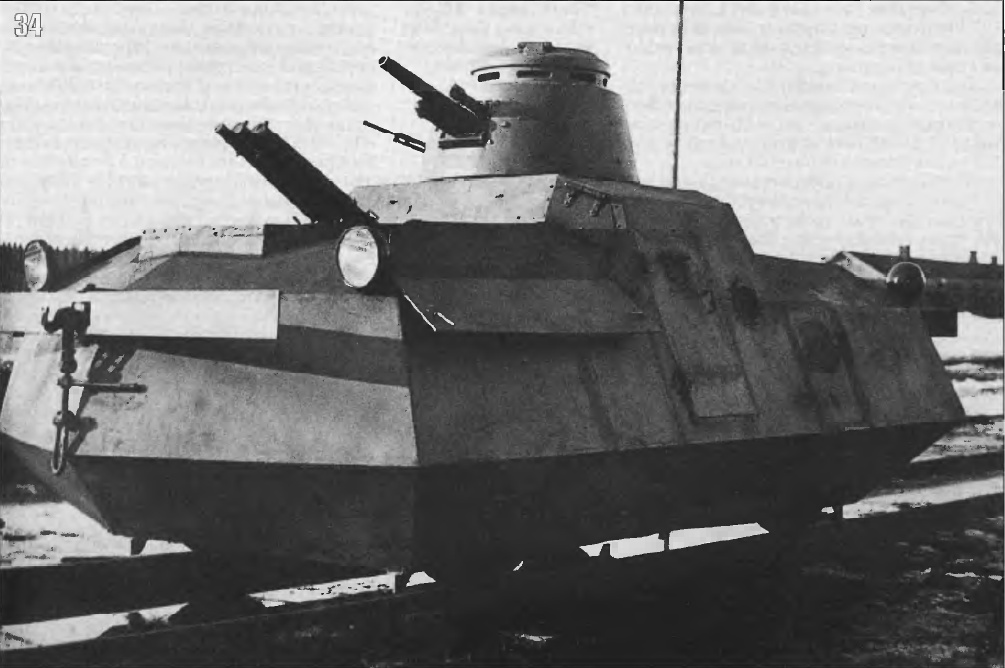
D-37 with D-13 turret, Mozherez plant, March 1932. the double AA Maxims system -ASKM- is clearly visible, source frontline illustration
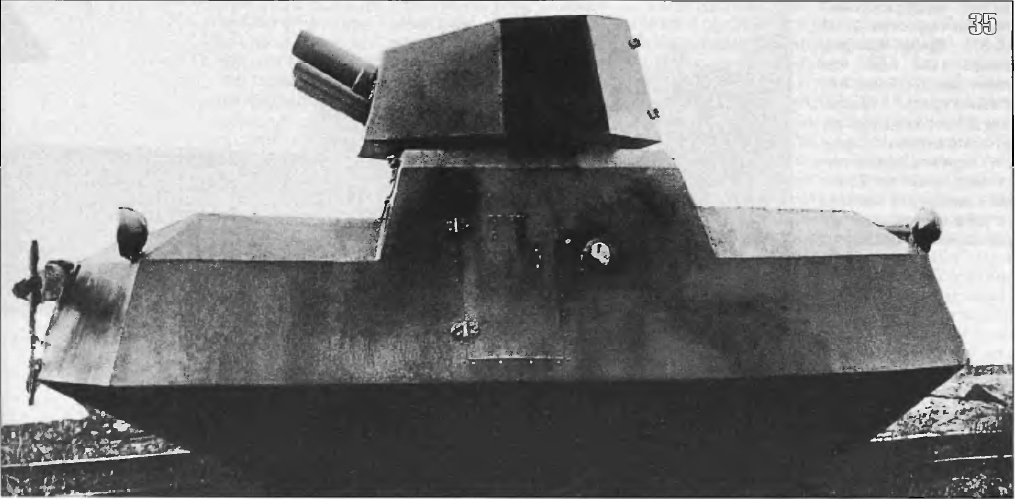
D-37 with the new D-38 turret with 76,2mm gun, mozherez plant, March 1933, source frontline illustration
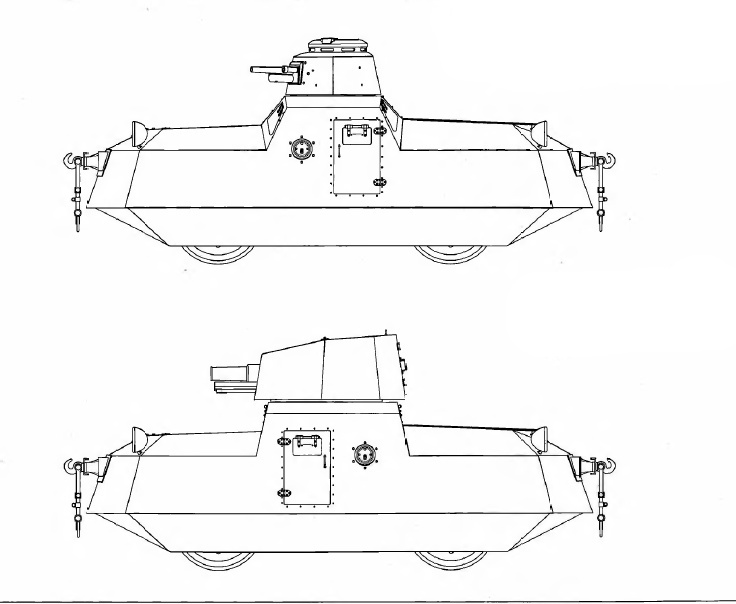
D-37 above with the D-13 37mm turret and below with the D-38 76,2mm turret, source frontline illustration
The DT-45 railcar :
This modification came with the introduction of a T-26 turret armed with a 45mm gun, a 71-TK radio, and a modified rear section. The D-37 now weighed 8,400 kg, the crew was increased to seven men, and it carried 224 rounds of 45mm ammunition. The D-37 was also equipped with a device for transferring from one railway track to another parallel track. This allowed, in a combat situation, the use of the adjacent railway line to bypass broken sections and to overtake trains.
The device consisted of a spring-loaded locking mechanism, two jacks, and two pairs of beams. The procedure was as follows: First, the springs were disconnected so that the wheels would rise with the body. Then, using two jacks operating simultaneously, the body was raised to a height that lifted the wheels to within 5 mm of the rail. After this, beams were placed on the rails, which were then attached to the rails and special supports (at the same time, the horizontal position was checked). The railcar was then moved on two pairs of small rollers fixed to the front and rear of the body. Movement could be done manually—requiring the effort of four people—or with a 0.5-ton winch, one end of whose chain was attached to an external support (telegraph, signal, or other mast), and the other to an eyelet welded to the floor of the carriage. Movement in this manner could be carried out over a distance between tracks not exceeding 4.1 meters. Trials of the vehicle, which was given the new name DT-45 (DT for heavy railcar), were conducted in November 1933 with good results. Admittedly, the hull was cramped, making the task difficult for the crew, the ventilation was inadequate, especially when firing a cannon, and the engine frequently overheated due to insufficient cooling. Despite its shortcomings, at the end of 1933, the UMM considered organizing the mass production of the DT-45, but this idea was soon abandoned and only one example remained. It was used in a separate armored train regiment for training purposes until mid-1938.
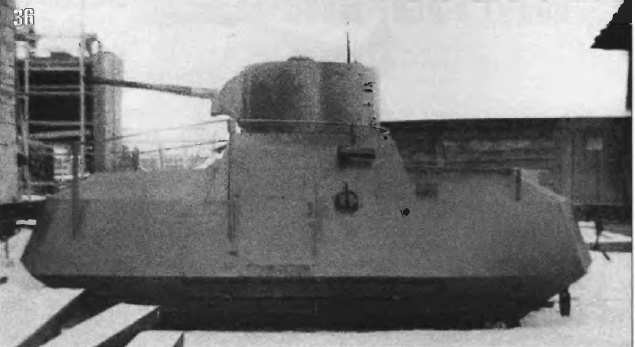
DT-45 with the new T-26 turret, Mozherez plant, January 1934, source frontline illustration
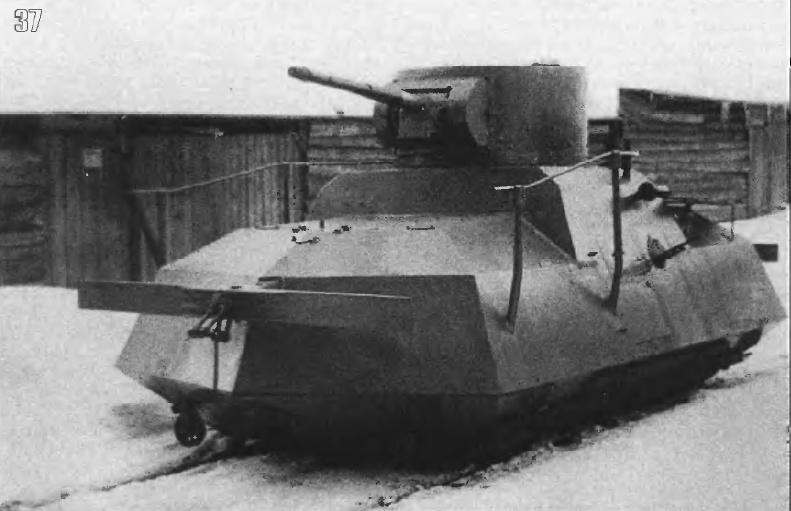
DT-45, Mozherez plant, January 1934, visible are the small rollers for transfer to a parallel track, source frontline illustration
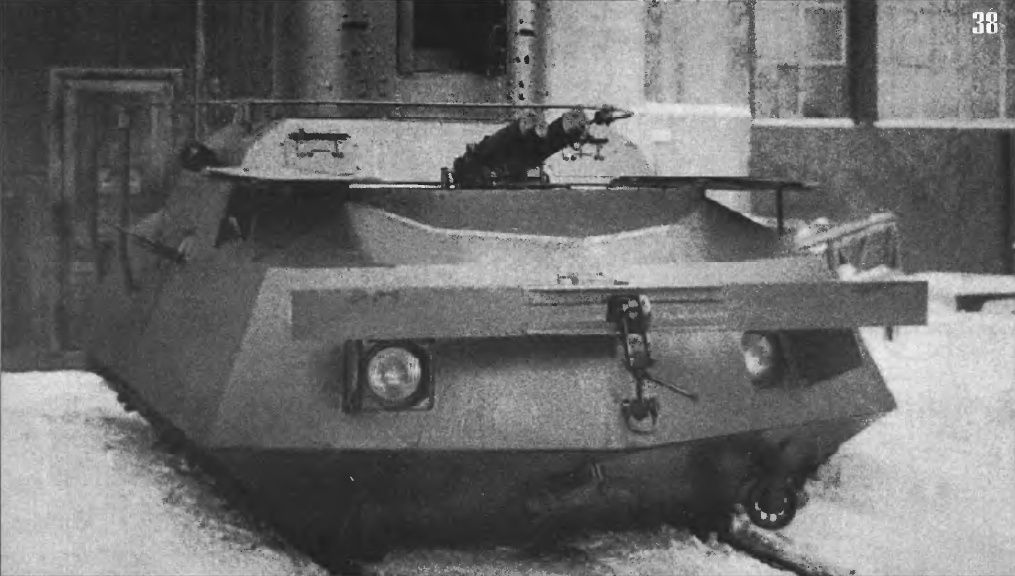
DT-45, Mozherez plant, January 1934, visible is the ASKM device for double Maxim AA fire, source frontline illustration
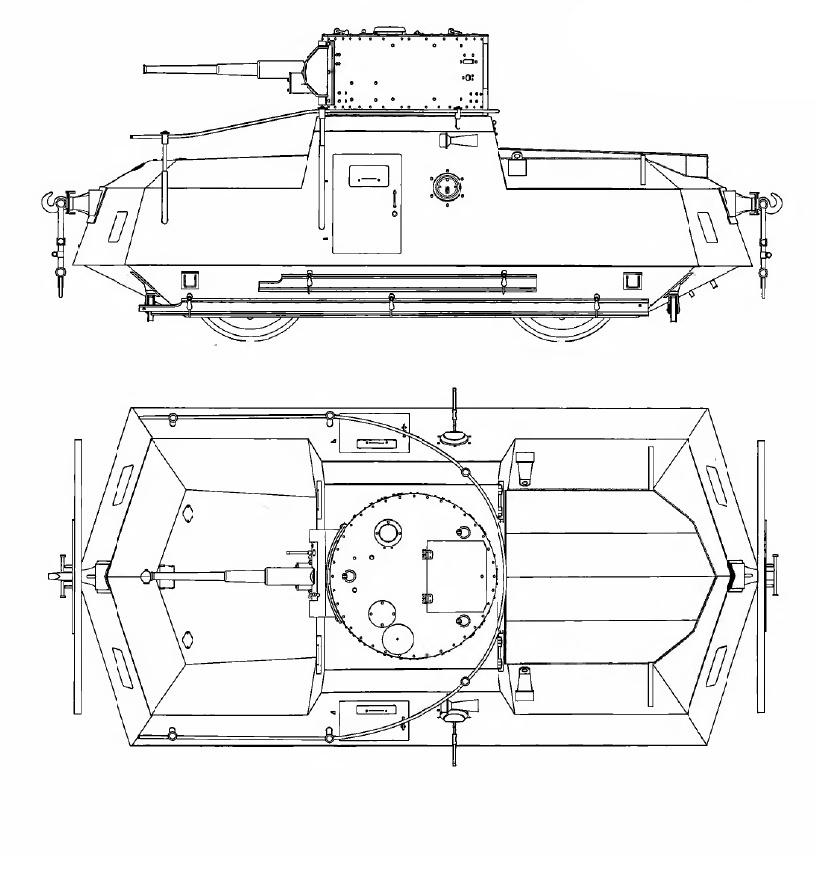
DT-45 left and above views, source frontline illustration
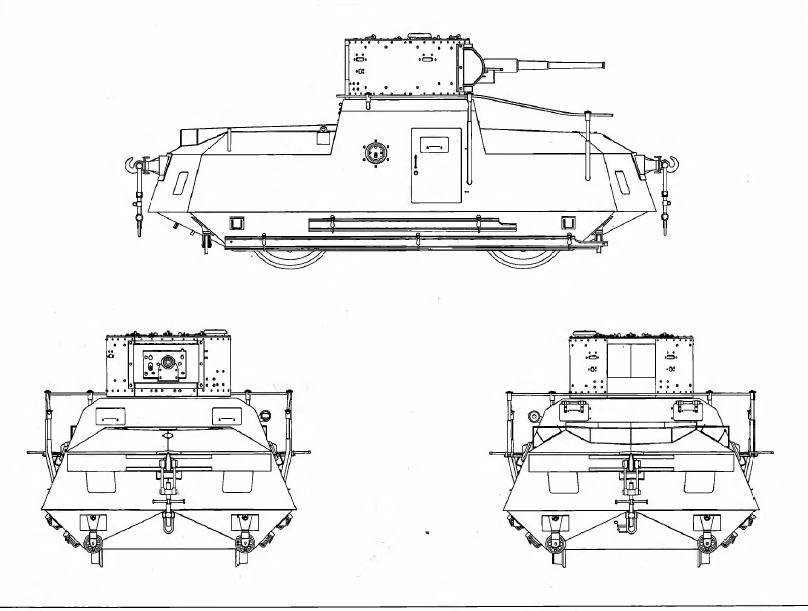
DT-45 right, front and rear views, source frontline illustration
source frontline illustration