
Historical Background :
By the end of the 1900s, it became clear that the the motorization of armies was inevitable. In Russia, the problem was complex and urgent because of the underdevelopment of the local automotive industry.
As elsewhere, the military administration traditionally did not trust new technologies. In Russia, it was relying on the railway and the cartage, the Russian road network being almost non-existent and the climatic conditions extreme.
At the same time, the defeat against Japan,the economic crisis and civil unrest of 1906 – 1907 claimed expenses for other important tasks. However, the military administration closely monitored the development of this problem abroad, performed tests of some types of mechanical engines, vehicles (charron for exemple), the use of which for military purposes, it seemed, had promised to bring quick benefits with low costs.
From1906 on, the Russian Empire unproductive customs policy conducted to high tax the import of spare parts, as well as machines for their production.This situation, according to the legislators, was decided to promote the development of domestic engineering. But at the same time the import of finished vehicles was low taxed.
The result was a predominance of foreign, primarily German, vehicles, while reducing the production of russian cars. As a result, at the beginning of the first world war,the automotive situation became critical: lack of spare parts for cars did not allowed to use them effectively in the armed forces.
However, the Russian army at the same time contributed to the development of the domestic automotive industry by constantly placing orders for motor vehicles with local companies. The inability of Russian industry to fully meet the army needs was due to their low technological level.
The military motorization was part of the reorganization of the Russian Imperial Army. In 1909 the Minister of War created an Automotive branch, whose role was to provide equipment for this motorization. It should be pointed out that we are talking here only of trucks and passenger cars administratively attached to the railway battalion.
In the budget for 1910, the Treasury allocated 245,000 rubles and then 14,0000 more for the transport of troops by vehicles. During the third International Automobile Exhibition from 15 to 27 may 1910, in St Petersburga new Russian manufacturer emergedwith the Russo-Baltic company located in Riga (Latvia), then in the Russian Empire, originally constructing railway wagons. This company later played a significant role in the motorization of the Russian army.
Finally, on 16 may 1910, an order was signed for the formation of the 1stcompany of automobile(two years later renamed the company of military and automobile) under command of captain Piotr Ivanovitch Sekretev, who later played a major role in the formation of the 1st automobile machine-gun company.
In July 1911, successfull tests were carried out for the use of military trucks. The utility of these machines was demonstrated, but the endurance of individual components and assemblies was also tested. During autumn 1912, a second test was conducted. The Commission had acquired 354 trucks and 42 passenger cars. These vehicles were assigned to the newly formed car company at the railway battalion.
These tests provided a wealth of experience in the motorization of the army and allowed the military leadership to formulate a clear understanding of the use of nomenclature, types and number of vehicles required. It became obvious that the army needs not only universal but also highly specialized vehicles.
The practice of using a new type of troops required a corresponding theory and regulatory. The creators of the theory and basics of combat use of vehicles are professor of General Staff Academy V.G. Boldyreva, with his 1911-1912 Academy lectures « The car and its tactical use », the captain V.O. Kapel with his « car service in the army », the Colonel Vladimir Aleksandrovich Zlatolinsky with his « The car and other types of mechanical traction as applied to military purposes », which studied the mechanization not only in terms of mobility and traction of different weapons but also in terms of combat vehicle.
At the declaration of war in August 1914, the Russian army possessed in all and for all 711 vehicles: 418 trucks, 239 cars, 34 special vehicles (sanitary, cistern, workshop). Only one Russian firm produced vehicles and only cars (127 in 1913), the Russo-Balt company based in Riga. That is why, in parallel with national efforts, a commission was set up under the direction of the commander of the automobile reserve company, Colonel Sekretev (the same who led the commission of 1911-1912). This commission went to England in September 1914 to buy vehicles for the Russian army. In addition to trucks, cars and special vehicles, it was also planned to buy armored cars if possible. A specification was drawn up by the military technical direction of the general staff. Among the recommendations, it was asked for an armored roof which made the Russian army the first to recommend fully armored vehicles. When they arrived in England, unfortunately, there were no vehicles that fulfilled the specifications. During negotiations with the firm Austin for the purchase of trucks, the Austin management agreed to work on an order for armored vehicles fulfilling the Russian conditions. A contract was signed for 48 vehicles with delivery for November 1914. In October, the commission left for France and concluded on October 20 a contract for the purchase of 40 Renault armored cars identical to those of the French army even if they did not meet the Russian specifications (they did not have an armored roof). At the end of 1914, the commission bought a total of 89 armored cars (48 Austin, 40 Renault, 1 Isotta-Fraschini). These vehicles arrived in Russia between November 1914 and April 1915. It should be noted that in addition to these armored cars, the commission also bought 1422 other various vehicles. Having received a telegram from General Sekretev regarding the purchase of 48 Austin armored cars (referred to in documents as vehicles of the 1st standard or 1st series) from England, the Automobile Department of the Main Military Technical Directorate (GVTU) of the Main Directorate of the General Staff (GUGSh), together with representatives of the Military Driving School and the Officer Rifle School, began developing a staffing plan for the formation of armored car units. The Main Military Technical Directorate (GVTU) was created in 1913 by renaming the previously existing Main Engineering Directorate. In early 1914, the GVTU was reorganized, after which it consisted of four departments and two committees. The fourth department (technical) included the aeronautics, automobile, railway, and sapper divisions.
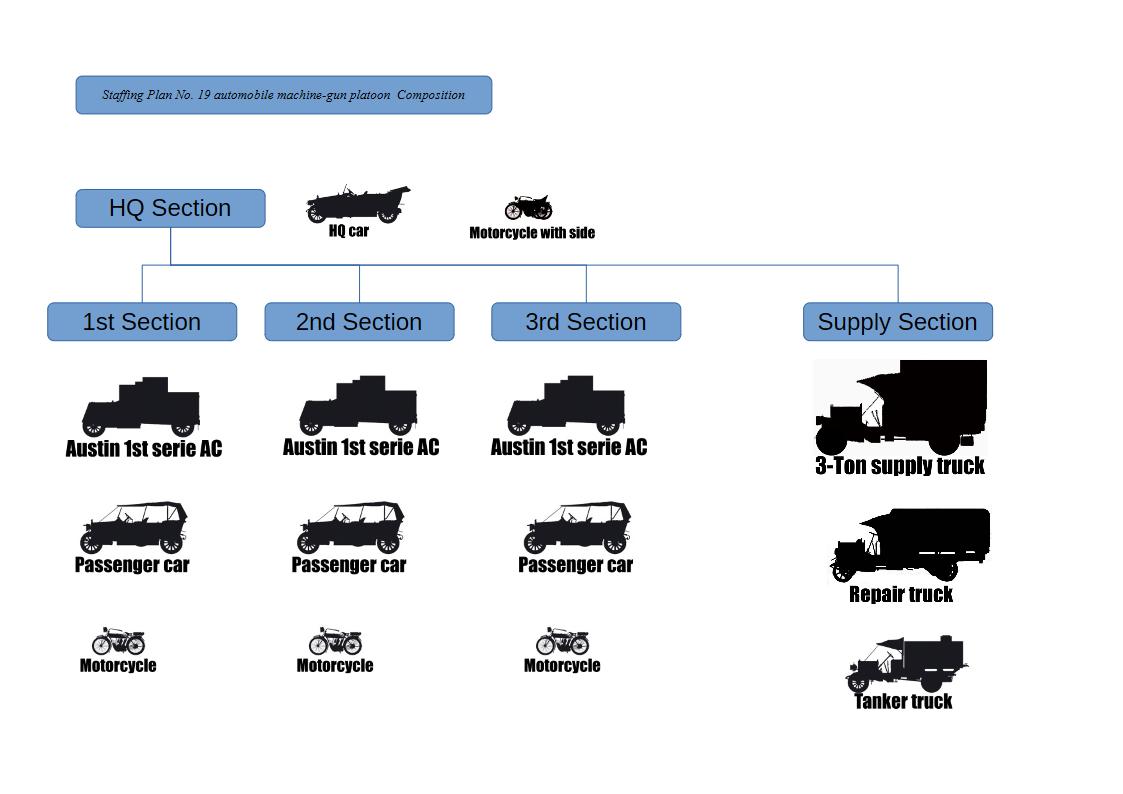
In early December 1914, Staffing Plan No. 19 for the automobile machine-gun platoon was Imperially approved.
Staffing Plan No. 19 automobile machine-gun platoon Composition:
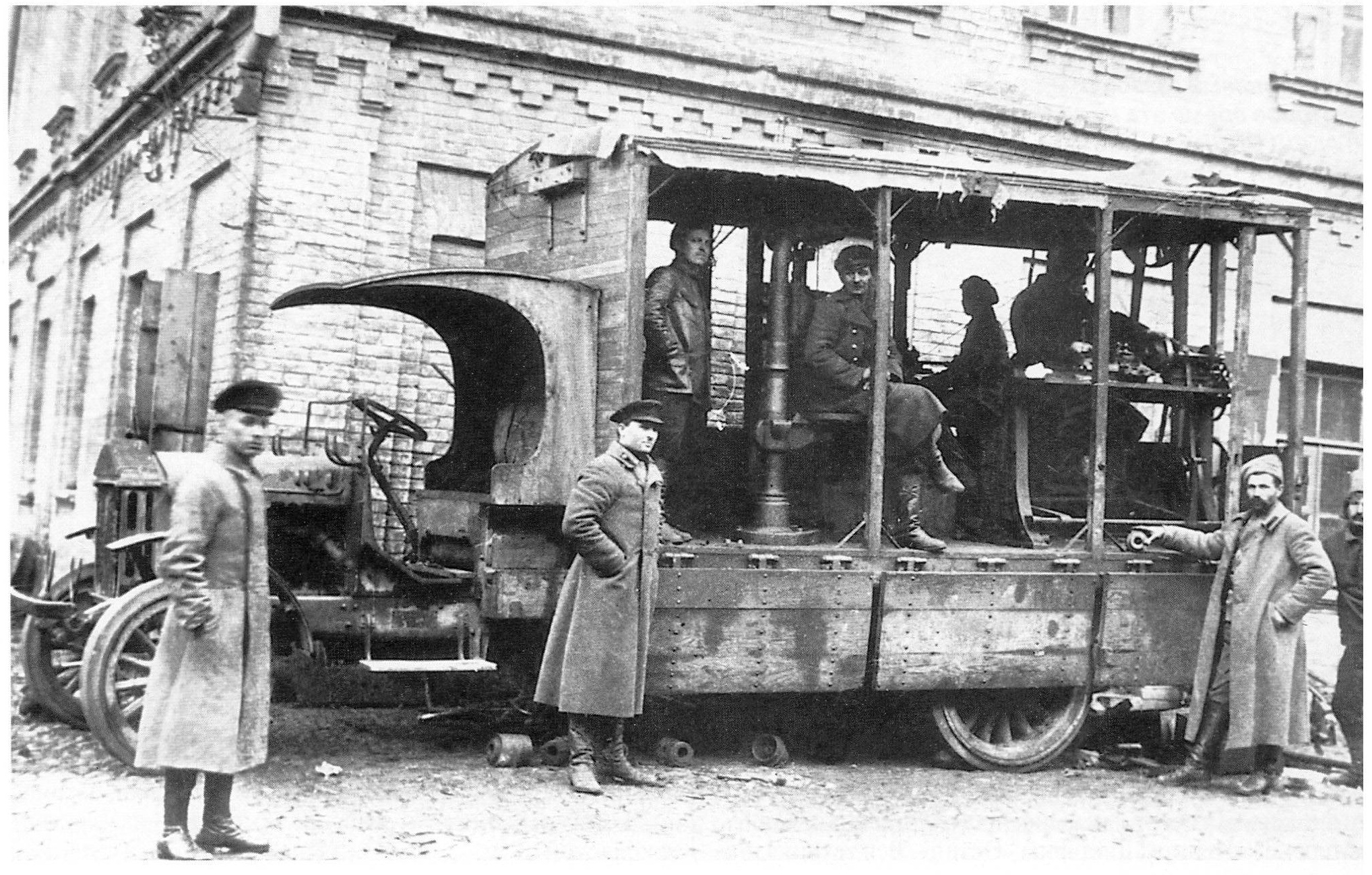
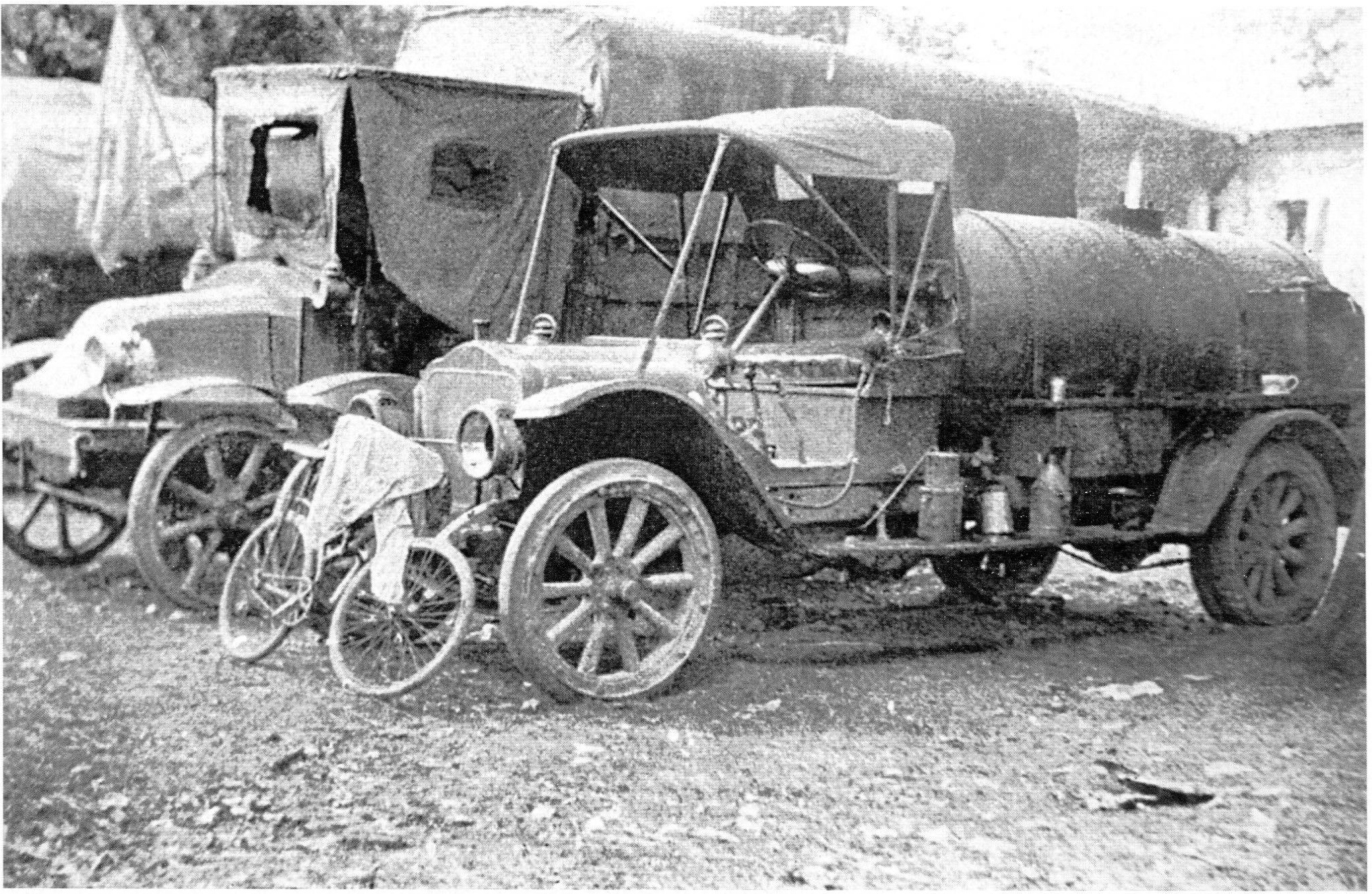
three Austin machine-gun armored cars, four passenger cars, one 3-ton truck, a repair shop, a tanker truck, and four motorcycles, one of which had a sidecar. Each armored car was assigned one passenger car and one motorcycle without a sidecar for maintenance.
Personnel :
The platoon’s personnel included four officers (according to the staff, the commander was a staff captain, and three junior officers – second lieutenants) and 46 non-commissioned officers and privates. A distinctive feature of the Russian Army’s armored car units was that, from the very beginning, they featured a large percentage of volunteers, not only among officers but also among non-commissioned officers. Among the latter, a high percentage were long-term enlistees and volunteers from among highly skilled mechanics and metalworkers. Overall, the overwhelming majority of those serving in armored units were literate individuals who quickly mastered new combat equipment, the use of which required technical training and initiative. The most skilled artillerymen, machine gunners, and drivers were selected for assignment to machine gun platoons. Among the armored unit officers, a large percentage came from artillery and guards units, as well as wartime ensigns who had higher technical educations or had worked as engineers before the war. All this led to the armored car units becoming a kind of army elite by mid-1915. This was facilitated by both the active use of armored cars in combat and the high percentage of decorated personnel. Therefore, the armored units, for the most part, remained true to their oath and resisted the influence of various parties in 1917.
Uniforms :
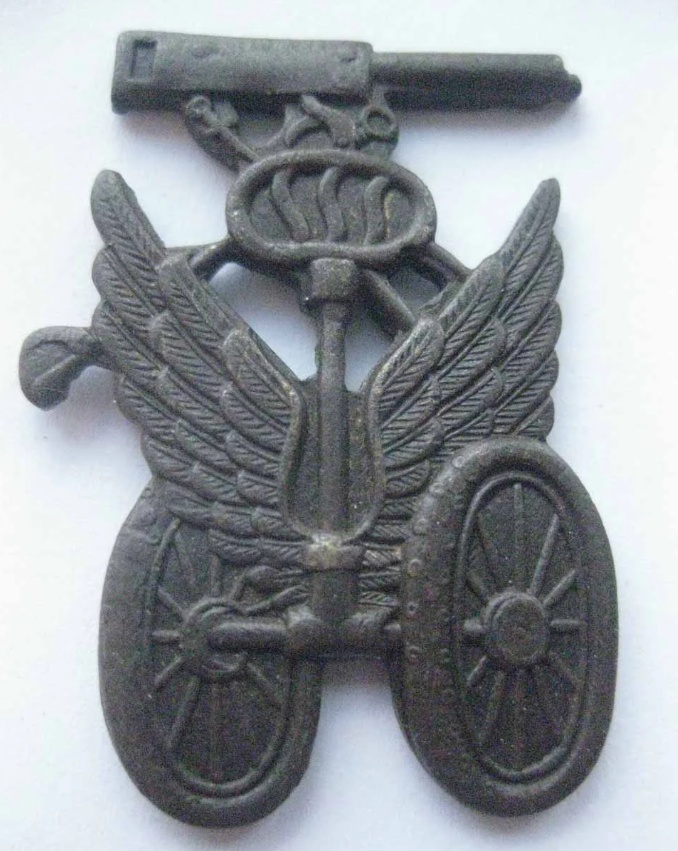
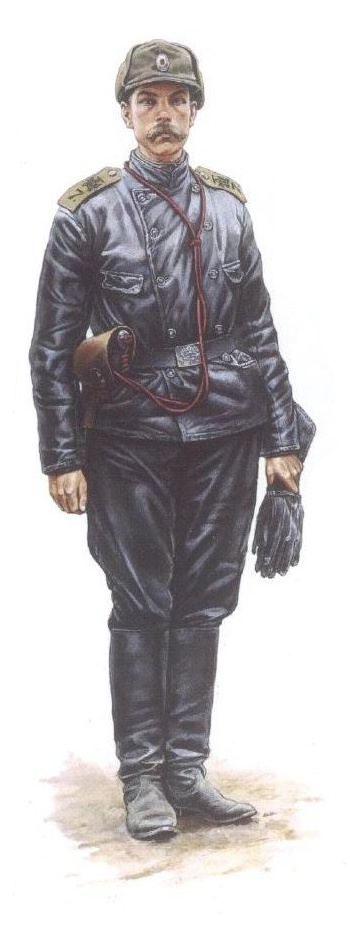
Leather uniforms (leather trousers and jacket) and a rather unique visored cap were introduced for armored vehicles. The 1st Machine Gun Company was the first to wear this type of uniform. The latter used two emblems—one for the vehicle and one for the machine gun—for coded shoulder straps. In 1915, Order No. 328 of the Military Department introduced a special emblem for machine gun units. It combined the symbols of vehicle and machine gun units. The emblem was worn on shoulder straps and was made of white or yellow metal, but it was also sometimes applied with paint and a stencil.
The first machine-gun platoons :
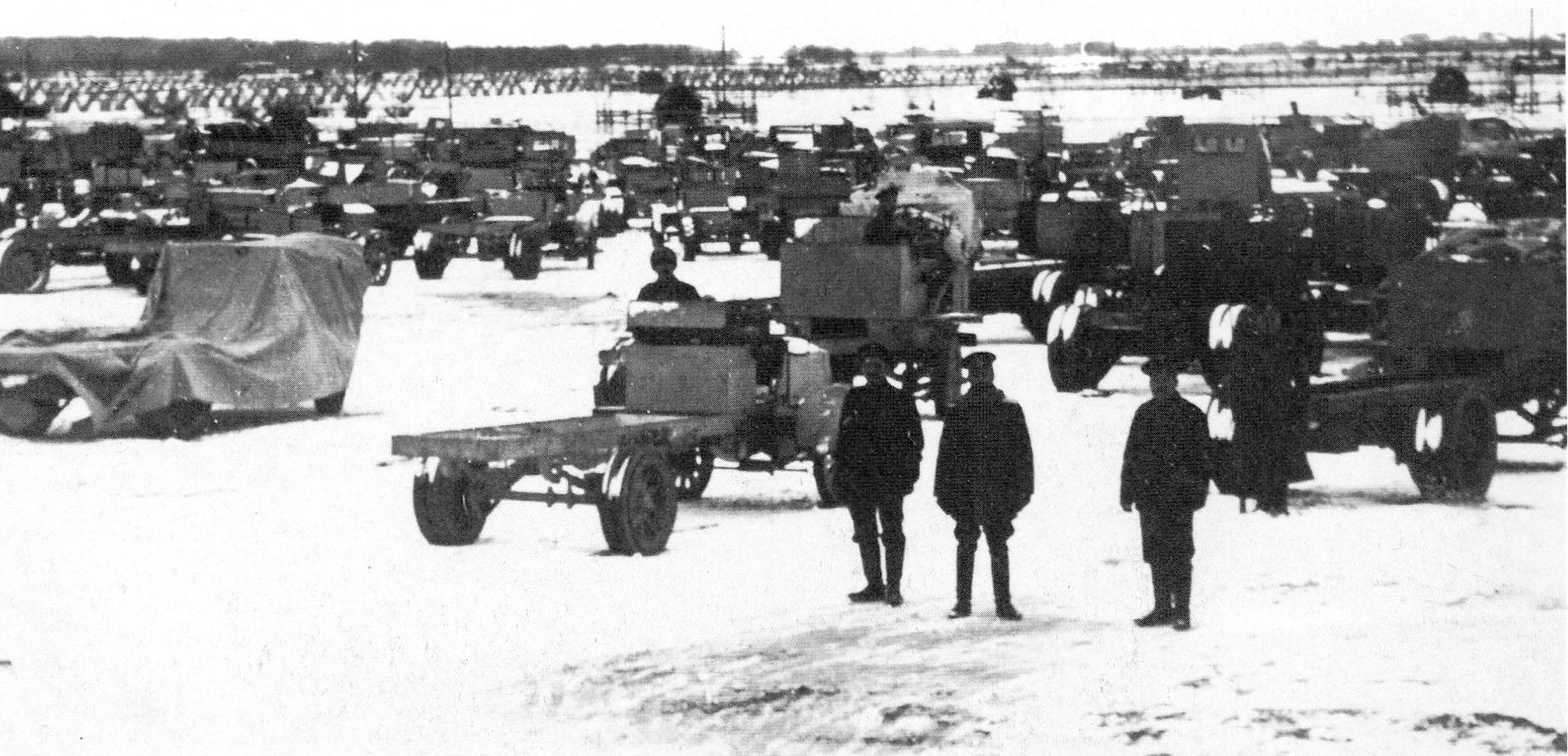
The formation of the first machine-gun platoons began immediately after the arrival of armored and auxiliary vehicles from abroad. By December 20, 1914, eight platoons (Nos. 5 through 12) were ready, and they departed for the front the following day. The passenger cars in these units included a wide variety of models (Benz, Pierce-Arrow, Locomotive, Packard, Ford, and others), Humbert and Enfield motorcycles, White trucks, Napier workshops, and Austin tankers. All the equipment supplied to the platoons was new, purchased by Colonel Sekretev’s commission. The exception was the passenger cars received from the Reserve Automobile Company. The formation of the first machine-gun platoons was carried out by the Officers’ Rifle School in Oranienbaum and the Military Driving School in Petrograd.
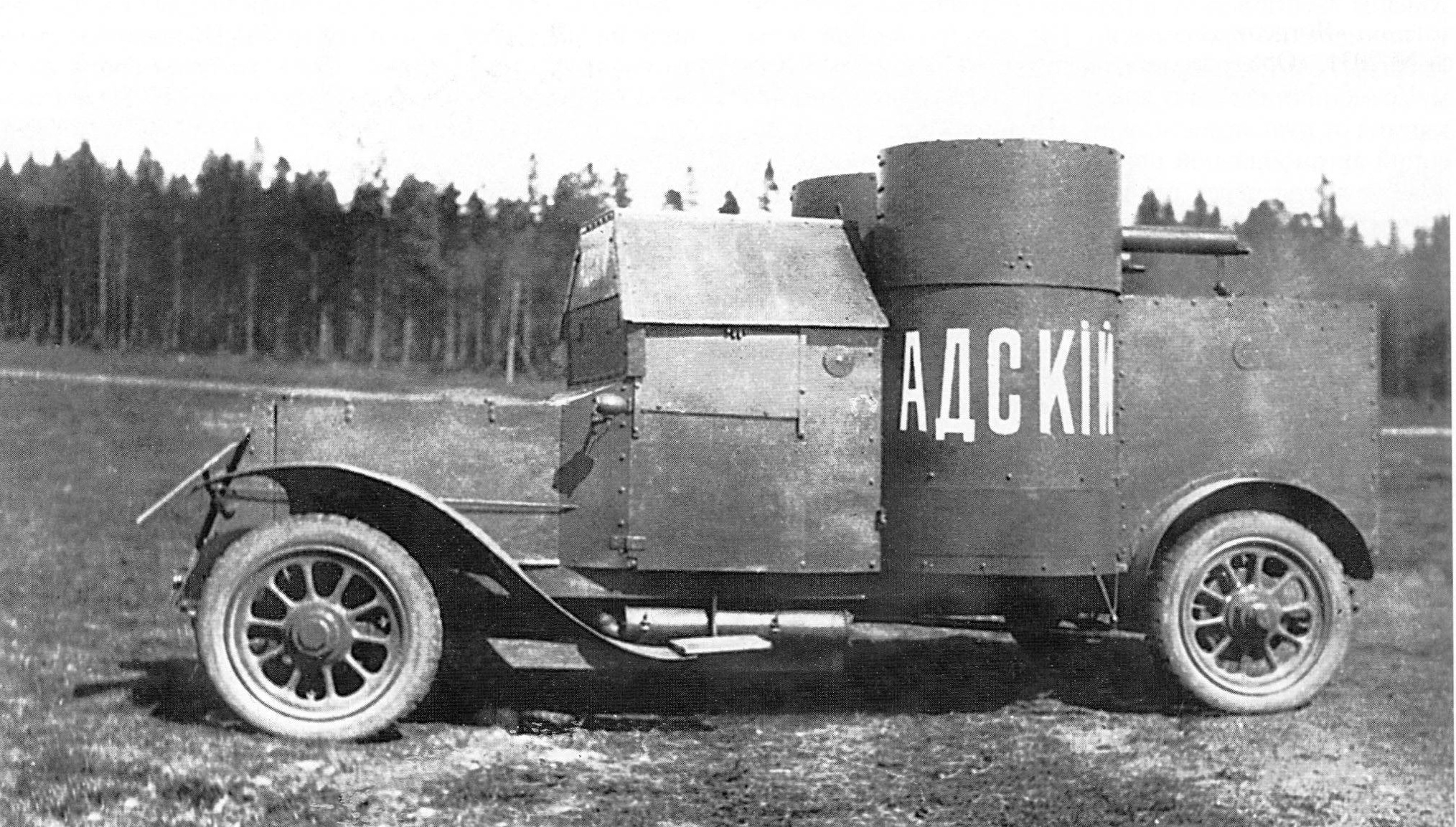
The combat operations of the 1st Machine Gun Company and the first machine gun platoons demonstrated the need for a cannon-armored car to support the machine gun vehicles. Therefore, in March 1915, staffing plan No. 20 was approved,
Staffing Plan No. 20 automobile machine-gun platoon Composition :
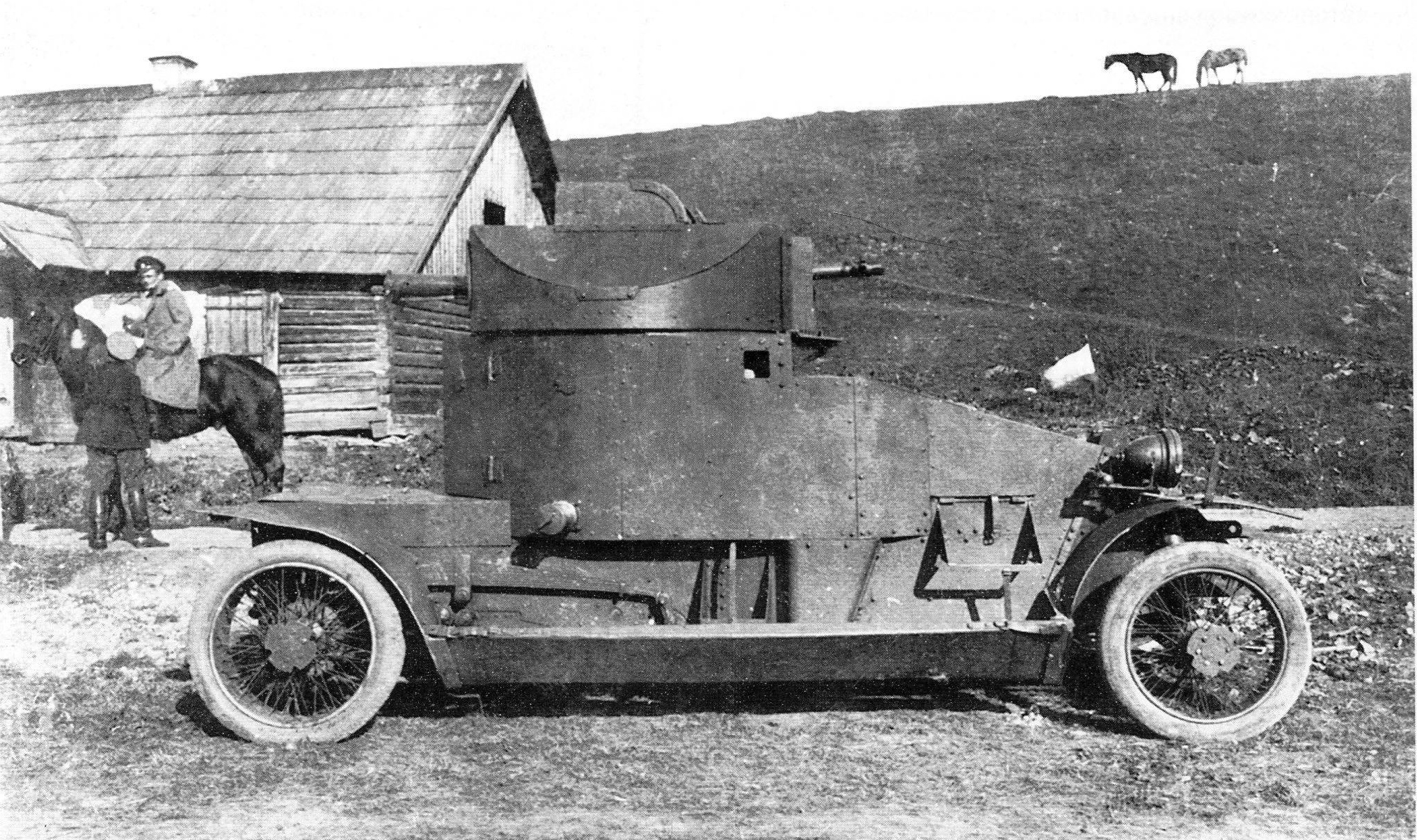
Two machine gun armored cars, and in place of the third, included a cannon section consisting of a Garford armored car armed with a 76-mm gun, built at the Putilov Factory. To improve the supply of combat vehicles, three more trucks were added—two 1.5-2-ton and one 3-ton. Thus, according to the new table of organization, a machine gun platoon included three armored cars (two machine guns and a cannon), four passenger cars, two 3-ton and two 1.5-2-ton trucks, a repair shop, a tanker truck, and four motorcycles, one with a sidecar.
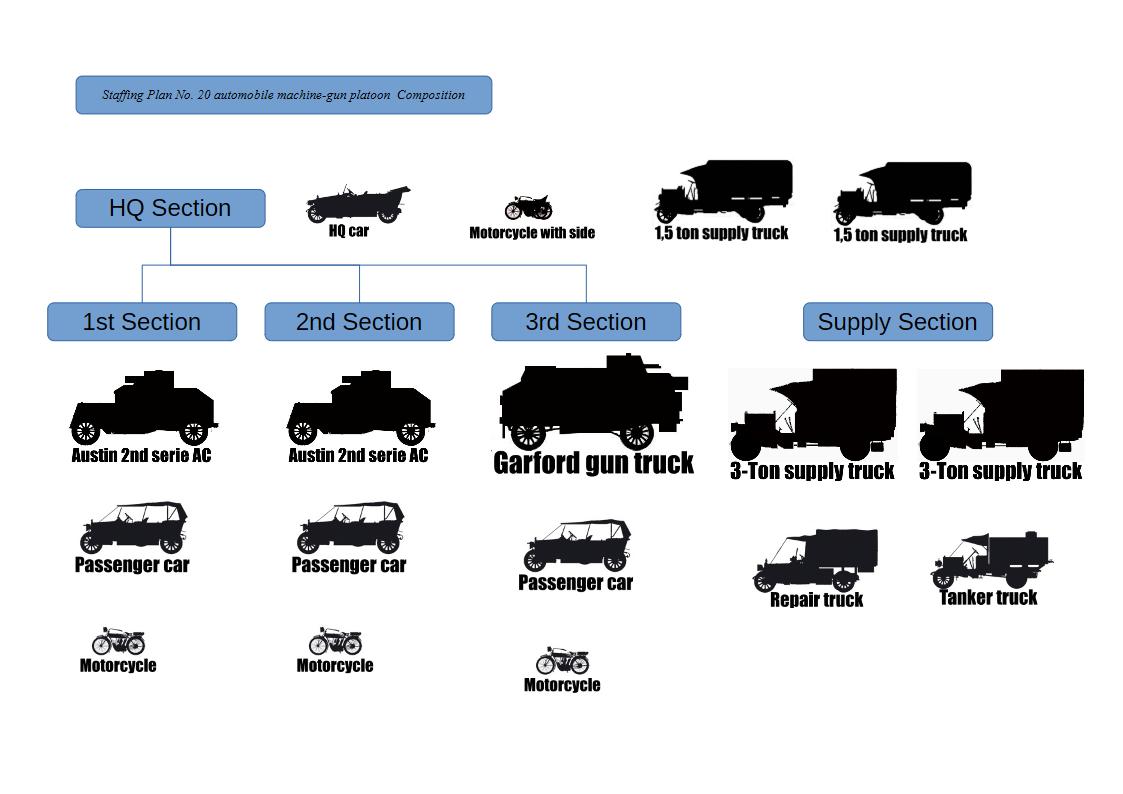
According to Table No. 20, 35 platoons (Nos. 13-47) were formed, with the 25th and 29th platoons having non-standard combat equipment (this will be discussed in separate chapters). Beginning with the 37th platoon, Lanchester armored cars with a 37mm cannon replaced the Garfords in the gun section. The first Austin-equipped platoons (Nos. 5-12) also received Garford armored cars and additional trucks, while the third machine gun vehicle was retained.
Other armored supply units :
To form machine-gun platoons and supply them with equipment, the Reserve Automobile Armored Company was formed in Petrograd in early March 1915. Captain Vyacheslav Aleksandrovich Khaletsky was appointed its commander. An armor department was established at the Military Automobile School to address the development of new types of armored vehicles. The Reserve Armored Company’s headquarters were located at 100 Nevsky Prospekt, its garage at 11 Inzhenernaya Street (the Mikhailovsky Manege, now the Winter Stadium), and its workshops at 19 Malaya Dvoryanskaya Street (the latter were referred to in documents as armored automobile workshops). Until its disbandment in late 1917, this unit played a key role in the formation of the Russian Army’s armored units and maintaining them in combat readiness. An Armor School was established within the company to train drivers and command personnel, as well as a warehouse for technical armored equipment. The company’s workshops repaired damaged or disabled combat and transport vehicles of the machine gun platoons arriving from the front. In addition, rear-area auto repair shops in Vilnius, Brest, Berdichev, Polotsk, and Kiev, as well as front-line workshops, were also involved in this work.
Personnel training :
Personnel training for armored vehicle units was conducted as follows. Officers, non-commissioned officers, and privates completed artillery, machine gun, and rifle training at a special course at the Officer’s Rifle School. Those in the automobile unit were trained at the Military Driving School, after which personnel entered the Armor School of the Reserve Armor Company. Here, training in armored vehicles and the formation of units took place, accompanied by a series of demonstration maneuvers and firing exercises at the range.
Tires questions :
It should be noted that both the Military Automobile School and the Officer Rifle School were quite active in developing armored vehicles. Moreover, the head of the latter, Major General Filatov, proved to be a great admirer of this new type of combat vehicle. He not only oversaw the training of officers for armored units but also designed several types of armored vehicles, which were then produced at domestic factories. It’s worth noting that, starting in the summer of 1915, all armored vehicles (except for the Garfords) received tires filled with so-called automass. This compound, created by the German chemist Huss and refined by specialists at the Military Automobile School, was injected into tires instead of air. A unique feature of automass was that it hardened in air and was therefore puncture-resistant. If a tire was punctured, the compound would flow out and, hardening, seal the hole. The first prototypes of tires with vehicle weights were manufactured in April 1915, but production wasn’t launched until July and August. A special tire factory was established at the military driving school to produce bulletproof tires. By 1917, the range of tires with vehicle weights on armored cars was at least 6,500 miles! The 1st series Austins arriving from England had two sets of wheels: standard pneumatic tires and combat tires with so-called buffer bands. The latter consisted of a fabric-reinforced rubber tire with « pimples, » mounted on rather massive wooden wheels. A drawback of this design was the armored car’s speed limit on the roads—no more than 30 km/h (tires with automatic transmission had no such limitation). Nevertheless, a certain number of wheels with buffer bands were ordered from England along with the armored cars. To compare these tires with Russian bulletproof tires, a motor rally from Petrograd to Moscow to Petrograd was held in early January 1917. Several vehicles equipped with automatic transmission tires and buffer bands supplied from England participated. The conclusion of the rally stated:
« The tires with the car mass gave favorable results, and although there was damage to the outer tires down to the canvas, the inner chambers with the car mass remained in normal condition and the car mass did not come out.
The tires with buffer strips began to deteriorate at the three-hundredth mile, and by the thousandth mile, the protrusions had significantly deteriorated, and even a white piece of the strip had fallen out. » After reviewing the results, the GVTU commission on January 18, 1917, concluded that the buffer strips were of little use and « should not be ordered in the future. »
It should be noted that at that time, no other army in the world had tires with a similar filler—Russian vehicles were not afraid of bullets and shrapnel: the tires remained elastic and functional even with five or more punctures.
Additional vehicles supply problems :
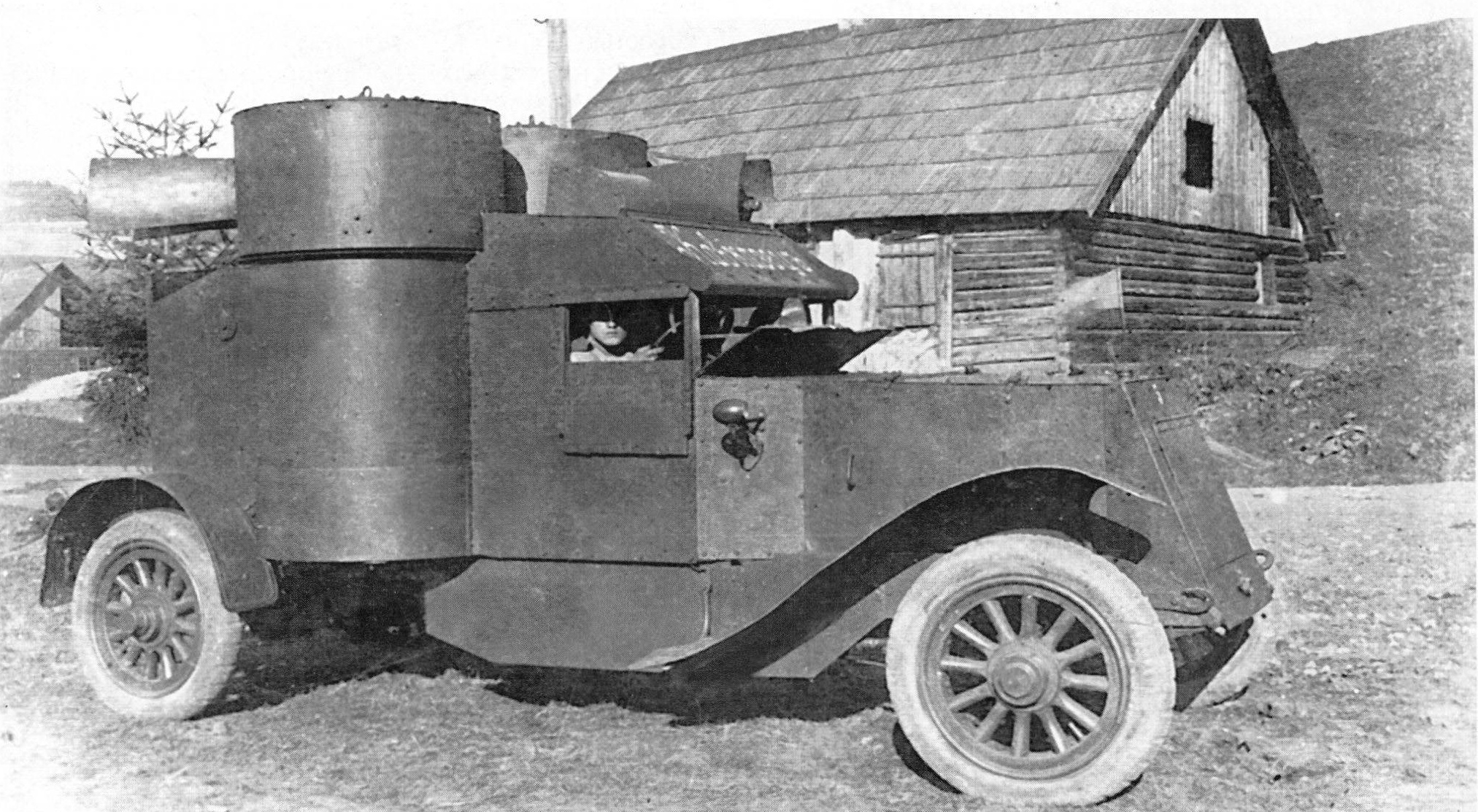
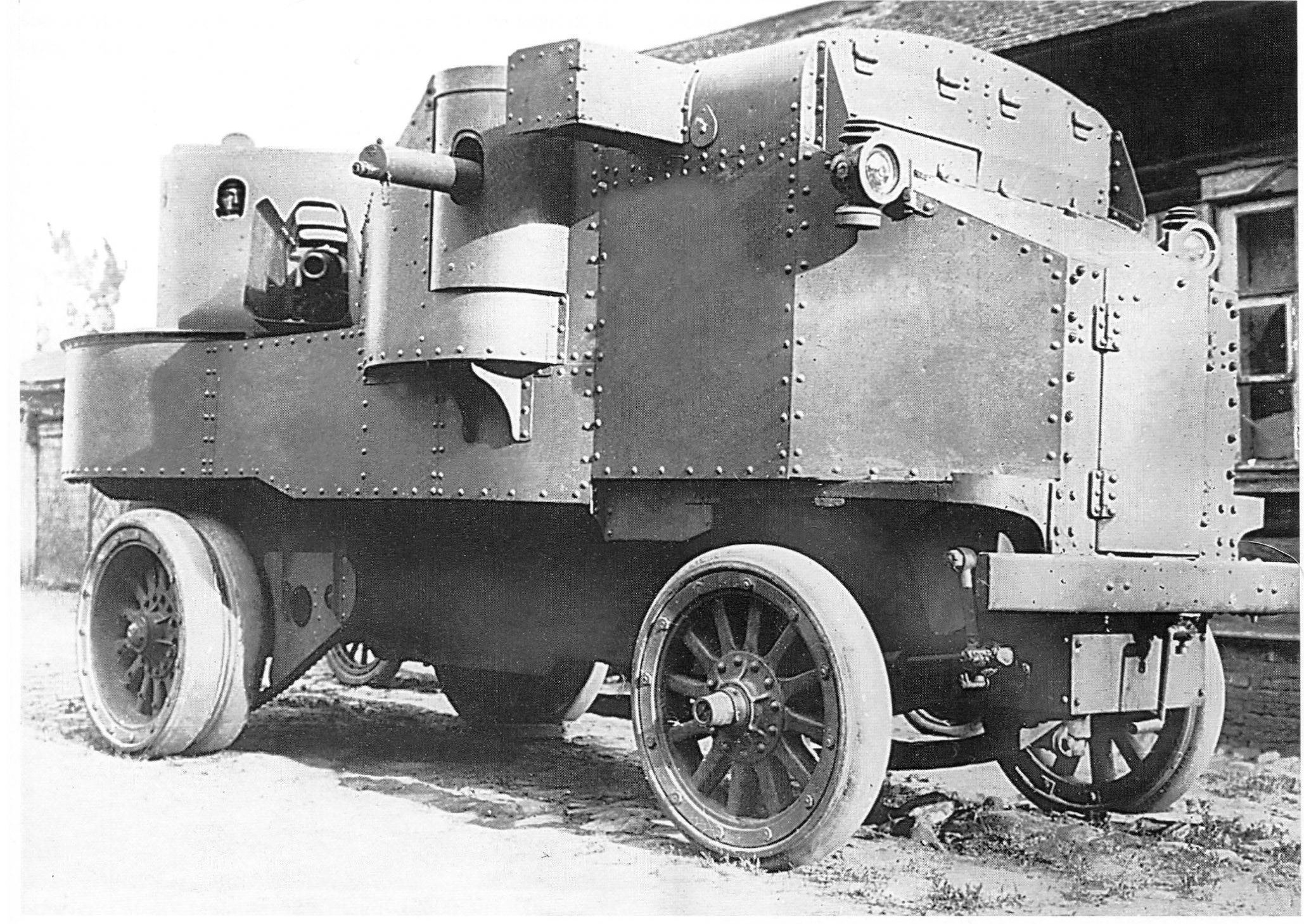
In the spring of 1915, as the formation of machine gun platoons using Austin 1st Series (5th through 23rd) vehicles was nearing completion, the need to order additional armored vehicles to support the new armor units arose. Since armoring vehicles at Russian factories required considerable time and, primarily, the delivery of the necessary chassis from abroad, the Main Military Technical Directorate decided to place orders abroad. In early March 1915, the Anglo-Russian Government Committee in London was tasked with concluding contracts for the manufacture of armored vehicles based on Russian designs.
In August 1914, the Anglo-Russian Supply Commission was established in London—a special organization for placing Russian military orders through the British government. In early 1915, the commission was renamed the Anglo-Russian Government Committee. It should be noted that when signing contracts, all firms were tasked with manufacturing armored vehicles according to Russian specifications: fully armored and with two machine gun turrets. The general armor design was developed by the Reserve Armored Company and the Armor Department of the Military Driving School under the supervision of the school’s officer, Staff Captain Mironov, and was shared with all firms upon signing the contracts.
As can be seen, 236 armored cars were supposed to arrive from abroad by December 1, 1915. However, only 161 actually arrived. The North American firm Morton, which, with typical zeal for that country, had committed to producing 75 armored vehicles, failed to deliver a single example by August 1915, so the contract with them had to be cancelled. Other companies were also slow to fulfill their orders: despite the established deadlines, the first armored cars arrived in Russia only in July-August 1915, and the bulk of the vehicles in October-December. In late 1914, technical committees of the Main Higher Technical School convened to review armored vehicle designs proposed by both domestic designers and various foreign firms. Representatives of the Military Driving School, the Reserve Armored Company, the Officer Rifle School, the Main Artillery Directorate, and armored units were invited to be part of. The chairman of this committee was Major General Svidzinsky. Given the large volume of various armored vehicles being delivered from abroad, as well as their production in Russian factories, on November 22, 1915, by order of the Minister of War, a special commission for the acceptance of armored vehicles was created. Initially, its official name was « Commission formed by order of the Minister of War for the inspection of armored vehicles that have arrived and are arriving, » but in early 1916, it was renamed the « Armored Vehicle Commission » (the name « Armored Commission » is still found in documents of the time). It reported directly to the Chief of the Main Military Technical Directorate. Major General Svidzinsky was appointed chairman of the commission (he was replaced in this post by Major General Filatov at the beginning of 1916), and its members included the commander of the Reserve Armored Company, Captain Khaletsky, the head of the Armored Department of the Military Driving School, Captain Bazhanov, as well as officers of the Main Artillery Directorate, Main Military Technical University, Main Directorate of the General Staff, the Reserve Armored Motor Vehicle Company, the Officer Rifle School, and the Military Driving School—Colonel Ternavsky, staff captains Makarevsky, Mironov, Neelov, and Ivanov, ensigns Kirillov, Karpov, and others. The Commission’s task was to evaluate the quality of armored vehicles purchased abroad and built in Russia, as well as to refine their designs for operations on the Russian front. It also carried out extensive work on the design of new armored vehicle models for production at domestic enterprises, as well as on improving the organization of armored units. Thanks to close contacts with other military departments and organizations—the Main Artillery Directorate, the Military Driving School, the Reserve Armored Motor Vehicle Company, and the Officers’ Rifle School—and, in large part, to the fact that the Commission included educated and technically literate individuals, great patriots of their cause, by the fall of 1917, the Russian Army surpassed its adversaries—Germany, Austria-Hungary, and Turkey—in the number of armored vehicles, their quality, combat tactics, and organization. Only in the number of combat vehicles did Russia lag behind Great Britain and France. Thus, the Armored Car Commission served as the prototype for the Main Armored Directorate of our army.
Transition to armored car divisions :
At the front, armored machine gun platoons were subordinate to the quartermaster generals of the army or corps, and in combat, they were attached to divisions or regiments. As a result, such a small platoon organization and the less-than-successful chain of command in the Active Army negatively impacted the performance of armored units. By the fall of 1915, it became clear that a transition to larger organizational forms was necessary, and the Russian Army already had such experience—the 1st Machine Gun Company. Incidentally, its commander, Colonel Dobrzhansky, actively advocated for the consolidation of armored cars into larger units based on the experience of his unit, writing repeatedly to the Headquarters of the Commander-in-Chief, the General Staff, and the Main Military Technical Directorate. For example, on May 12, 1916, Dobrzhansky sent a letter to the Main Military Technical Directorate stating the following:
“…The appropriate use of a new type of weapon, organized like the unit I formed, must be concentrated in the hands of the commander, whose experience is entrusted with the development and possible massing of the fire of his detachment depending on the place and situation.
Apparently, these considerations were also taken into account in the formation of the Belgian armored division, located on another of our fronts, as well as in the British division that had arrived in Russia but had not yet entered the Theater of Military Operations. Its strength was almost, but its bulk was considerably, greater than that of the 1st Machine Gun Company. The idea of an armored unit is strength, speed, devastating fire at close range, and complete independence in logistics and supply, which is not achieved in secondary platoon formations attached to corps, which are under the care of the latter’s chiefs of staff in terms of combat and logistics.
Apparently, the final impetus for changing the organization of armored units was the use of armored cars during the so-called Lutsk Breakthrough – the offensive of the Southwestern Front in the summer of 1916. Although armored cars operated very effectively during this operation, providing significant support to their units, it became clear that the platoon organization did not allow for the use of combat vehicles in large numbers.
By order of the Chief of Staff of the Supreme Commander-in-Chief on June 7, 1916, it was planned to form 12 armored car divisions (corresponding to the number of armies). Machine gun platoons were renamed squads, retaining their previous numbering, and incorporated into the divisions. It was envisaged that each division, reporting directly to the army headquarters, would have four to six squads, « corresponding to the number of corps in the army. »
Armored car divisions composition :
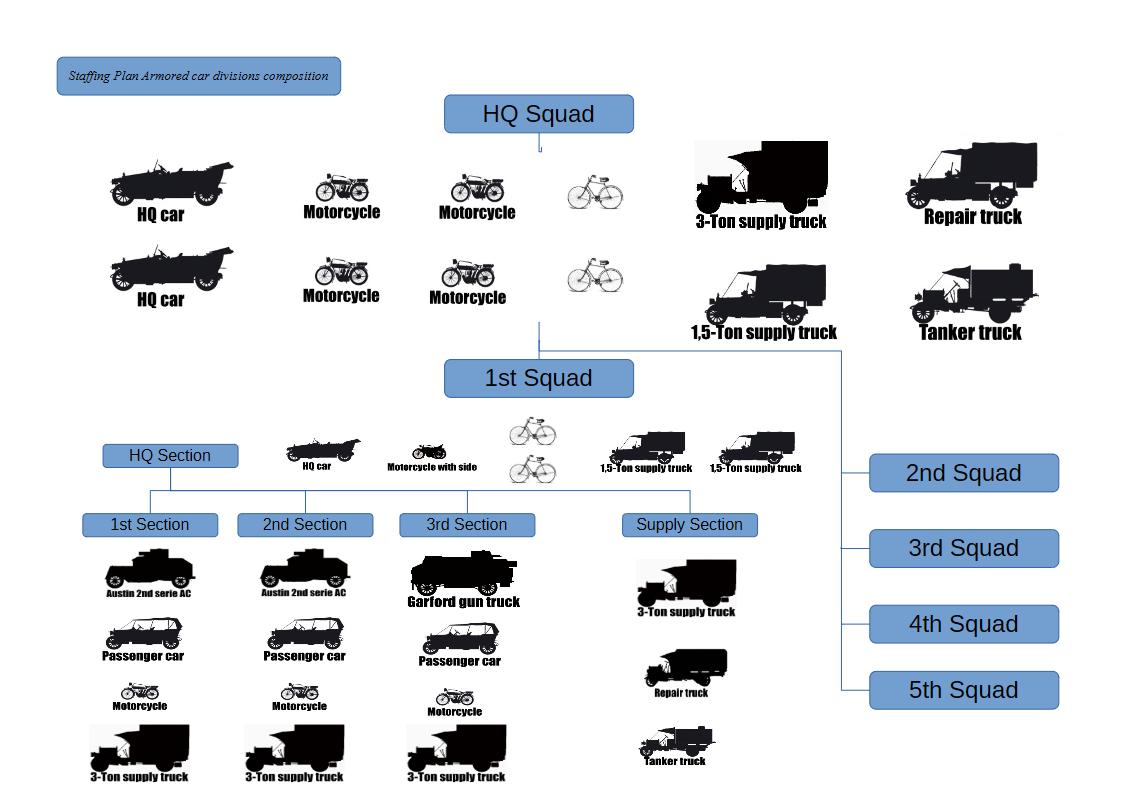
According to the staffing and table listing announced in this order, the armored car division’s command squadron included two passenger cars, one 3-ton truck and one 1.5-2-ton truck, a repair shop, a tanker truck, four motorcycles, and two bicycles. The command staff consisted of four officers (a commander, a supply manager, a senior officer, and an adjutant), one or two military officials (clerks), and 56 soldiers and non-commissioned officers. Sometimes, the command staff included an additional officer or engineer, who served as the division’s mechanic. each division would have four to six squads. When machine gun platoons were renamed squads, their combat complement (three armored vehicles) remained the same; changes were made only to the auxiliary equipment. Thus, to improve the supply of armored vehicles, the number of trucks in them was increased from two to four—one per armored vehicle plus one per squad. Additionally, to conserve gasoline and the life of the motorcycles, the squad received two bicycles—for communications and transmitting orders.
Special units :
Separate machine-gun squads were retained only in areas where geographic conditions made it impractical to organize them into divisions—in the Caucasus. A total of 12 divisions were created: 1st, 2nd, 3rd, 4th, 5th, 7th, 8th, 9th, 10th, 11th, 12th, and the Special Army (in addition, there was a Special Purpose Armored Division, which had its own organization, as discussed below).
Armored car divisions formation :
The formation of divisional command posts was carried out in Petrograd by the Reserve Armored Company from July 2 to early August 1916, after which the command posts were sent to the front. This lengthy formation period was due both to the selection of personnel for divisional commanders and officers and to a shortage of motor vehicles, particularly tank trucks and repair shops.
Uniforms :
On August 11, 1916, a decree of the Imperial Government established for armored units « a uniform and special insignia, established by Order No. 328 of the Military Department of 1915, coded according to the division number. » However, it is not known if this insigna was used on shoulder straps in the troops.
Other units modifications :
On October 10, 1916, by order of the Chief of Staff of the Supreme Commander-in-Chief, the Reserve Armored Company was reorganized into a Reserve Armored Battalion, retaining its previous functions. According to the new Table of Manpower No. 2, it consisted of eight training armored vehicles—three each in the cannon and machine gun sections, and two in the armored vehicle school, renamed the armored vehicle driver school. Captain V. Khaletsky remained the division commander.
Machine gun Squads modification :
On November 15, 1916, another change was made to the organization chart of the machine gun squad. To more effectively utilize combat vehicles in combat, an additional machine gun armored car was added. This vehicle was intended to serve as a spare in case one of the armored cars needed repairs. However, it was not possible to convert all squads to the new organization chart—there were not enough armored cars. Nevertheless, in early 1917, some armored units of the Western and Southwestern Fronts (the 18th, 23rd, 46th, and several other squads) received a fourth armored car.
1917 Revolution disorganization :
After the February Revolution of 1917, the well-established system of supplying and forming armored units in the Russian army rapidly began to unravel. A wave of rallies and demonstrations swept the country and the army, and various councils began to emerge everywhere, actively intervening in various military matters and the armed forces’ supply system. For example, on March 25, 1917, the chairman of the Armored Car Commission sent the following letter to the Main Military Technical Directorate:
« According to available information, it has become clear that the armored cars in Petrograd fit for the front, namely six Austins and 20 Armstrong-Whitworth-Fiats, which have just arrived from England, cannot be sent out of Petrograd due to the lack of consent from the Council of Workers’ Deputies, which considers it necessary to keep these vehicles in Petrograd against counterrevolution. However, at the same time, there are 35 Sheffield Simplex and Armia-Motor-Lories vehicles in Petrograd that are unfit for the front, which, it would seem, could successfully serve the aforementioned purpose. In communicating the above, I request that appropriate, urgent decisions be made. »
The problem was solved, albeit with great difficulty, and in the spring the armored vehicles began to be sent to the troops.
From June 20 to 22, 1917, the All-Russian Armored Automobile Congress of representatives of front-line armored units and the Reserve Armored Division was held in Petrograd. It resolved to disband the Armored Car Commission (which ceased operations on June 22) and elected a temporary governing body for armored units—the All-Russian Armored Executive Committee (Vsebroniskom), chaired by Lieutenant Ganzhumov. The congress also resolved to develop a plan to establish an independent Armored Department within the Main Military Technical University (previously, its functions had been performed by Vsebroniskom).
The armor department of the Main Military Engineering Directorate was organized on September 30, 1917, and its staff included no one familiar from their work on the Armored Car Commission. The department’s work continued until its abolition on December 20, 1917, but nothing significant was accomplished in the development of armored units.
As for the armored car divisions serving at the front, they remained in existence until early 1918, when in February and March a specially created liquidation commission of the Council for the Command of the Armored Forces of the RSFSR carried out their demobilization.
Armored car divisions fate :
According to the final document, the fate of the armored car divisions of the Russian Army was as follows:
“The 1st, 2nd, 3rd and 4th fell into German hands almost intact; the 5th was completely demobilized, the 6th too; the 7th and 8th divisions were not demobilized, since their vehicles were taken in Kyiv by the Ukrainians; the 9th demobilized only the command; the 10th was captured by the Polish legionnaires, the 30th squad from its composition was disarmed in Kazan, where it rebelled against the Soviet power in the days of October, and a pitiful part of it fled to Kaledin on the Don; the 11th division demobilized from its composition only the 43rd and part of the 47th squads, part of the rest – the 34th, 6th and 41st – were captured near Dubno, in Krymenets and Volochisk and Ukrainized; the 12th was completely demobilized, and as for the Special Purpose divisions and the Special Army, they were completely Ukrainized.”
Armored vehicles, as they say, « passed from hand to hand » and were actively used in battles during the Civil War raging on the territory of the former Russian Empire, but that is another story.