
The Hotchkiss Izhorski armored car model is here
At the beginning of the First World War, Russia could only rely on its vehicle resources to form armored car units. These resources were scarces because limited only to the vehicles manufactured by the Russo-Baltic company in Riga. The Izhorski factories in St. Petersburg were therefore requisitioned to produce armored cars from the autumn of 1914 onwards from Russo-Baltic automobiles. This production was rapid and the 1st automobile machine-gun company was formed and sent to the front. Its designer, Colonel Dobrzhansky, left with it, leaving his teams of engineers behind. Fortunately, naval engineer A. Y. Grauen, who was in charge of the technical design during Colonel Dobrzhansky supervision was still in the Izhorski factories.
In early 1915, the military department ordered engineers from the Izhorski Plant, to develop among other cannon armored cars projects, a new armored car. Using the existing experience and developments, (the front of the Hotchkiss-Izhorski armored car looks very much like the Russo-Balt armored car) the designers quickly developed the project. Like in other countries at that time, the enineers simply took an existing and quite solid commercial chassis, put an armored hull and weapons on it. For obscure reasons, the new armored car project did not receive its own name. In the documents of that time, it appeared under the name « passenger cars with a machine gun. »
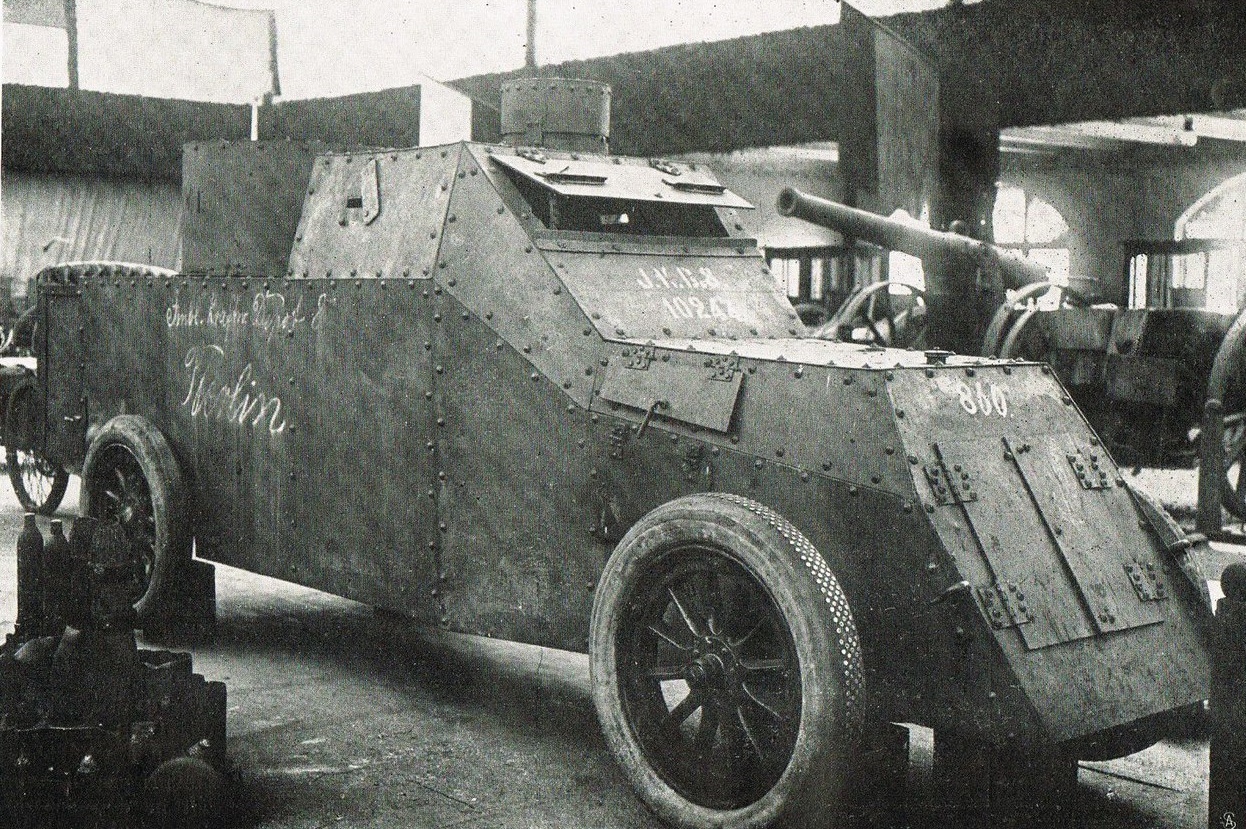
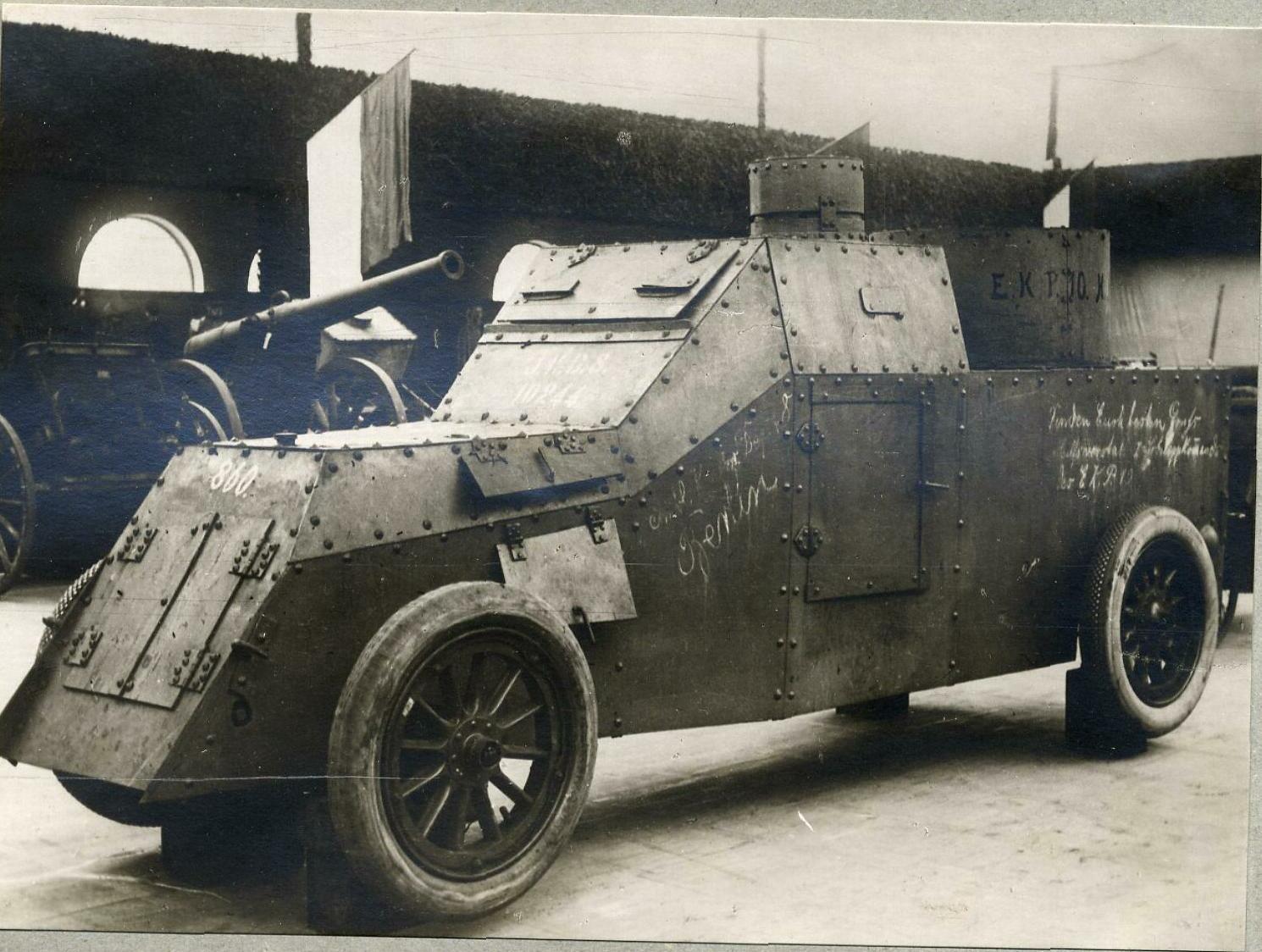
Considering the chassis, it seems that specialists agree to say that these were Hotchkiss ones with Hotchkiss 60 CV engines, that’s why when Germans captured them they classiffied them as french armored cars. The design was classic with the engine at the front then the driving and control compartment for the driver and commander, then the fighting compartment. There was no separation between the driving and combat compartment. Original features were the presence of a turret unlike the Russo-Balt and a small circular rotating cupola for the commander with slots from the driving compartment. The 4×2 chassis had a suspension based on leaf springs. A mechanical transmission transmitted torque to the leading rear wheels. The wheels retained the old design with spokes. The armor was made of 6 mm plates riveted to a metal frame. To go faster, there were no curved plates, the hull was therefore made of a a large number of plain plates of different shapes and sizes. Access was via a single door on the left side of the driving compartment and a double door at the rear of the vehicle. In front, the driver and commander were protected by a frontal plate with a large viewing hatch. In a combat situation, it was necessary to lower the hatch cover, view was provided through viewing slits. to reduce the height of the armored car, the turret was placed on the rear lowered part of the hull. Due to its location, the turret allowed firing in all directions, with the exception of the sector limited by the driving compartment. Thus, the armored car fully corresponded to the ideas of the time, when it was believed that an armored vehicle should be advanced onto the battlefield in reverse. The crew consisted of three people. Commander and driver were located in the driving and control compartment, commander on the left side and driver on the right side. Only one crew member, a gunner, was in the combat compartment at the rear. Armament was only one Maxim machine gun in the turret.
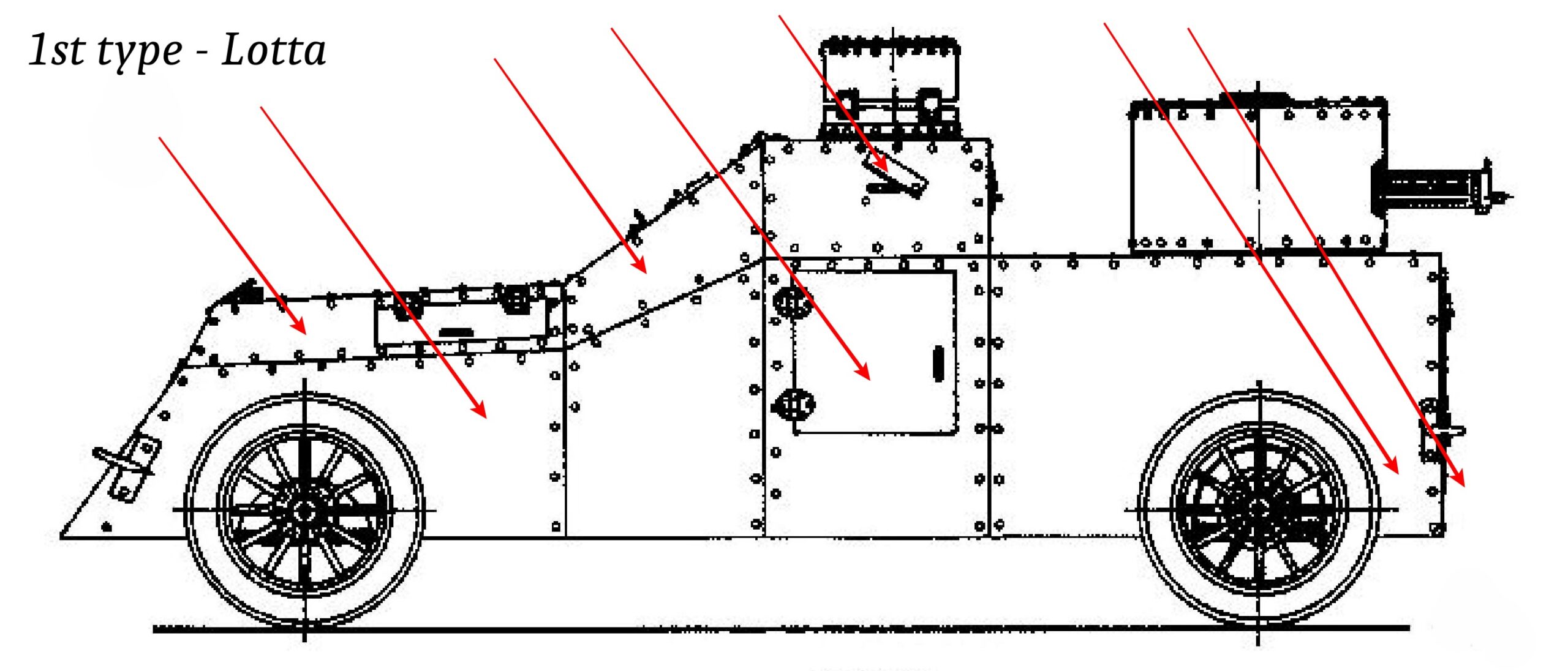
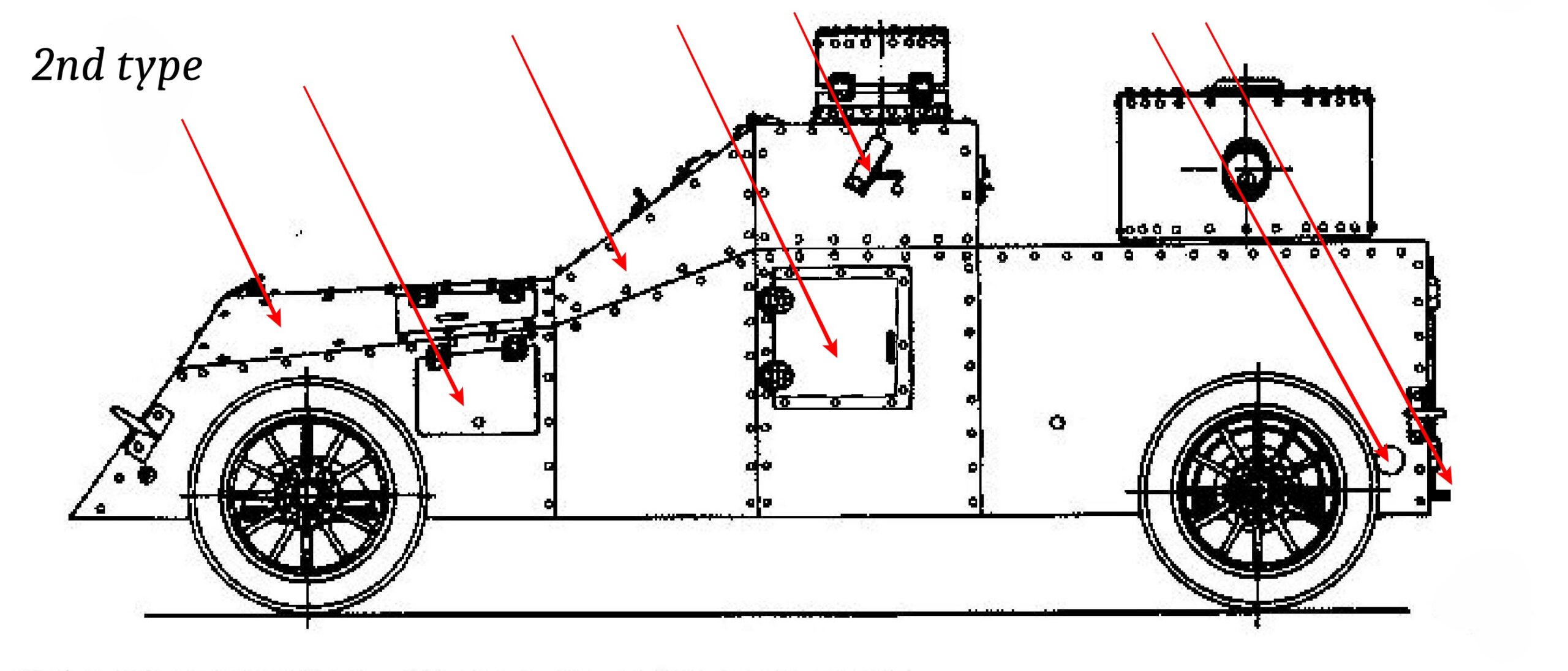
It should be noted that the hulls of the two armored cars built by the Izhorski Plant had some differences. After the construction of the first vehicle, it was decided to make some changes to the project, as a result of which the two armored vehicles can be easily distinguished from each other. The main difference is in the shape of the vertical and inclined sheets of the hood, more rectangular for the first armored car, more trapezoïdal for the second one. There were other differences, the exhaust pipe ended under the vehicle for the first type and went through the rear plate to exit outside for the second one. The side door on the left side of the body was single for the first vehicle and reinforced by a riveted plate around its perimeter on the second one. There was a single hatch on the left of the engine compartment for the first vehicle, a double for the second one. There were two small round protrusions on the lower rear side of the body, just behind the rear wheel for the second vehicle. The small side slits in the driving compartment opened in opposite directions between the first and second model.
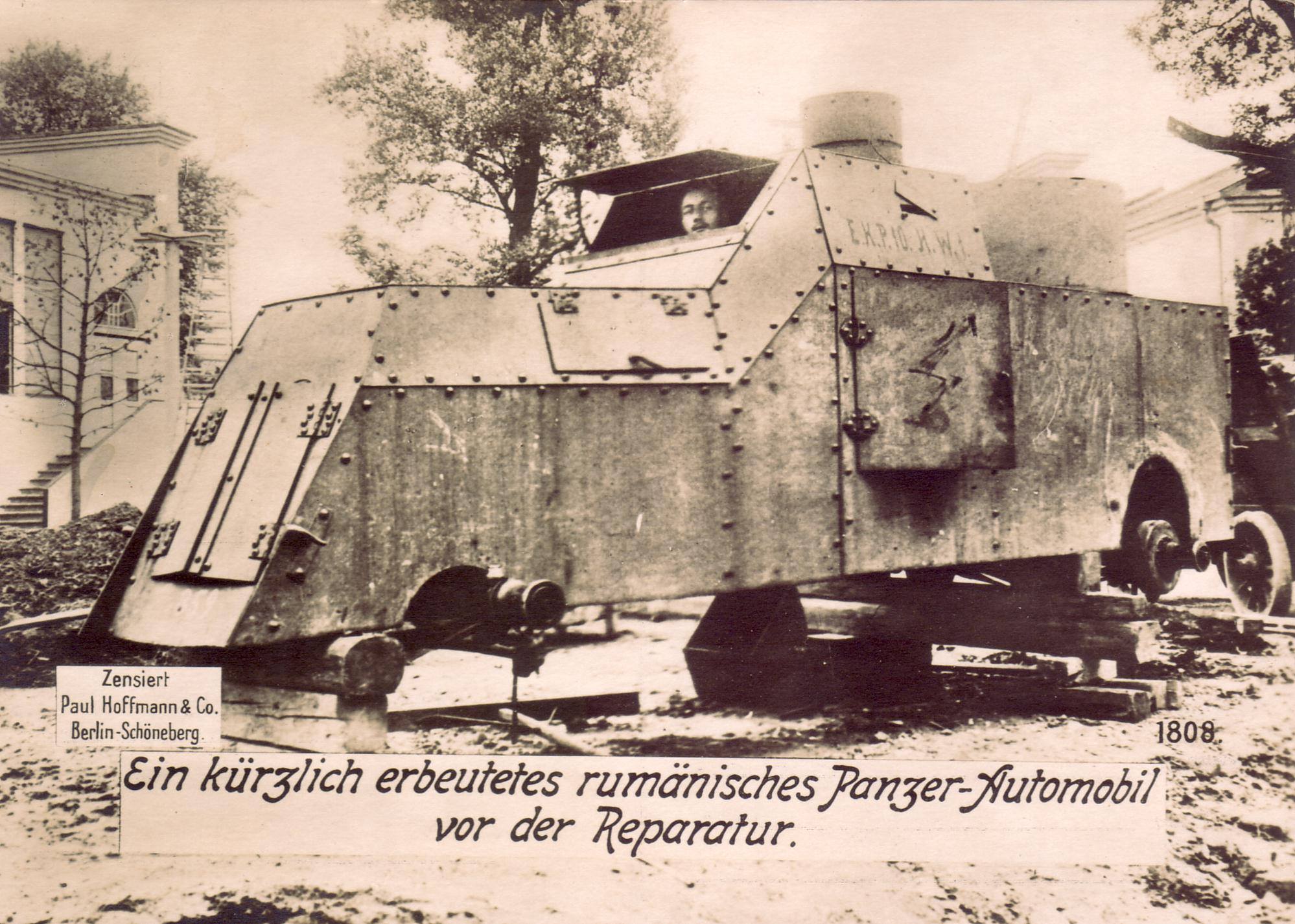
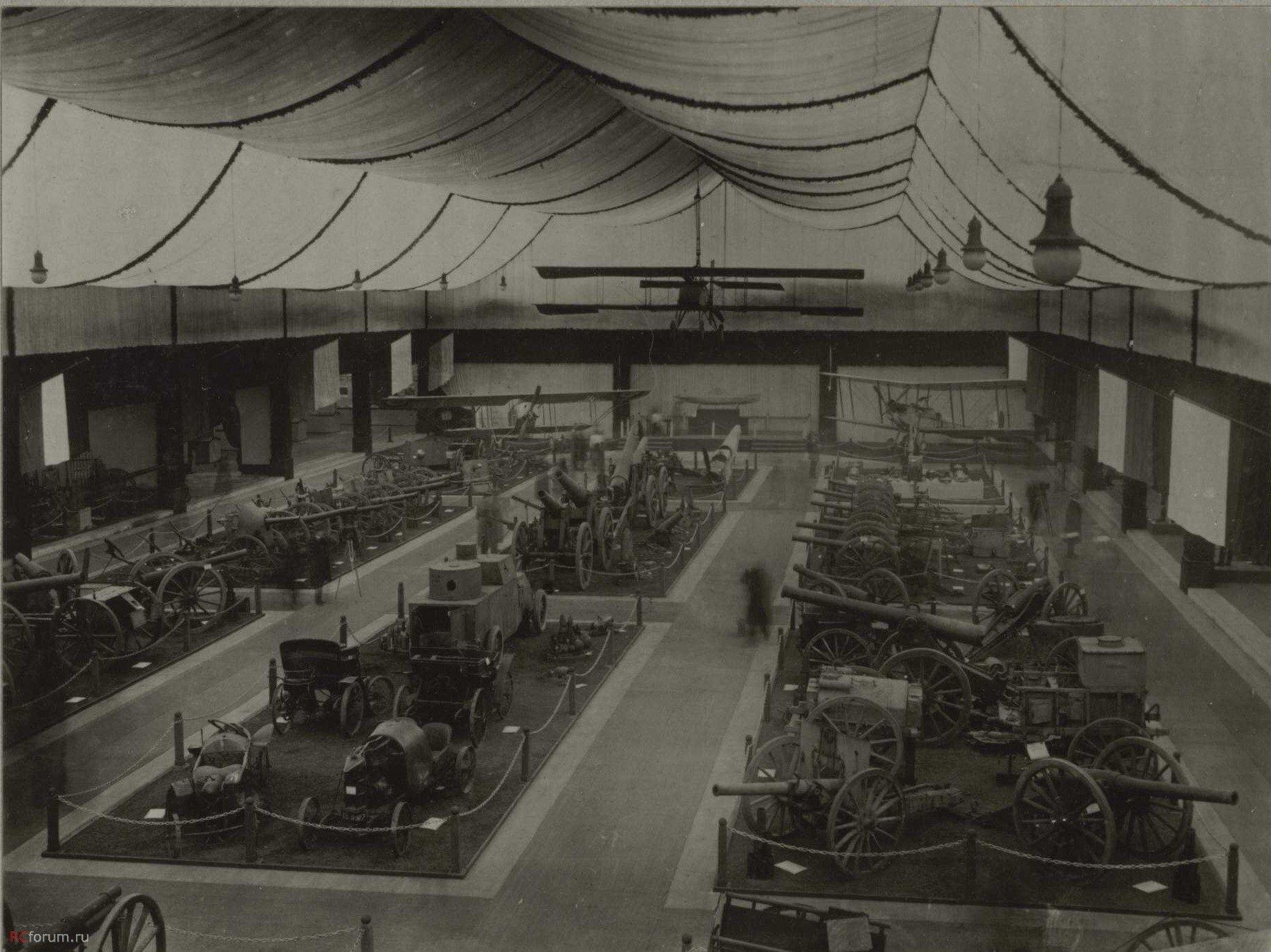
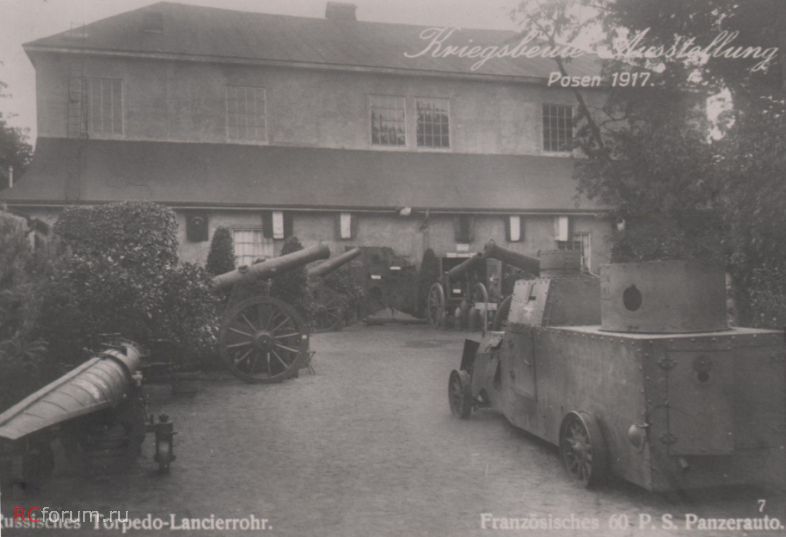
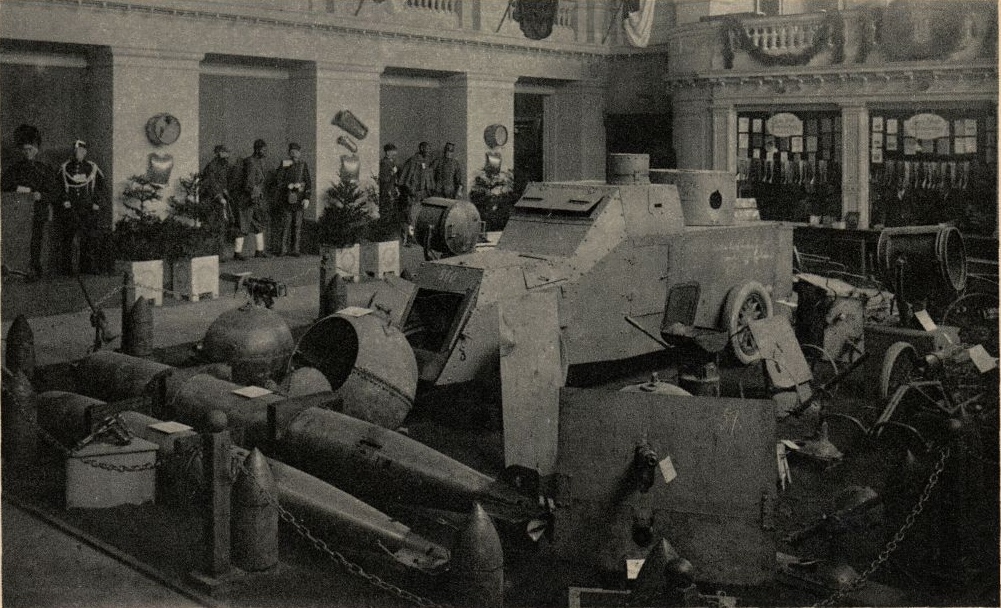
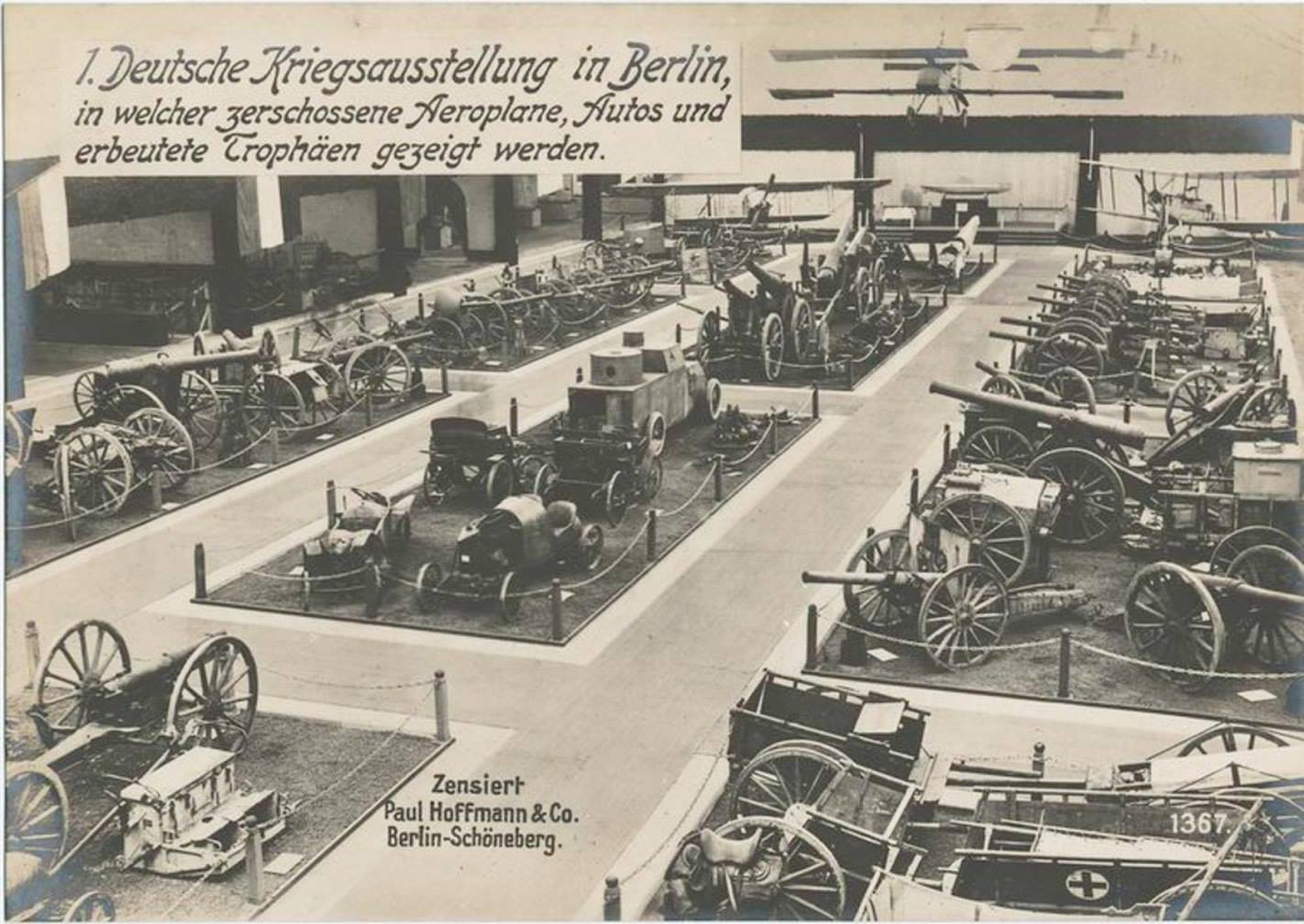
The construction of the two new armored cars was completed in the spring of 1915. They were tested at the proving ground and handed over to the army. However, this equipment was not sent to the front. According to available data, both machine-gun armored cars were handed over to the 1st machine-gun company (not to be confused with Dobrzhansky’s 1st automobile machine-gun company), where they were used for training personnel and were also used as vehicles for escorting columns. In August 1915, during the battles near Willna (now Vilnius), the 10th German Army captured both models. German specialists studied the captured armored cars and gave them a low rating. As a result, they were of no interest to the army and one (the second model) was transferred to a mobile exhibition of captured weapons and equipment traveling around the country named Deutsche Kriegsausstellung.
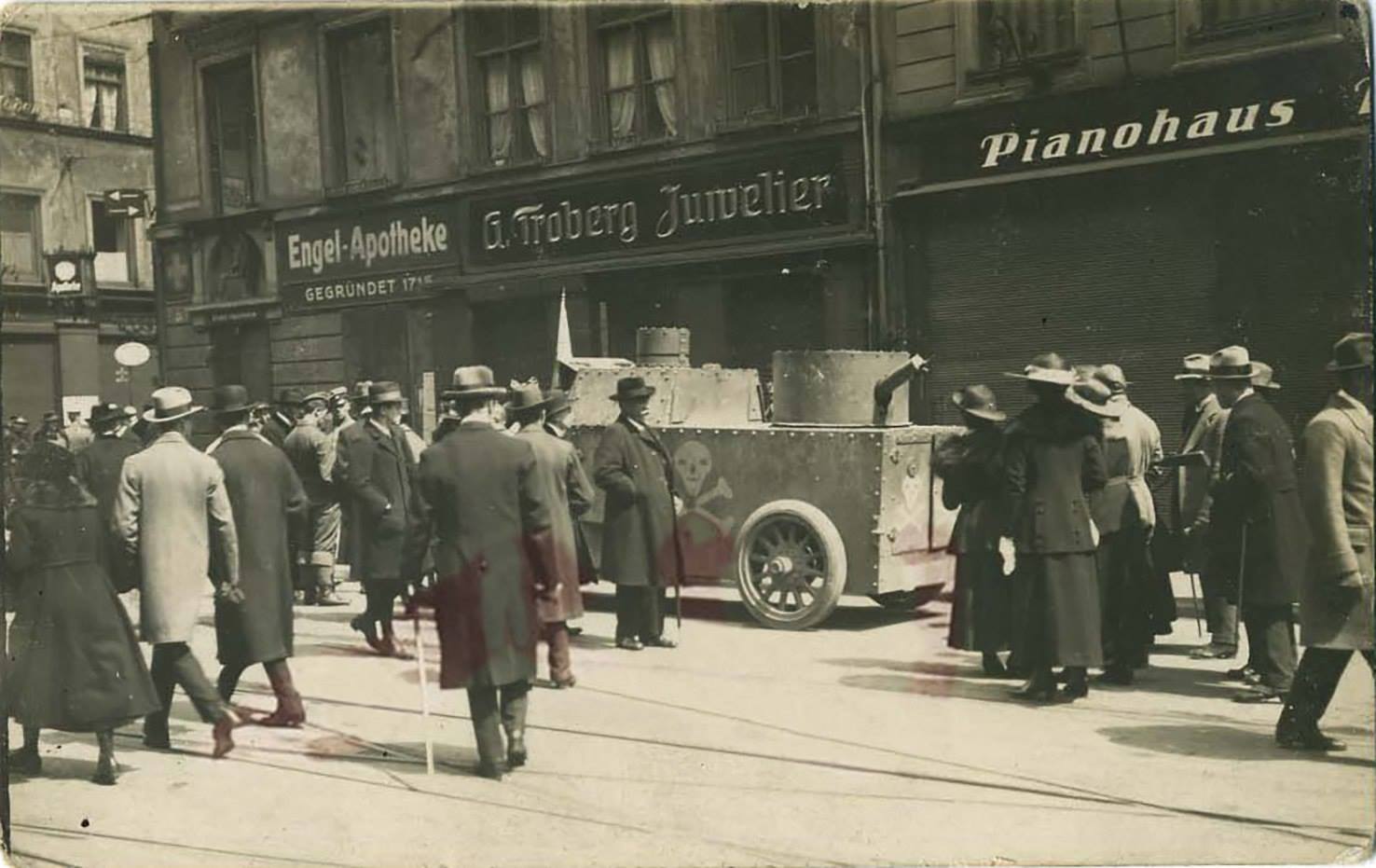
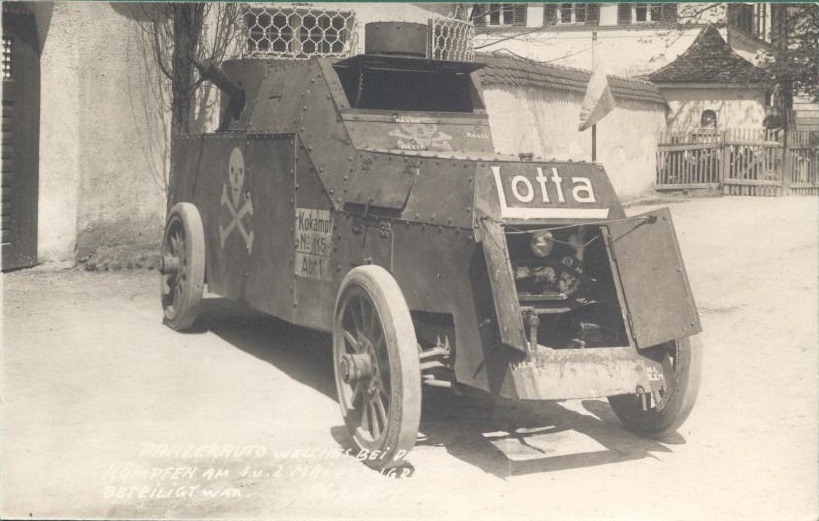
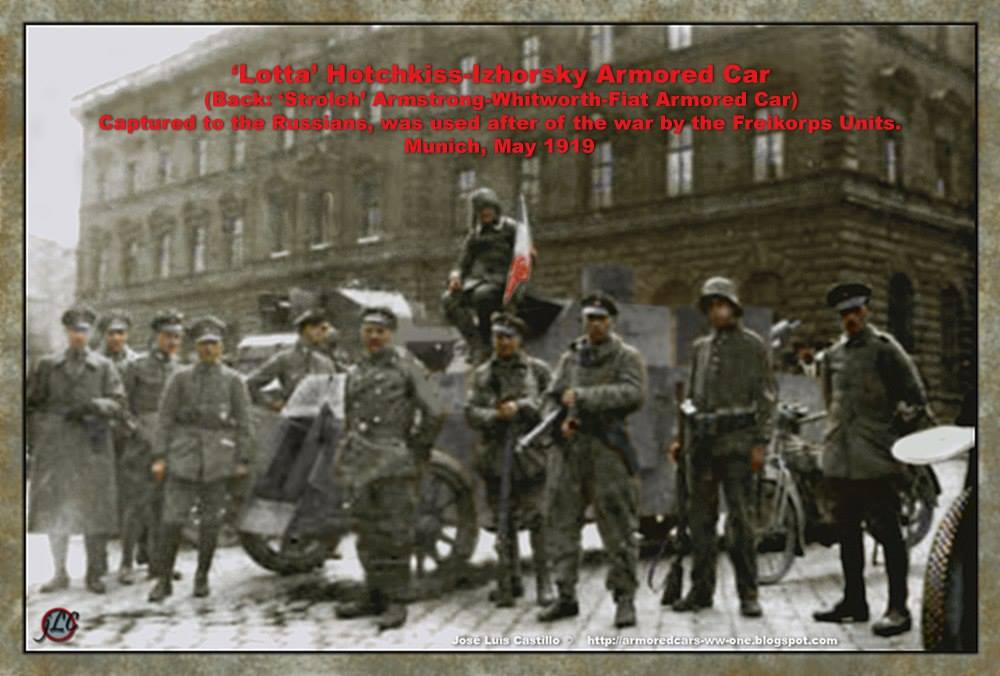
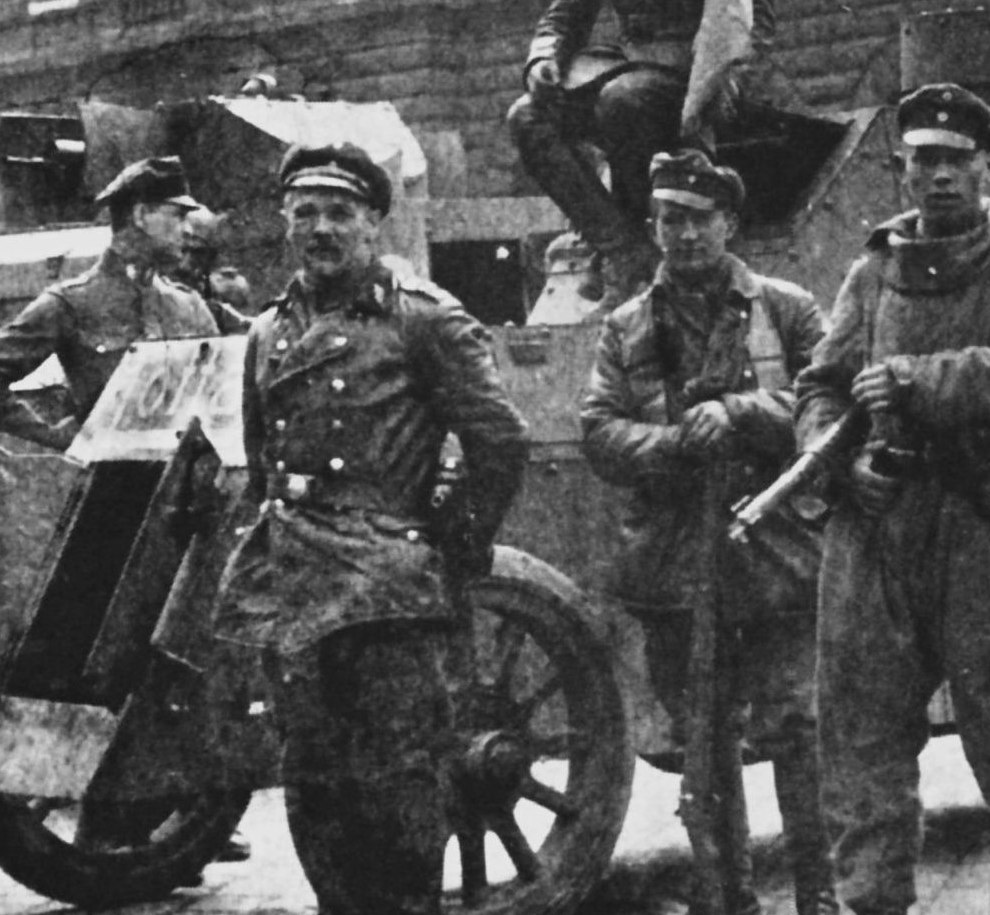
After the war, the two armored cars were used by the Freikorps units, the first model been named « Lotta », during the Berlin uprising and Munich uprising. Two armoured car platoons of the Berlin-based Kokampf (well, in truth Lankwitz-based) were sent to Munich in May 1919, commanded by Hauptmann von Braumüller with Freikorps von Oven. The second one, included the Armstrong-Whitworth Fiat « Strolch », the ex-Belgian Peugeot now renamed « Raudi », and « Lotta », these platoons returned to Berlin after their mission on May 20, 1919. In the 20s, probably due to lack of spare parts, the two vehicles were scrapped.
Unfortunately, there are no photos of Hotchkiss Izhorski under Russian service, all of the available photos were taken by the Germans during the war or after with the Freikorps.
1st type
2nd type
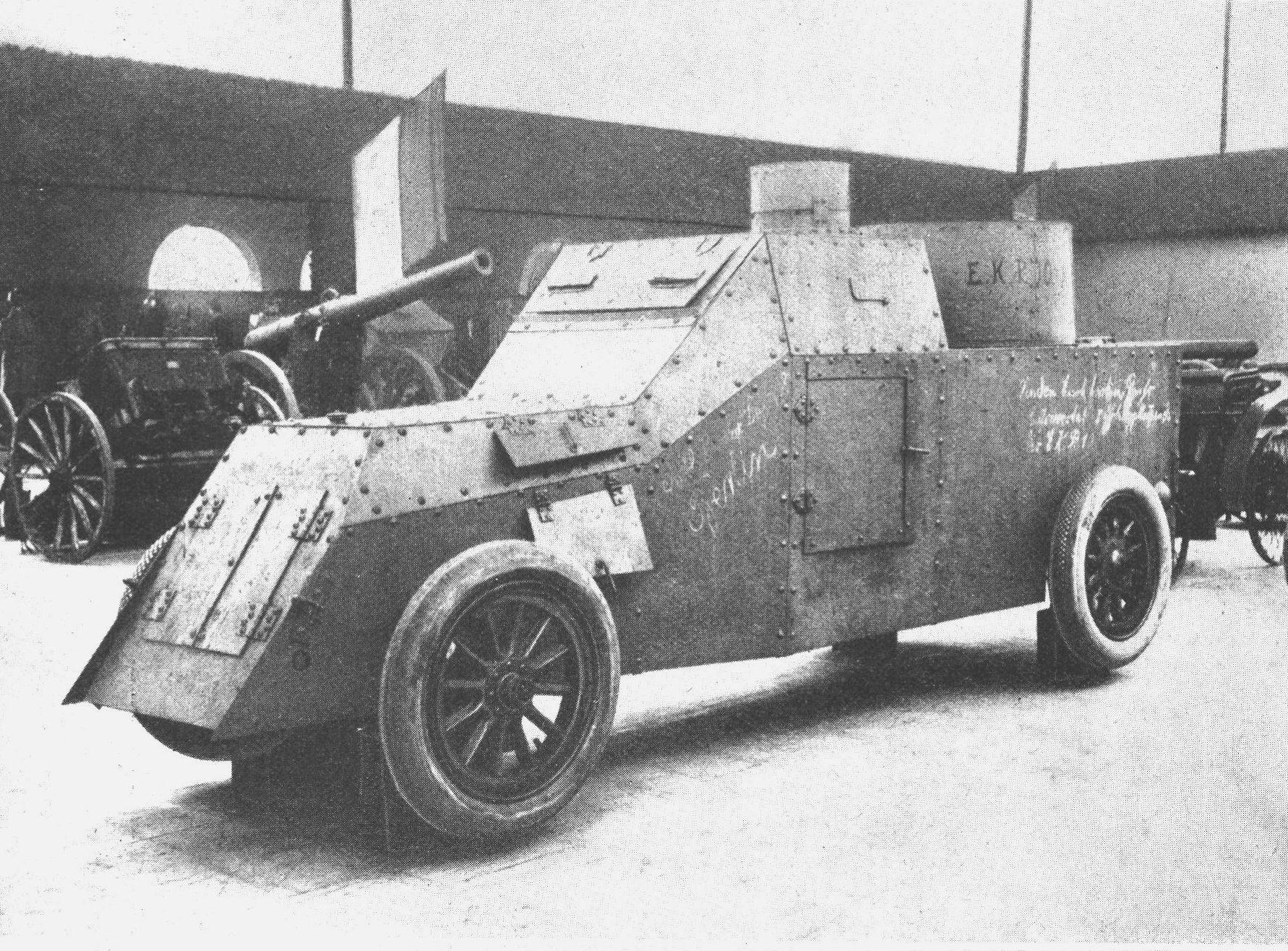
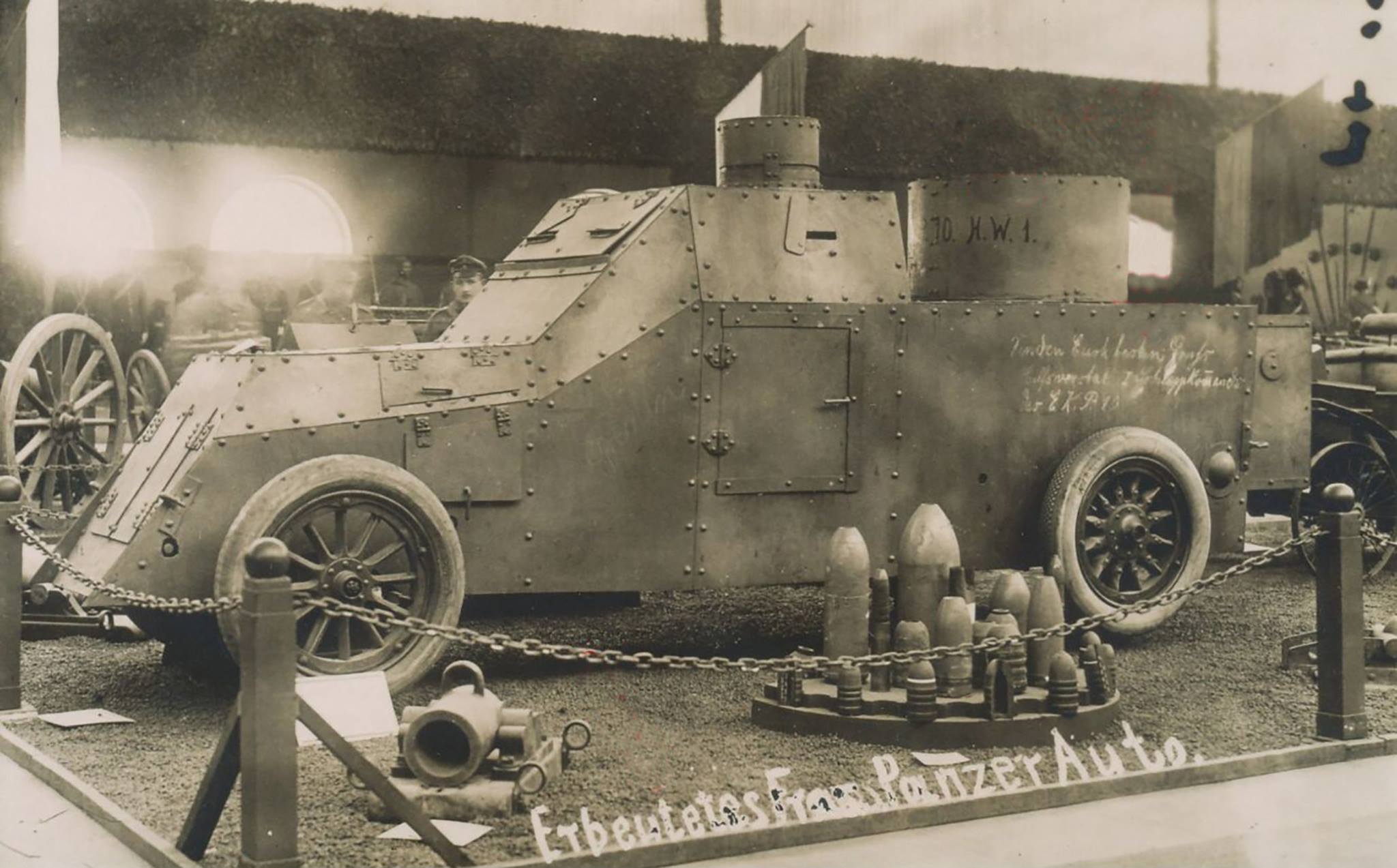
And here are the differences between the two types
And here is a video taken in Berlin during the Kapp putsch march 1920