
I – Austro-Hungarian Armored Fighting Vehicle (AFV) Development (1905–1915) :
The history of Austro-Hungarian armored development is defined by a stark contrast between visionary engineering and bureaucratic stagnation. Despite possessing the technical framework to lead the world in mechanized warfare, the Kaiserliche und Königliche (K.u.K.) military administration entered World War I with a significant technological deficit.
1 – The Pre-War Innovation Gap :
Before the assassination of Archduke Franz Ferdinand, Austro-Hungarian engineers had already proposed two of the most significant milestones in AFV history:
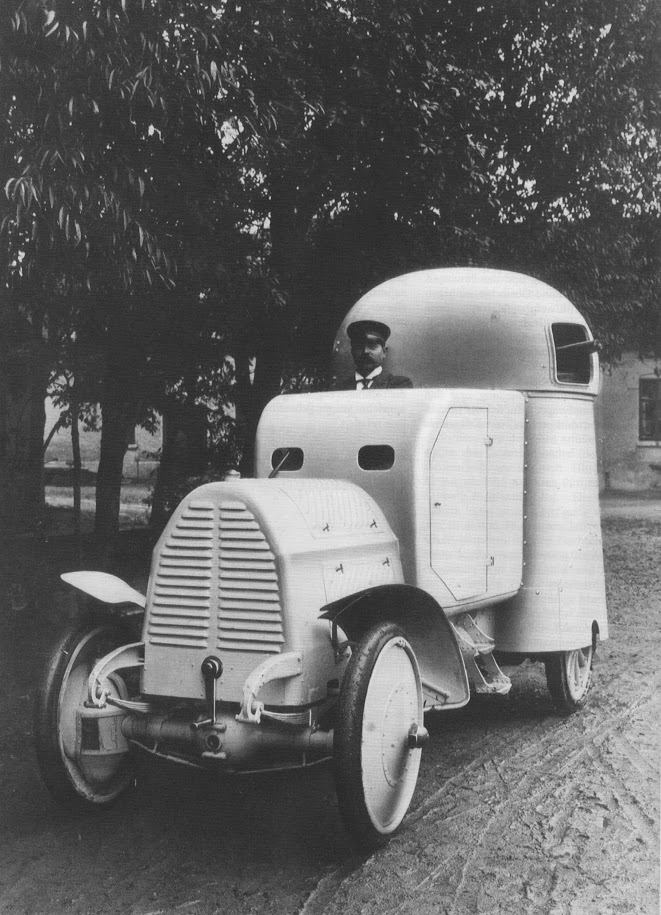
The Austro-Daimler Panzerautomobil (1905): Designed by Paul Daimler, this was the first fully armored car featuring four-wheel drive (4WD). It boasted a fully rotating turret and a 35-hp engine. Despite its sophistication, Emperor Franz Joseph I was reportedly unimpressed after the vehicle spooked the horses during a demonstration, leading the War Ministry to reject the concept as having no practical military application.
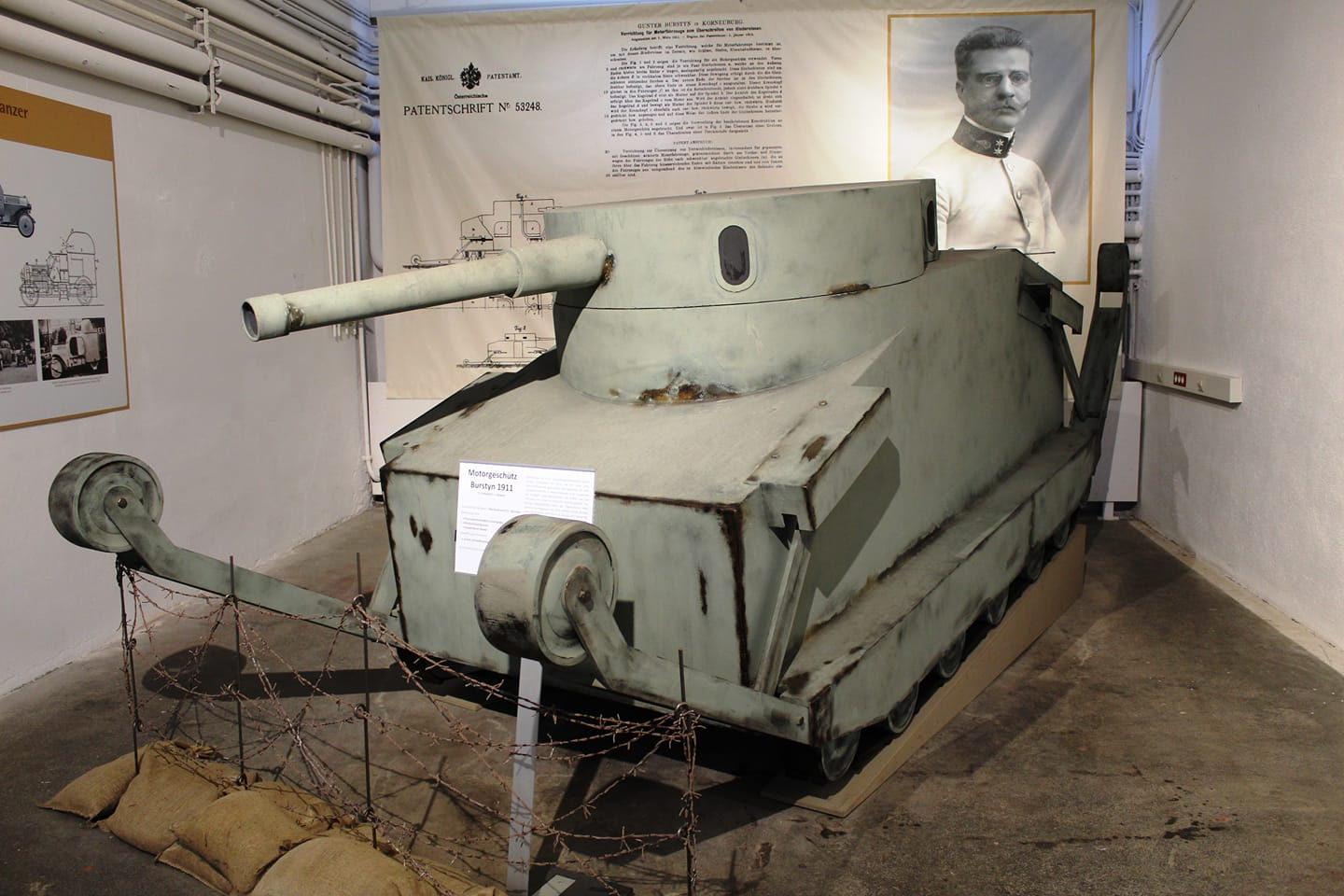
The Burstyn Motorgeschütz (1911): Gunther Burstyn’s design was a visionary precursor to the modern tank. It featured a tracked chassis and a small caliber gun in a rotating turret. Most remarkably, it included « swiveling arms » at the front and rear to assist in trench crossing—a technical solution to the mobility issues that would later define the Western Front. The War Ministry declined to even fund a prototype.
2 – 1914: The Strategic Deficit :
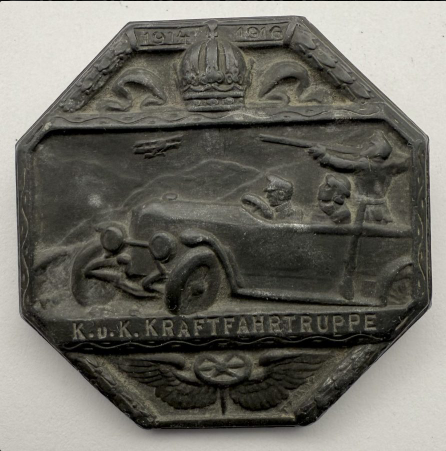
When the Empire declared war on Serbia on July 28, 1914, and subsequently mobilized against Russia, the K.u.K. Armee possessed zero armored cars. While the German Empire began deploying improvised « Ersatz » armored cars almost immediately to support cavalry screen operations, the Austro-Hungarian War Ministry maintained a rigid stance against internal development. This left Austro-Hungarian units essentially « blind » and vulnerable to mobile reconnaissance during the fluid opening stages of the conflict.

3 – 1915: Emergence of the « Improvised » Generation :
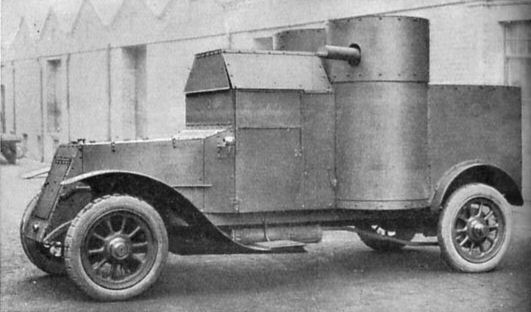
By the second half of 1915, the tactical reality of the Eastern Front changed. The appearance of Russian Austin Armored Cars and other Entente-supplied vehicles created a psychological and tactical « armor shock » among Austro-Hungarian troops. This pressure led to the development of two distinct AFV projects, notably bypassing the central War Ministry’s initial oversight:
– The Romfell (1915)
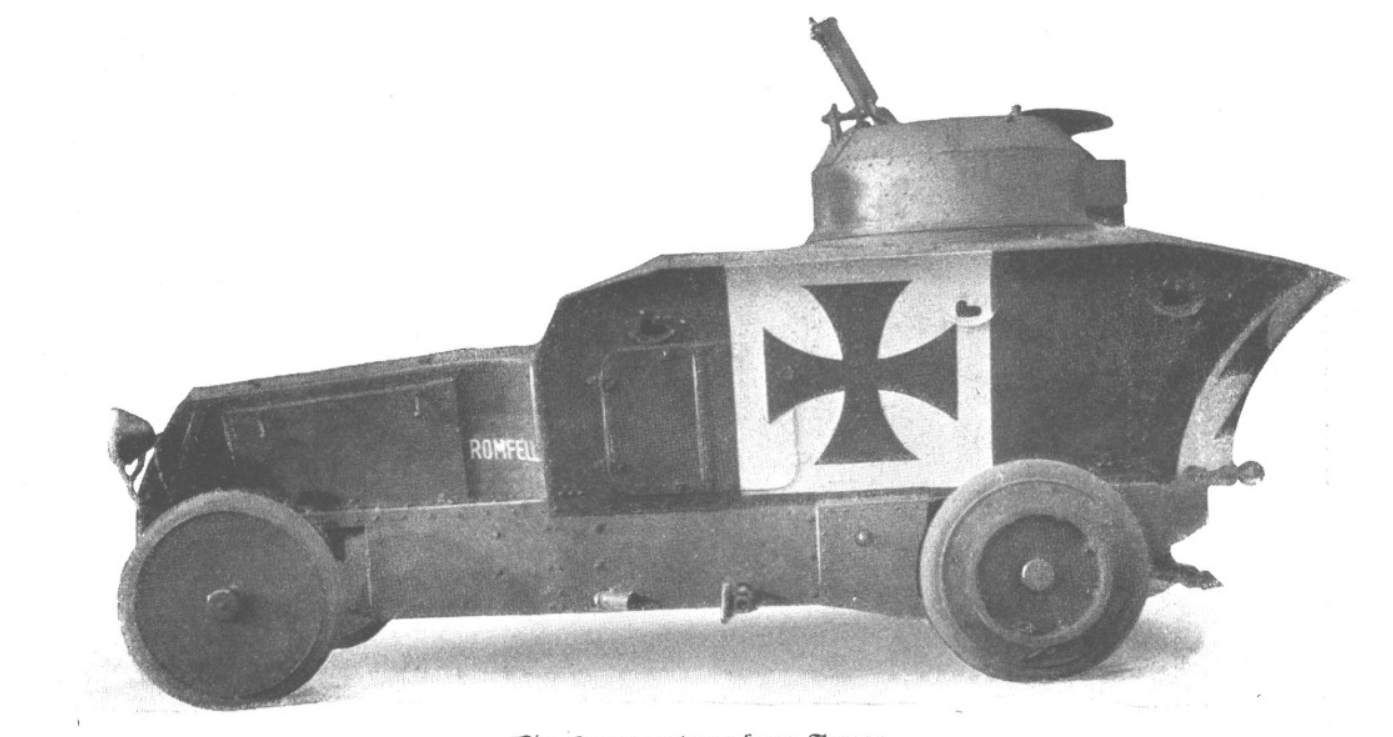
Developed in Budapest by Captain Romanic and Lieutenant Fellner (from whose names the « Rom-Fell » moniker was derived), this vehicle was technically advanced for its time.
Chassis: Based on a Mercedes 37/95hp commercial chassis (and later on captured Italian chassis).
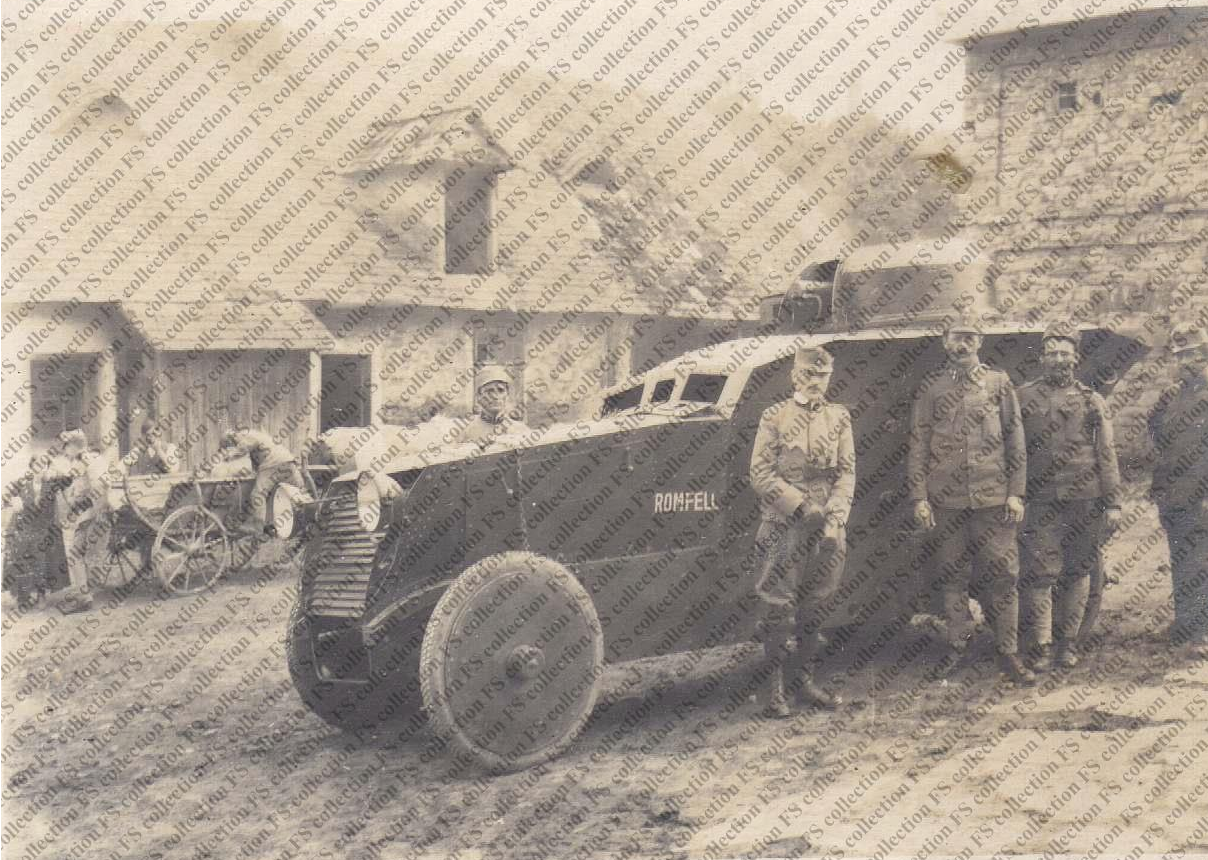
Armor: Characterized by uniquely curved plates designed to deflect incoming small-arms fire and shrapnel—a primitive predecessor to sloped armor principles.
Armament: A 0.31 in (8mm) Schwarzlose M.07/12 machine gun housed in a cylindrical rotating turret.
– The Junovicz (1915)
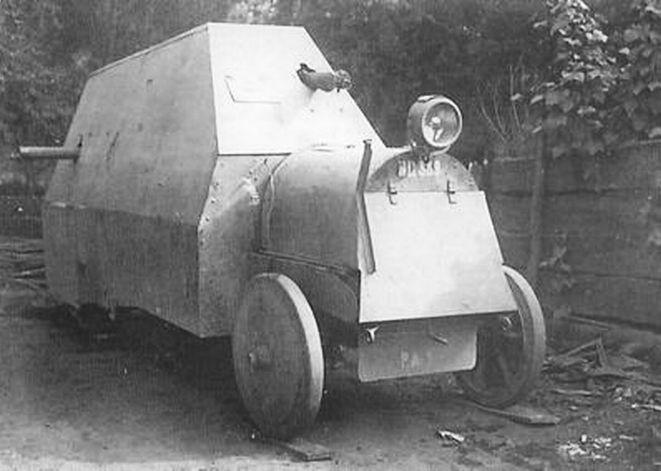
While the Romfell was a bespoke design, the Junovicz was a quintessential improvised armored car (Behelfspanzerwagen).
Chassis: Built upon various heavy truck chassis, including Fiat, Büssing, and Saurer models.
Design: It featured a boxy, rudimentary armored superstructure. It was significantly larger and heavier than the Romfell, carrying up to five machine guns, making it more of a « moving pillbox » than a reconnaissance vehicle.
4 – Summary of Technical Stagnation :
The Austro-Hungarian failure to mechanize was not a failure of intellect, but of doctrine. The K.u.K. War Ministry viewed armored vehicles as expensive, unproven gadgets that threatened the traditional roles of the cavalry. It was only through the unsanctioned initiatives of civilian engineers and field officers in 1915 that the Empire finally began its slow, uphill climb toward armored parity.
II – Technical and Administrative History of the Romfell Armored Car :
The Romfell armored car stands as a testament to localized military-industrial initiative within the Austro-Hungarian Empire. Its development was not a product of central planning but a sophisticated « black project » executed by a specialized technical cell within the Kraftfahrersatzdepot No. 39 (Automotive Replacement Depot) in Budapest.
1. The Technical Design Group and Intellectual Pedigree :
The project was characterized by a high degree of academic and mechanical synergy, involving personnel who possessed both frontline military experience and advanced engineering backgrounds:
Command and Vision: Hauptmann Branko Romanić, the depot commander, initiated the project as a response to the clear tactical deficit in armored reconnaissance.
Engineering and Layout: Oberleutnant Simon Fellner, commander of the Hauptwerkstätte (Main Workshop), was the primary architect of the vehicle’s structural design. The designation « Romfell » was a linguistic amalgamation of Romanić and Fellner.
Theoretical Ballistics and Structural Integrity: Reserve Lieutenant Emil Vidéky, formerly an assistant professor at the Technical University of Budapest, provided the mathematical rigor required for the armor’s unique curved geometry.
Production Oversight: Imre Kádár managed day-to-day assembly, while Lieutenants Ágoston and Fazekas acted as technical liaisons, coordinating with civilian contractors for high-precision components, specifically regarding the internal combustion power plant and drivetrain synchronization.
2. Infrastructure: The Zápolya Street Facility :
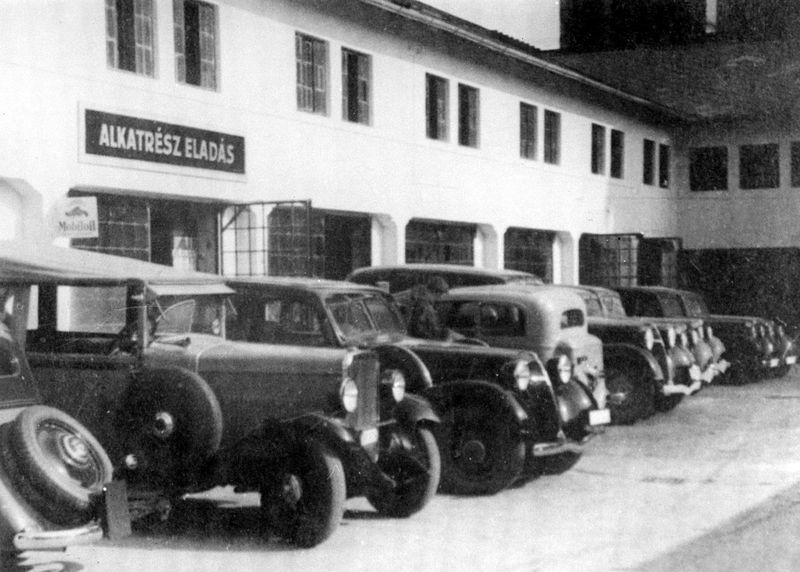
The physical construction took place at 13 Zápolya Street (present-day Gogol Street), Budapest. This site had a specific automotive lineage:
Pre-War Utility: In 1911, it served as the headquarters for Magyar Automobilgyár Rt., an importer and specialized repair facility for French Dion-Bouton chassis.
Wartime Requisition: After the company’s dissolution in 1913, the K.u.K. (Imperial and Royal) Army purchased and expanded the facility. The existing specialized repair infrastructure made it the ideal location for the « clandestine » assembly of an armored vehicle, away from the prying eyes of the Vienna-based War Ministry.
3. Procurement Conflict and the « Wireless » Discovery :
The project nearly faced immediate cancellation due to an unauthorized procurement request. On July 30, 1915, the Budapest team requested a wireless radio from the firm Siemens & Halske with a range of 100–150 km.
This request triggered an investigation by the War Ministry. The initial ministerial reaction was overwhelmingly negative, predicated on two primary concerns:
Resource Misallocation: The Ministry viewed the conversion as a « waste » of a high-performance Mercedes chassis (A VI 865) which was prioritized for standard transport logistics.
Lack of Doctrine: At the time, there was no established K.u.K. doctrine for radio-equipped mobile armor, making the 150 km range requirement seem excessive and technically redundant.
4. Technical Inspection and Validation :
The project was saved by the intervention of Oberleutnant Erich Kurzel Edler von Runtscheiner, a technical consultant from the 5/M Department of the War Ministry. This department oversaw mechanized assets, including automotive units, airships, and balloon divisions.
Von Runtscheiner’s report was a turning point. He praised the ballistic integrity of the curved armor plates and the overall craftsmanship, recognizing the vehicle’s potential for independent reconnaissance and fire support.
5. Logistical Specifications and Registration :
Following the positive inspection, the vehicle was formally integrated into the military register.
Technical Component | Specification / Transformation |
Base Chassis | Mercedes 37/95 hp heavy passenger car |
Initial Registration | A VI 865 (Standard Transport) |
Military Re-registration | XI-271 (Armored Asset, as of August 18, 1915) |
Primary Armament | 8mm Schwarzlose M.07/12 Machine Gun |
Armament Integration | Initially debated for field-fitting, but ultimately integrated at the Depot workshop for superior turret alignment. |
Radio Equipment | Integrated Siemens & Halske wireless suite for long-range communication. |
6. Administrative Evolution: From Volunteers to Command :
The Romfell emerged during a period of rapid organizational flux.
The Voluntary Body: The project drew technical DNA from the m. kir. Önkéntes Gépkocsizó Testületet (Royal Hungarian Voluntary Automotive Body), a hybrid civilian-military organization founded in 1906. This body utilized private vehicles and expertise from the Magyar Automobil Club, providing a pre-existing culture of automotive innovation in Budapest.
The Kraftfahrtruppenkommando: On August 1, 1915, the K.u.K. Kraftfahrtruppenkommando (Imperial and Royal Automotive Troops Command) was established in Vienna. This central authority subordinated the Budapest Depot, finally providing a formal command structure that could support the Romfell’s deployment.
7. Leadership Continuity (1914–1918) :
The project’s success was largely due to the stable leadership at Depot No. 39. Despite reassignments, the two « fathers » of the vehicle maintained control:
Captain Romanić commanded the depot for the majority of the war (1914–Jan 1916 and May 1917–Apr 1918).
During Romanić’s temporary transfer to Klosterneuburg (1916–1917), Oberleutnant Fellner—the vehicle’s primary designer—assumed command of the entire depot, ensuring that technical support and subsequent iterations of the Romfell design remained.
III – Biographies of the Romfell Architects: Fellner and Romanić :
The collaboration between Simon Fellner and Branko Romanić represents a pivotal intersection of high-level industrial engineering and military logistics. Both men were rooted in the Ganz Works in Budapest, one of the most significant mechanical engineering conglomerates in Central Europe at the time, which provided the technical foundation for the Romfell’s sophisticated design.
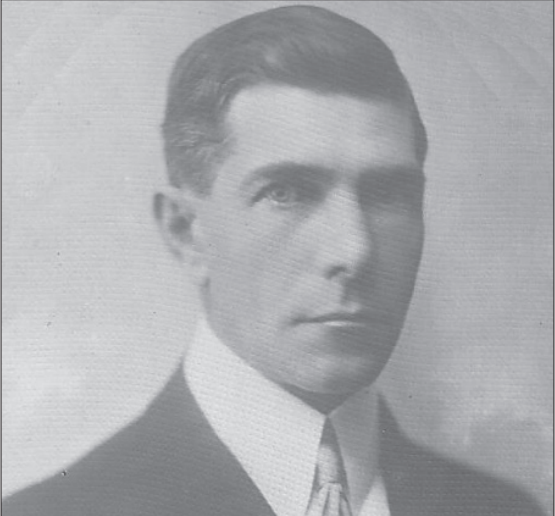
1. Simon Fellner: Engineering Pedigree and Post-War Industrialism :
Fellner’s career was defined by a rigorous academic background and international technical exposure, which likely contributed to the « avant-garde » nature of the Romfell.
Academic Foundation: Born in 1880 in Temeschwar, Fellner earned his degree in mechanical engineering in 1902 from the Franz Joseph University in Klausenburg.
Industrial Tenure: From 1903 to 1917, he was a key figure at the Ganz Works, interrupted only by technical study tours to Hannover and London (1905–1906). These trips exposed him to contemporary British and German automotive trends during a period of rapid internal combustion evolution.
Wartime Role: As an Oberleutnant and commander of the Depot’s Hauptwerkstätte, Fellner was the primary technical architect of the Romfell’s structural and mechanical systems.
Post-War Entrepreneurship: In 1920, Fellner oversaw the transition of the Budapest military workshop into Unitas, a civilian automotive enterprise. Under his leadership as technical director, Unitas achieved several milestones:
Tatra Representation: In 1928, he secured a prestigious agreement to represent the Czechoslovak firm Tatra in Hungary—a brand known for its own innovative, unconventional engineering (such as backbone tube chassis and air-cooled engines).
Motorsports: Fellner utilized his engineering acumen in competitive racing, famously winning the Swabian Race in 1929.
Legacy: Fellner remained a titan of the Hungarian automotive sector until 1933, passing away in 1947.
2. Branko Romanić:
The Link Between Heavy Industry and Mechanized Agriculture
While less biographical data exists for Hauptmann Branko Romanić, his professional trajectory suggests a specialization in heavy propulsion and tracked systems.
Professional Background: Like Fellner, Romanić was a Chief Engineer at the Ganz Works. His status as a reserve officer combined with his high-ranking industrial position made him the ideal bridge between the War Ministry’s requirements and the Depot’s production capabilities.
Technological Vision: Romanić’s interest in mechanized mobility extended beyond armored cars. In April 1918—immediately upon relinquishing command of the Depot—he filed patents in both Germany and Austria-Hungary for a three-wheeled agricultural tractor.
Strategic Partnerships: Romanić’s tractor project was co-developed with Dr. Leo Steiner, a critical figure in Austro-Hungarian mechanization. Steiner was the pre-war importer of Holt Caterpillar tractors, the very machines that provided the tracked basis for the earliest British and French tanks. This connection suggests that Romanić was intimately familiar with the global state of tracked and off-road propulsion technology.
3. Comparative Summary of Expertise :
The Romfell was not merely a military vehicle but a product of the Ganz Works’ corporate engineering culture, adapted for the battlefield.
Feature | Simon Fellner | Branko Romanić |
Primary Industry | Automotive & Precision Mechanical (Ganz) | Heavy Engineering & Propulsion (Ganz) |
Key Technical Focus | Chassis design, streamlined armor, and post-war commercialization. | Powerplants, agricultural mechanization, and tracked-vehicle theory. |
Academic/Technical Influence | British & German automotive schools. | Holt Caterpillar/Steiner influence on heavy traction. |
Post-War Contribution | Technical Director of Unitas; representative of Tatra. | Developer of patented three-wheeled tractor systems. |
This synergy—Fellner’s automotive refinement and Romanić’s heavy-traction expertise—explains why the Romfell featured such advanced technical specifications, including its unique curved armor and sophisticated wireless integration, far exceeding the « improvised » standards of other 1915-era armored cars.
IV – Engineering Specifications:
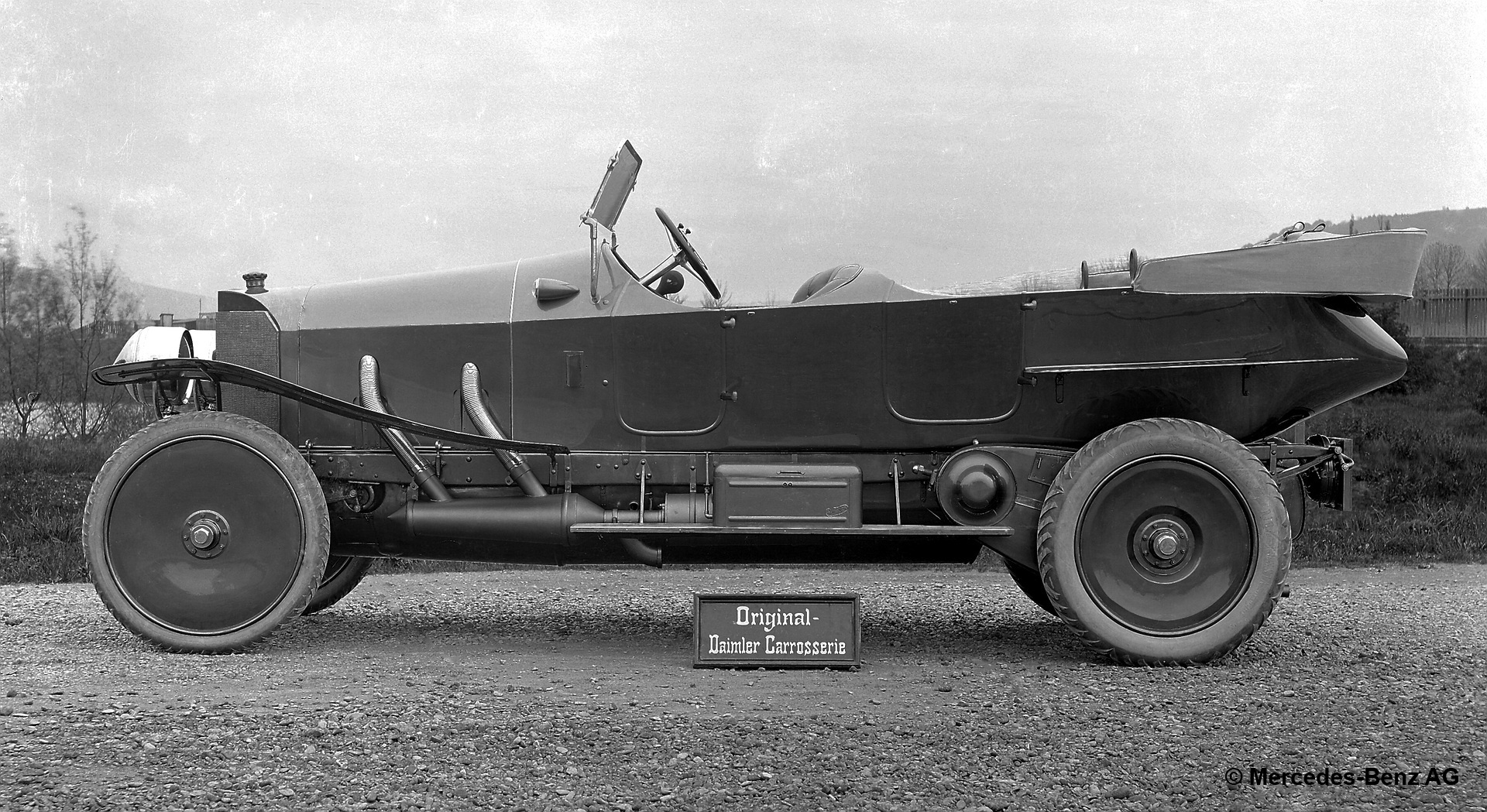
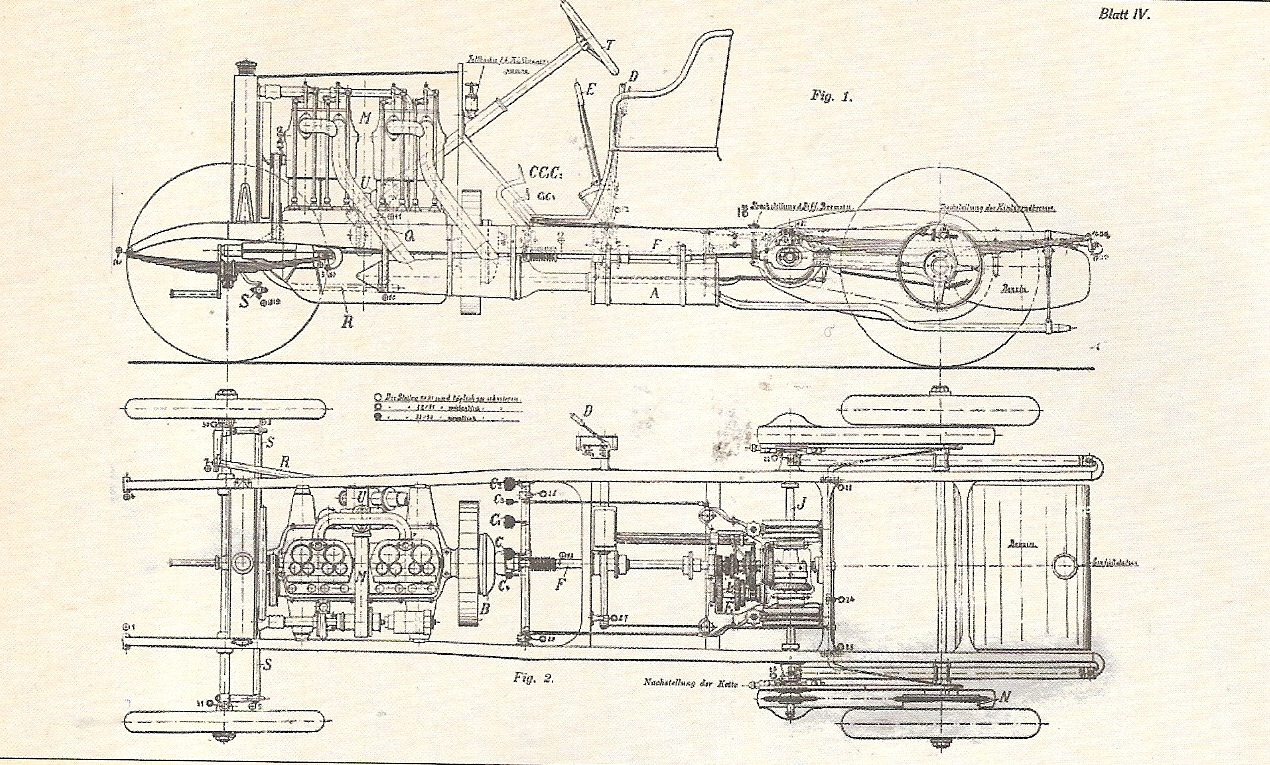
The technical superiority of the Romfell was largely anchored in the selection of its donor vehicle: the Mercedes 37/90 PS. Produced between 1913 and 1914, this chassis was one of the most powerful civilian platforms of the era, providing a high-performance foundation that allowed the Romfell to maintain mobility despite its substantial armor package.
1. The Mercedes 37/90 PS Chassis Architecture :
Unlike many improvised armored cars that utilized standard truck frames, the Romfell utilized a high-end, chain-driven passenger chassis. While the core mechanical layout remained largely stock, significant structural hardening was required to transition from a 2.6-tonne gross weight limit to a 5-tonne combat load.
Structural Reinforcement: To mitigate the stresses of the armored superstructure, engineers reinforced the main frame, cross-members, spring bolts, and mounting suspensions.
Weight Dynamics:
Original Chassis Weight: 1,525 kg.
Curb Weight (Standard): 1,950 kg.
Combat Weight (Romfell): Approximately 5,000 kg (5 tonnes).
Note: Historical discrepancies often cite a weight of 7 tonnes, but technical analysis of the Mercedes 37/90 PS load-bearing capacity supports the 5-tonne figure.
2. Powerplant and Drivetrain Technicals :
The heart of the Romfell was a massive 9.5-liter engine that provided a power-to-weight ratio far exceeding its contemporaries.
Engine Specifications:
Type: 4-cylinder in-line, four-stroke petrol engine.
Displacement: 9,530 cc.
Bore x Stroke: 130 x 180 mm.
Output: 90–95 hp at 1,300 rpm.
Fuel System: Piston-type carburetor.
Fuel Capacity: 125-liter tank located at the rear of the chassis.
Consumption: 29–33 liters per 100 km.
Transmission and Final Drive:
Gearbox: 4-speed manual transmission.
Drive Type: Rear-Wheel Drive (RWD).
Final Drive: Power was delivered to the rear axle via encapsulated chains. This was a robust, albeit older, technology that offered high durability in muddy or grit-heavy environments compared to contemporary shaft drives.
3. Mobility and Tactical Performance :
The 90-95 hp output allowed the Romfell to remain surprisingly agile. For context, most armored cars of the 1914–1915 period relied on 40–60 hp engines. The only true peer in terms of performance was the British Rolls-Royce Armored Car, which produced 80 hp for a 4.7-tonne frame.
Terrain / Condition | Maximum Speed |
Paved / High-Quality Roads | 28 – 40 km/h |
Off-Road (Optimal Conditions) | Up to 25 km/h |
Original Donor Speed (Unarmored) | 115 km/h |
Despite being restricted by a non-driven front steering axle (4×2 configuration), the sheer torque of the 9,530 cc engine allowed the Romfell to negotiate terrain that would have immobilized less powerful vehicles.
4. Comparison: Romfell vs. Contemporary Armor (1915) :
Vehicle | Weight | Horsepower | Engine Displacement |
Romfell | ~5.0 tonnes | 90–95 hp | 9,530 cc |
Rolls-Royce (UK) | 4.7 tonnes | 80 hp | 7,428 cc |
Austin (Russia) | 3.5 – 5.3 tonnes | 30–50 hp | ~5,000 cc |
Standard « Ersatz » (DE) | 4.0 – 6.0 tonnes | 40–60 hp | Variable |
The Romfell’s engineering choice—prioritizing a high-output, large-displacement engine—ensured that the vehicle was not merely a « mobile pillbox » but a viable reconnaissance asset capable of keeping pace with cavalry or motorized columns under favorable conditions.
V – Ballistic Engineering and Structural Layout of the Romfell :
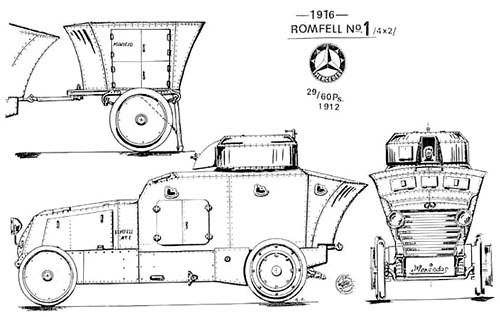
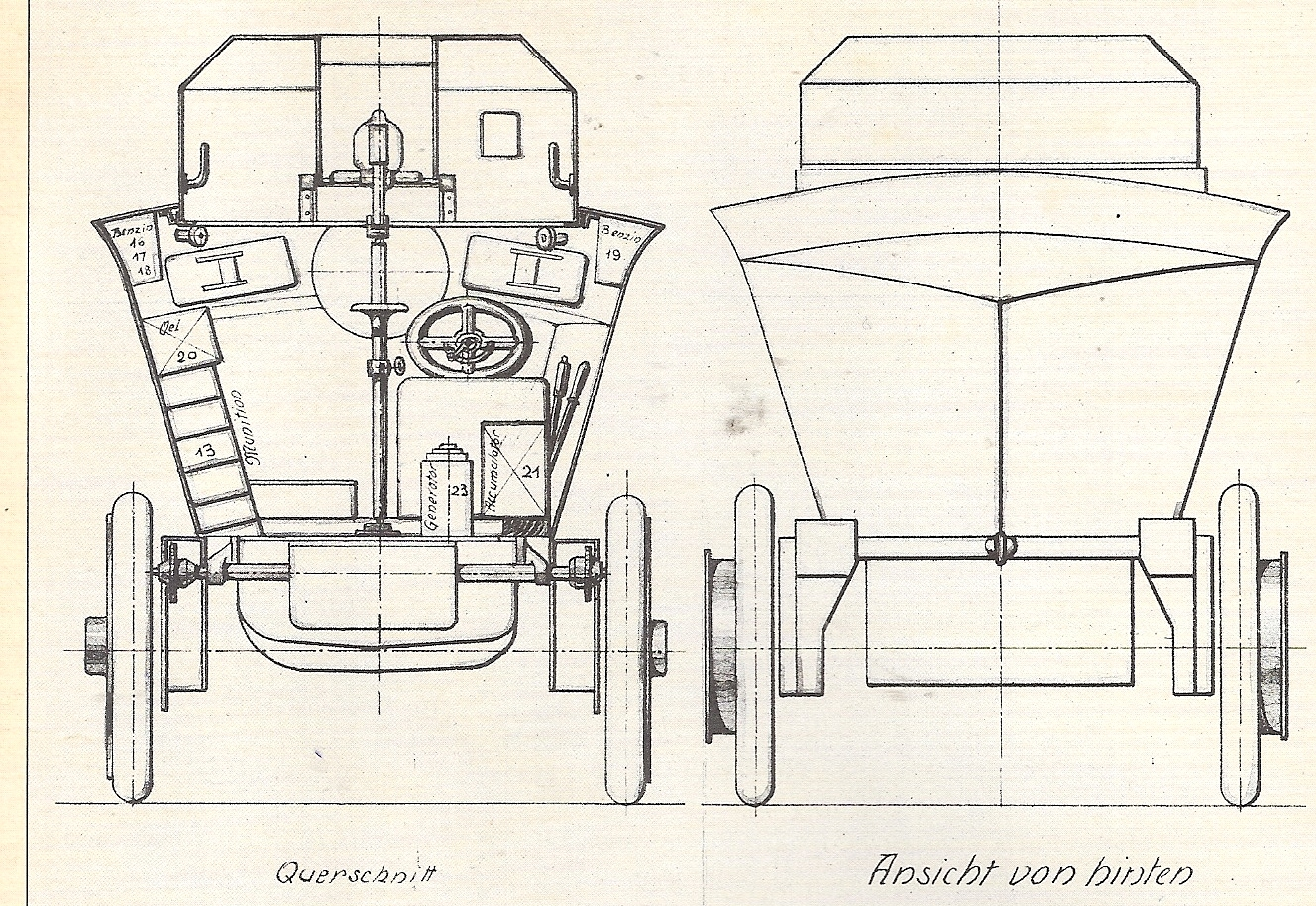
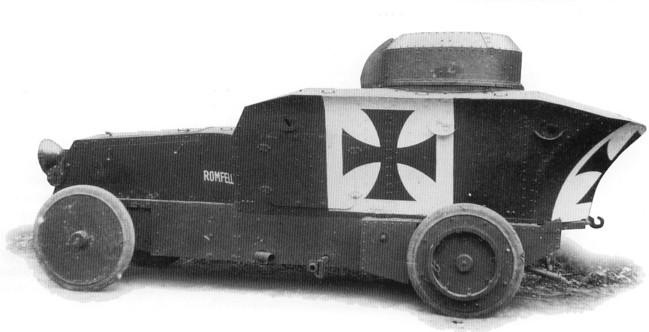
The Romfell’s design philosophy prioritized weight efficiency through ballistic geometry. By utilizing high-grade materials and angled surfaces, the engineering team achieved high levels of protection without the excessive weight typical of early « moving pillboxes. »
1. Armor Composition and Ballistic Resistance :
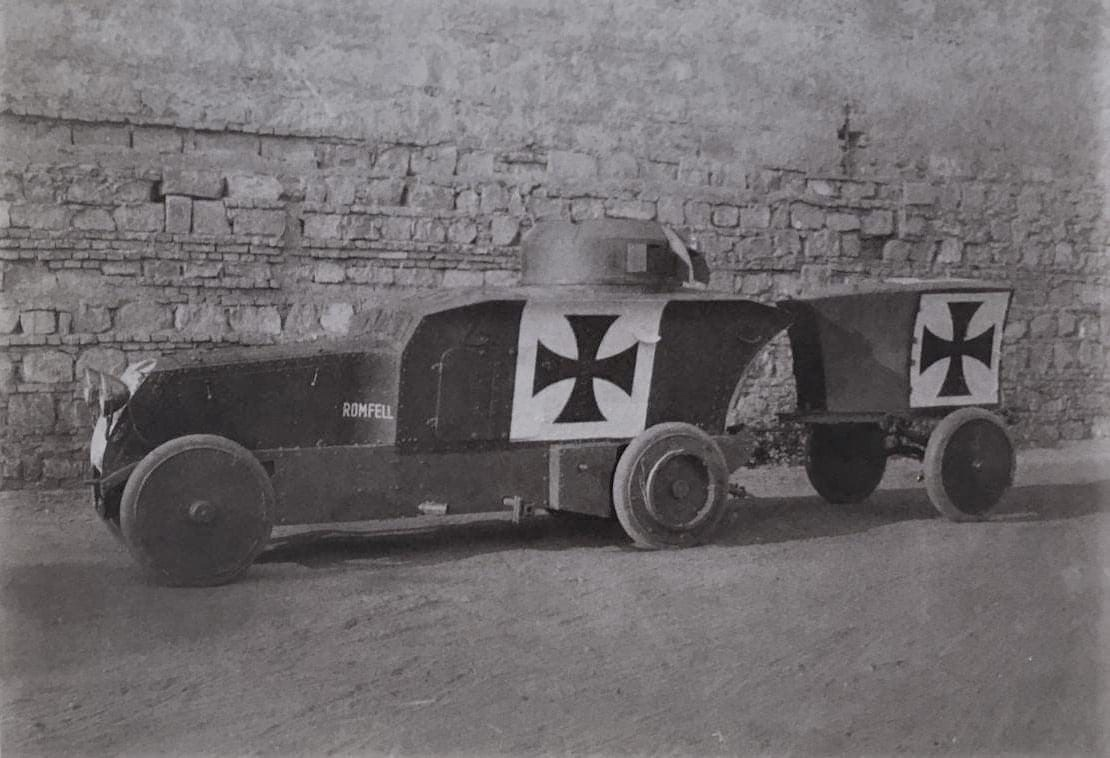
The vehicle was encased in nickel-chrome steel, selected for its superior hardness and tensile strength. The plating thickness was varied based on the likelihood of direct impact, creating a primitive but effective « incremental armor » scheme.
Deflection Strategy: The design ensured that incoming rounds could rarely strike the surface at a 90-degree angle. The side plates were tilted outwards at 75 degrees, and the rear plates were meticulously curved into a bow shape to maximize the ricochet probability.
Protection Thresholds:
Standard 8 mm Mannlicher: Proof against penetration at ranges exceeding 110 m.
Pointed German S-Bullets (Spitzer): Proof against penetration at ranges exceeding 300 m.
Plating Thickness Distribution:
Primary Surfaces (Sides and Turret Verticals): 6.5 mm to 7 mm.
Secondary Chassis Parts: 4.5 mm to 5 mm.
Horizontal Surfaces (Roof/Floor): 2 mm to 2.5 mm.
Assembly: The plates were secured to a skeletal metal frame using approximately 1,500 to 1,600 rivets.
2. Crew Ergonomics and Visibility :
The interior layout was compact, reflecting the vehicle’s dual role in reconnaissance and fire support.
Ingress/Egress: The crew accessed the interior through small, two-part square hatches located on the hull sides.
Direct Fire Support: The hull featured multiple shooting ports for small arms:
Left Side: Three ports (one situated above the hatch).
Right Side: Two ports (omitted above the hatch to provide space for the driver’s station).
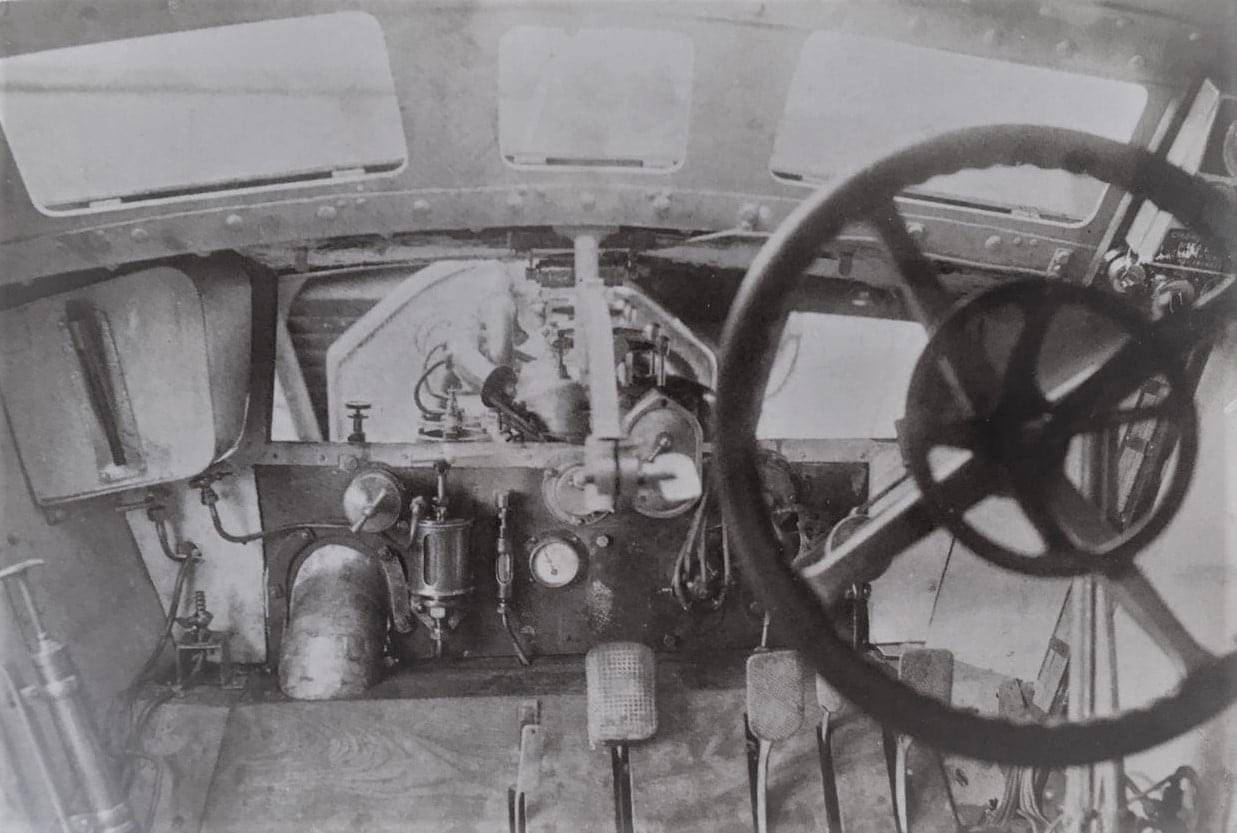
Optics and Lighting:
The driver utilized a single frontal vision hatch, supplemented by two additional hatches: one for the commander/observer on the left and a central square hatch.
All vision slots could be mechanically locked from the inside for maximum security.
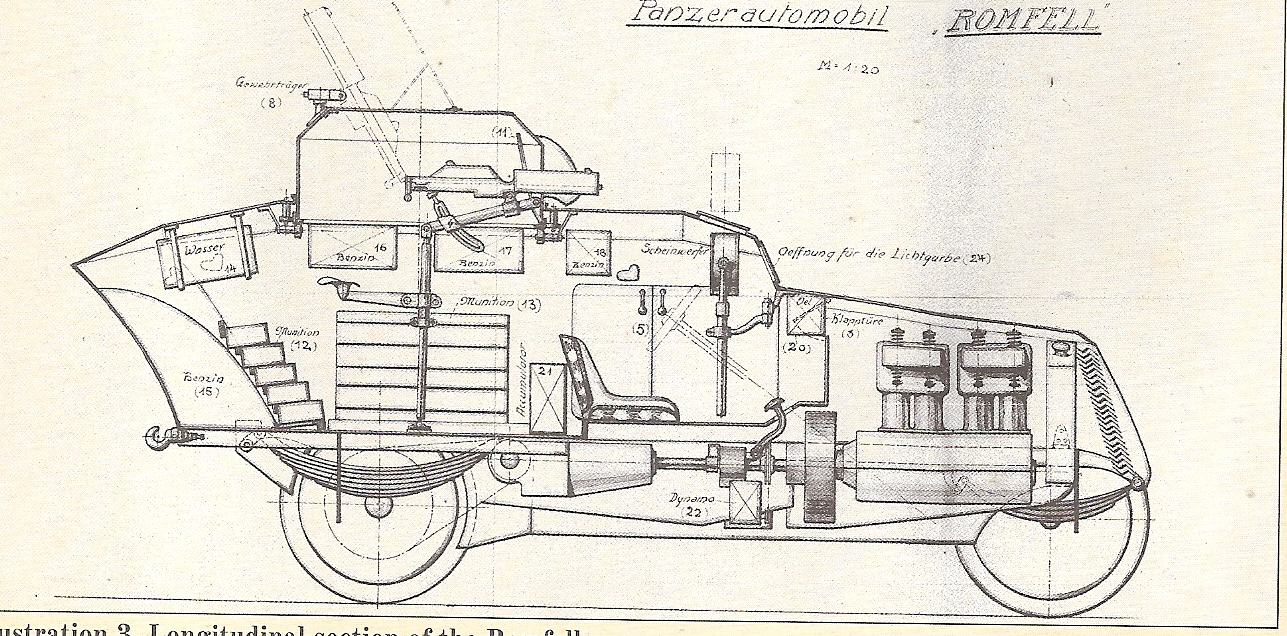
Illumination: A retractable Zeiss Acetylene searchlight was mounted behind the central hatch. It featured a vertical displacement mechanism, allowing it to be raised through a dedicated roof aperture for nighttime operations or signaling.
3. Propulsion Protection and Mechanical Features :
Given the vulnerability of the front-mounted radiator and engine, specialized armored shielding was integrated into the nose.
Radiator Armor: A specialized shutter system consisting of fifteen armored slats protected the radiator core. This provided a balance between ballistic protection and the high airflow required to cool the 9.5-liter Mercedes engine.
Engine Access: Maintenance hatches were located on both the lateral and superior surfaces of the engine compartment.
Cold Start Capability: An aperture located below the radiator slats allowed for the insertion of a manual starting crank directly to the crankshaft.
4. Rear Hull Extrusions and Hill-Hold Mechanism :
The rear of the Romfell featured two distinct technical appendages designed for logistical and tactical utility:
Towing Assembly: A standard hook attached to the lowest rear plate, intended for the transport of a supply or ammunition trailer.
The Anchor Contraption: A specialized mechanical « hill-stop » was integrated into the lower chassis.
Design: Two iron bars with sharp, downward-facing edges connected by a horizontal stabilizer.
Operation: A chain-link system allowed the crew to drop the bars to the ground when ascending steep inclines.
Technical Limitation: While innovative, the system was highly dependent on soil density. On surfaces that were too hard (rock) or too loose (deep sand/mud), the anchor failed to achieve the necessary purchase to prevent the 5-tonne vehicle from rolling backward.
Technical Summary Table: Structural Layout
Component | Technical Detail |
Material | Nickel-chrome steel (Riveted) |
Max Armor Thickness | 7 mm (Sides/Turret) |
Min Armor Thickness | 2 mm (Roof) |
Deflection Angle | 75° (Side Plates) |
Optical Suite | 3 Front Hatches, Zeiss Acetylene Searchlight |
Cooling Protection | 15-slat armored shutter |
Safety Feature | Manual chain-operated rear hill anchor |
VI – Turret Architecture and Ballistic Systems of the Romfell :
The Romfell’s offensive capability was centered on a sophisticated, multi-role turret system. Its engineering addressed the critical challenges of early armored warfare: weight distribution, 360-degree target acquisition, and the emerging threat of aerial observation.
1. Structural Integration and Turret Ring :
Because the Romfell’s chassis and roof utilized thin 2–2.5 mm plates to minimize total mass, the roof lacked the structural rigidity to support a heavy, rotating turret.
Reinforcement Geometry: Engineers integrated a dedicated internal support frame. This is externally evidenced by two distinct horizontal rows of rivets running along the upper periphery of the hull side plates, which anchored the load-bearing struts to the chassis.
The Turret Ring: The assembly sat on an 1,100 mm diameter ring, positioned slightly aft of the center-line. This rearward placement balanced the weight of the massive 9.5L Mercedes engine located at the front.
2. Primary Armament: The Schwarzlose M.07/12 :
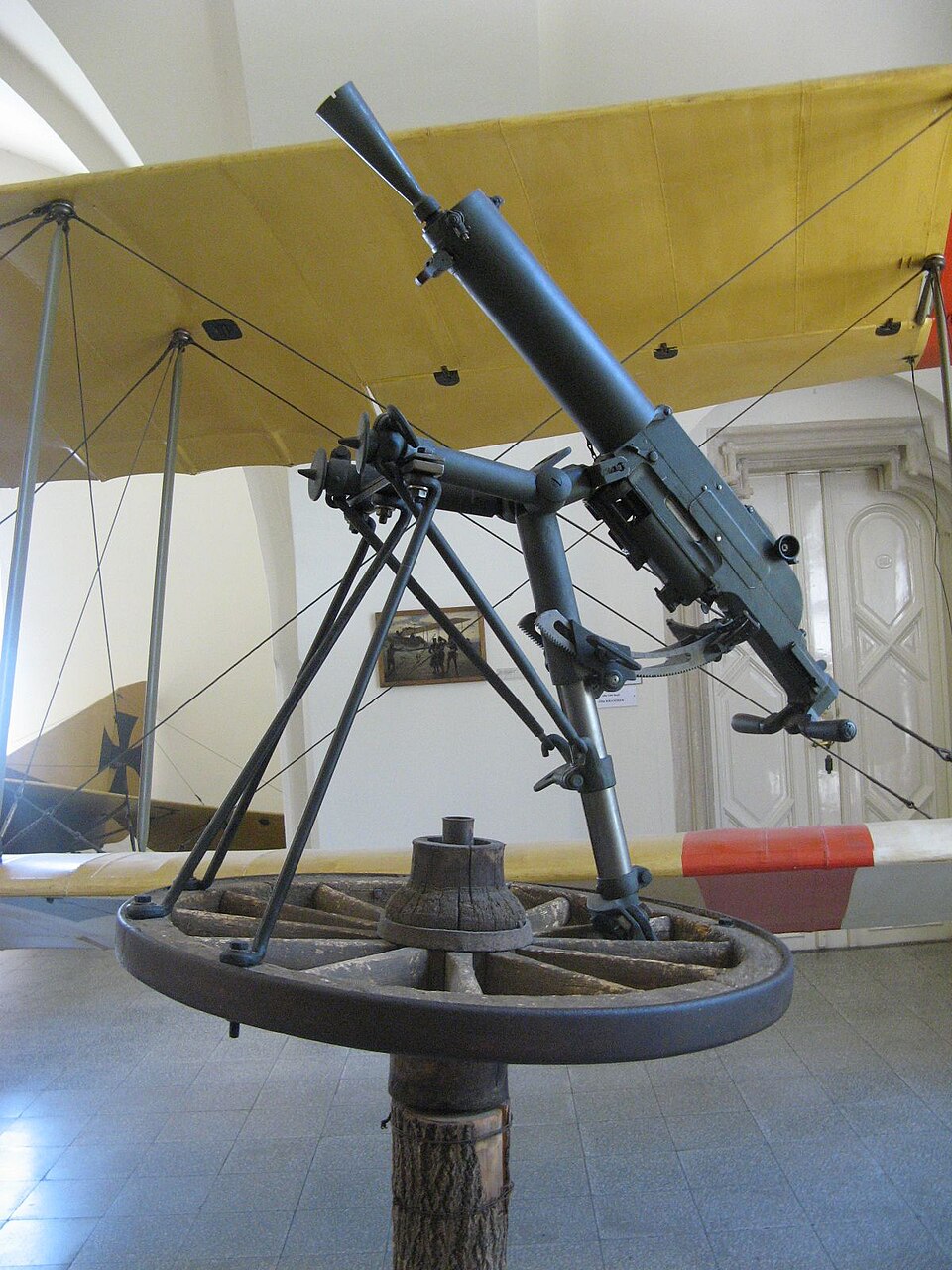
The vehicle was armed with the standard-issue heavy machine gun of the Austro-Hungarian Empire: the Schwarzlose M.07/12.
Mechanical Specifications: A water-cooled, blowback-operated design, the Schwarzlose was noted for its mechanical simplicity. To optimize it for armored vehicle use, it likely utilized a stiffened mainspring, increasing its cyclic rate to approximately 580 rounds per minute.
Ammunition Logistics: The Romfell featured an immense ammunition capacity designed for sustained independent operations:
Onboard Storage: 8,000 rounds.
Trailer Storage: 12,000 rounds (towed via the rear hook).
Total Capacity: 20,000 rounds.
3. Turret Functionality and Elevation Matrix :
The turret was a dual-purpose fighting compartment designed for both ground-level engagement and anti-aircraft defense.
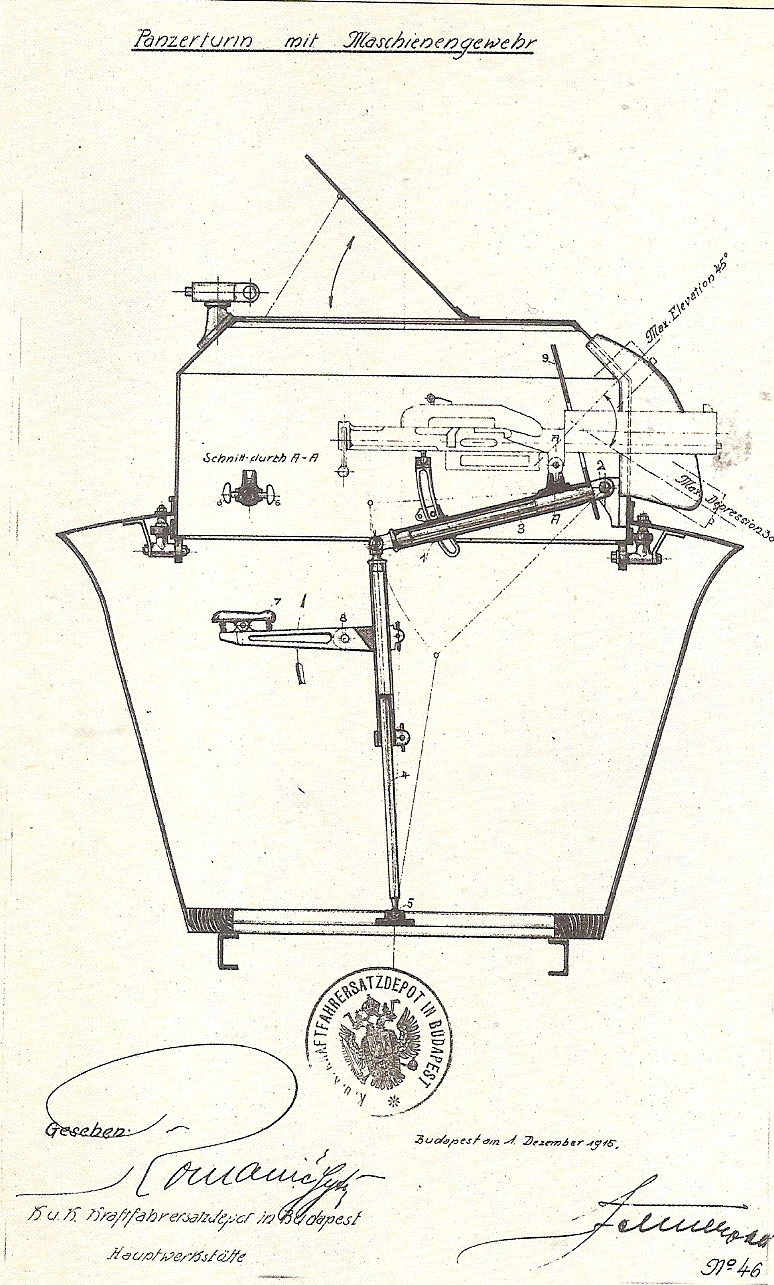
Articulation: The turret offered a full 360° traverse. The primary gun port allowed for an elevation of +45° and a depression of -30°, providing excellent coverage in mountainous or urban terrain.
Gun Shielding: The barrel was flanked by two extruding armored « cheeks » that provided lateral protection against small arms fire while the gun was at high angles of elevation.
Multi-Function Top Hatch: A large, forward-hinging hatch on the turret roof served four critical technical roles:
Anti-Aircraft (AA) Capability: The machine gun could be unmounted from its primary slot and relocated to a rear pintle mount on the turret, allowing it to engage aircraft through the open hatch.
Ventilation: During sustained firing, the hatch was opened to dissipate toxic cordite gases that would otherwise accumulate in the cramped 5-tonne hull.
Observation: It allowed the commander to stand in the turret for 360° unshielded observation.
Maintenance: It provided the necessary clearance for clearing jams or swapping barrels.
4. Technical Data Summary: Weaponry & Turret :
Feature | Specification |
Armament | 8mm Schwarzlose M.07/12 |
Rate of Fire | ~580 RPM |
Ammunition (Total) | 20,000 rounds |
Turret Traverse | 360° |
Elevation Range | +45° to -30° |
Turret Ring Diameter | 1,100 mm |
Crew (Turret) | 2 (Gunner and Commander/Loader) |
This turret configuration made the Romfell one of the most versatile armored cars of 1915, capable of pivoting from a mobile infantry support role to a dedicated anti-balloon or anti-aircraft platform in a matter of minutes.
VII – Auxiliary Equipment, Logistics, and the Trailer Assembly :
The operational capability of the Romfell was intended to be self-sustaining through a combination of advanced communication suites, a secondary armament array, and a specialized logistical tender. However, the practicalities of 1915-era combat eventually forced a transition from integrated trailers to dedicated support vehicles.
1. Communication Suite: The Siemens & Halske Wireless :
One of the most ambitious technical aspects of the Romfell project was the integration of a long-range wireless telegraphy station.
Technical Requirement: The design team requisitioned a unit from Siemens & Halske capable of a transmission radius of 100 to 150 km.
Significance: In 1915, most armored cars relied on visual signals (flags or lamps) or short-range dispatch riders. A 150 km range would have theoretically allowed the Romfell to communicate directly with higher-echelon command hubs far behind the front lines.
Operational Status: Despite being a visionary concept, historical records suggest this specific radio station was never formally integrated into the production vehicles, likely due to the weight of the vacuum-tube equipment of the era and the logistical difficulty of mounting a sufficiently large antenna on a mobile platform.
2. Secondary Armament and Small Arms :
Beyond the turret-mounted Schwarzlose, the crew was equipped with a versatile range of small arms for close-quarters defense and emergency egress.
Auxiliary Machine Gun: A secondary Schwarzlose M.07/12 was carried as a reserve or for use in the anti-aircraft pintle mount. This unit was typically stored in the trailer during transit to conserve internal hull space.
Long-Range Small Arms: One Mannlicher M.95 8 mm infantry rifle (bolt-action) was provided for the commander/observer to engage distant targets or for sentry duty.
Sidearms: Two Steyr M1912 9 mm pistols were issued for the driver and gunner, providing compact personal defense within the cramped confines of the armored body.
3. The Logistic Tender: Single-Axle Trailer :
The Romfell’s design originally included a single-axle, unbraked trailer linked to the chassis via the rear towing hook.
Logistical Role: The trailer functioned as a mobile supply dump, containing:
Ammunition: 12,000 rounds of 8 mm belted ammunition.
Fuel: Reserve canisters for the 9.5L Mercedes engine.
Spare Parts: Maintenance kits for the chain-drive system and engine components.
Technical Failure: While the trailer theoretically extended the vehicle’s independent range, it introduced significant tactical drawbacks:
Mobility Degradation: The added drag and weight of the trailer severely hampered the Romfell’s off-road performance.
Maneuverability Constraints: The single-axle design made reversing in combat conditions nearly impossible and increased the vehicle’s turning radius.
4. Transition to Motorized Support Columns :
Due to the mobility issues inherent in the trailer design, the K.u.K. command eventually abandoned the integrated tender concept.
Standardized Support: The trailer was replaced by a dedicated support truck (typically a 3-tonne variant). This truck would shadow the Romfell, carrying its massive 20,000-round ammunition load and fuel reserves while allowing the armored car to maintain its maximum road speed and agility during reconnaissance maneuvers.
Summary of Auxiliary Specifications
Equipment Type | Specification / Model | Operational Note |
Primary Radio | Siemens & Halske Wireless | Desired 150 km range; likely not fitted. |
Secondary MG | Schwarzlose M.07/12 | Stored in trailer/truck as a reserve. |
Personal Rifle | Mannlicher M.95 (8 mm) | Standard bolt-action carbine. |
Personal Pistols | 2x Steyr M1912 (9 mm) | High-velocity internal-magazine sidearms. |
Logistical Tender | Single-axle Trailer | Discontinued in favor of support trucks. |
The evolution from a self-contained « land ship » with a trailer to a vehicle supported by a motorized column reflects the birth of modern mechanized combined-arms doctrine.
The emergence of the Romfell in late 1915 was not merely a result of engineering ambition, but a reactive necessity triggered by « armor shock » on the Eastern Front. While the Austro-Hungarian high command had previously dismissed armored vehicles as specialized novelties, the tactical efficacy of the Imperial Russian Army’s mechanized units forced a rapid doctrinal shift.
1. The Tactical Impact of Russian Mechanized Sorties (Sept–Oct 1915) :
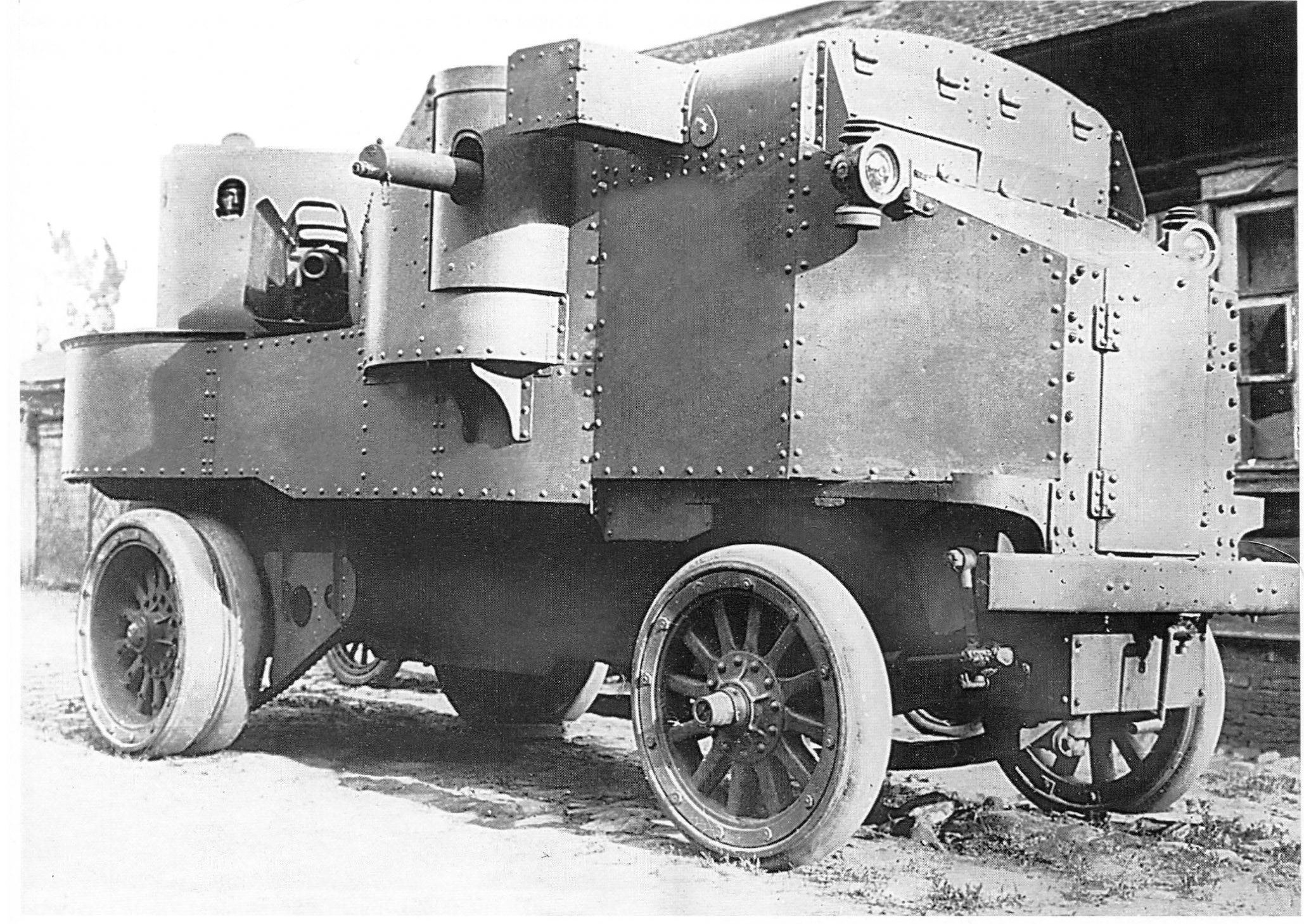
By late 1915, the Russian Empire had successfully integrated armored cars—primarily Austin Armored Cars (British-built chassis with Russian modifications) and the domestically produced Garford-Putilov—into their reconnaissance and breakthrough operations.
Documentation from the Austro-Hungarian field armies highlights several critical encounters that decimated infantry morale:
The Lutsk-Rivne Corridor (September 1915): The Austro-Hungarian 4th Army reported coordinated deployments of up to four armored vehicles operating in tandem. This demonstrated that the Russians were already moving toward small-unit mechanized tactics rather than using vehicles as isolated curiosities.
The Klevan Engagement (September 13, 1915): A single Russian armored car reportedly routed the 10th and 45th Infantry Regiments (IR) of the 24th Infantry Division (ID). The psychological effect of mobile, bullet-proof fire platforms caused « great unrest, » leading to the total dispersal of seasoned infantry units who lacked dedicated anti-armor weaponry.
The Zielona Attrition (October 1915): The 7th Army recorded the successful destruction of a Russian vehicle via a direct artillery strike near Zielona. This confirmed that while armored cars were immune to small arms, they remained vulnerable to high-explosive (HE) shells and field guns.
2. Doctrinal Shift: From Rejection to Requirement :
The reports from these encounters filtered up through the ranks, creating a grassroots demand for domestic armored assets. The timing of these encounters was pivotal for the Romanić-Fellner project:
Infantry Vulnerability: The dispersal of entire regiments by a few vehicles proved that the traditional infantry square or trench line was insufficient against high-speed, machine-gun-armed motorization.
Psychological Parity: Austro-Hungarian troops demanded their own « iron clad » vehicles to counter the Russian advantage.
The Romfell Validation: The technical completion of the first Romfell in Budapest coincided perfectly with this surge in demand. The War Ministry, which had viewed the Mercedes chassis conversion as a « waste, » was forced to acknowledge that the vehicle was now a strategic priority.
3. Technical Comparison: Romfell vs. Russian « Austin » (Series I/II) :
The Romfell was technically superior to the contemporary Russian Austin in several key performance metrics, which would have provided the K.u.K. troops with a significant edge had it been deployed in larger numbers.
Feature | K.u.K. Romfell | Russian Austin (Series II) |
Engine Output | 90–95 hp | 50 hp |
Max Speed (Road) | 40 km/h | 60 km/h |
Armor Geometry | Sloped/Curved (Advanced) | Vertical/Flat (Basic) |
Primary Armament | 1x 8mm Schwarzlose | 2x 7.62mm Maxim |
Turret Traverse | 360° Single Turret | Dual Sponson Turrets (Limited Arc) |
4. Conclusion: Armor as a Defensive Necessity :
The formal acceptance of the Romfell into service in October 1915 transformed it from an unauthorized experiment into a symbol of Austro-Hungarian modernization. The « unrest » caused by Russian armor at Klevan acted as the ultimate catalyst, proving that in the era of industrial warfare, technical innovation in the workshop was just as vital as bravery in the trenches.
VIII – Historical and Technical Monograph :
The Romfell stands as one of the most aesthetically distinct and technically idiosyncratic armored fighting vehicles (AFVs) of the First World War. Developed within the Austro-Hungarian Empire, its history reflects the transition from Edwardian-era engineering optimism to the brutal, practical necessities of Alpine and Eastern Front warfare.
1. Origins and the Mercedes Era (1915–1916) :
Mechanical Specifications & Early Trials :
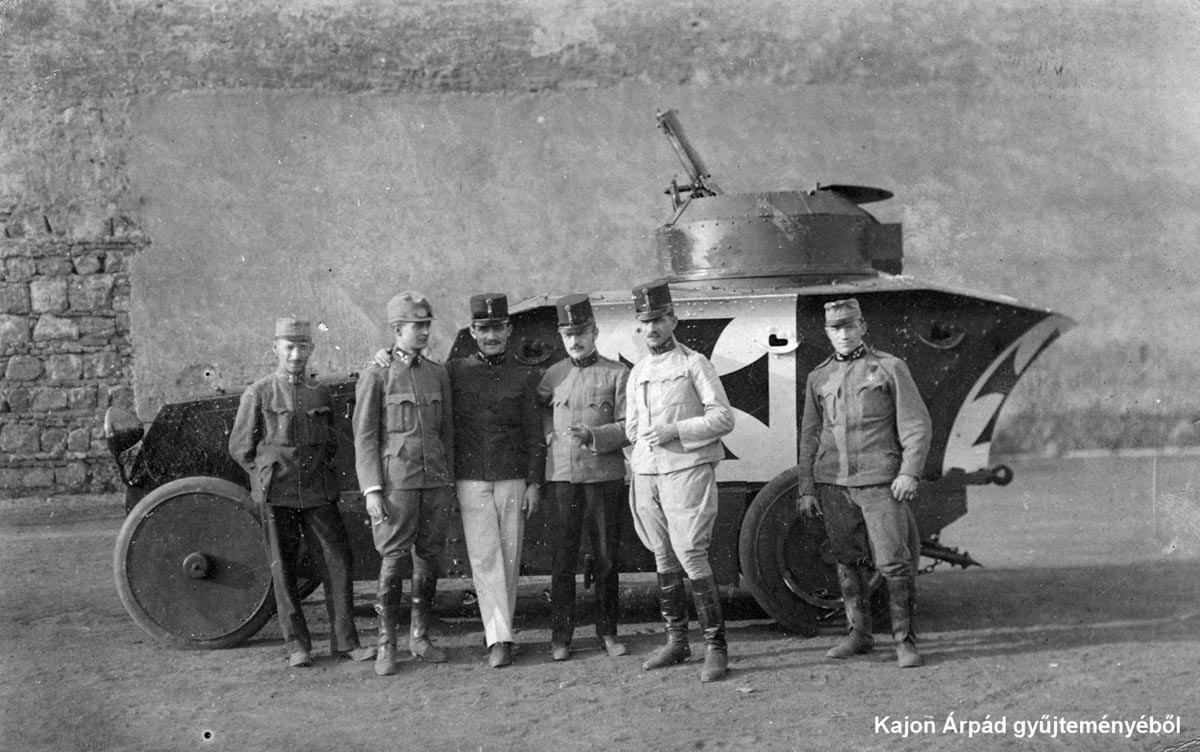
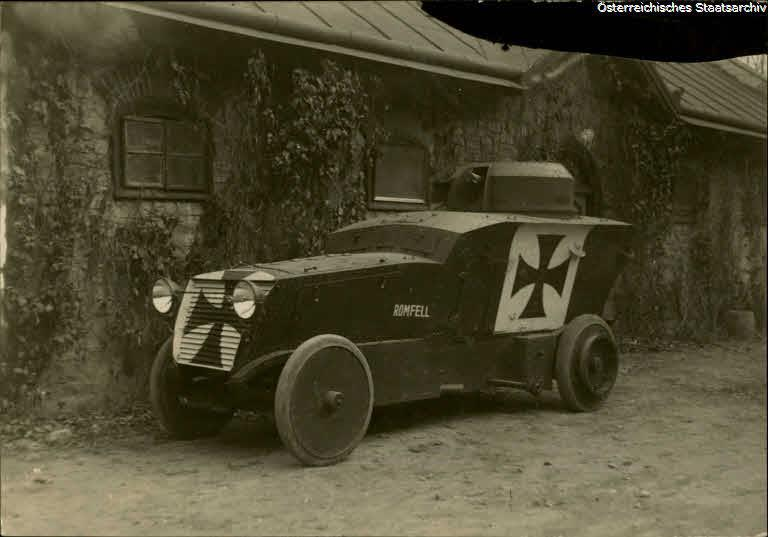
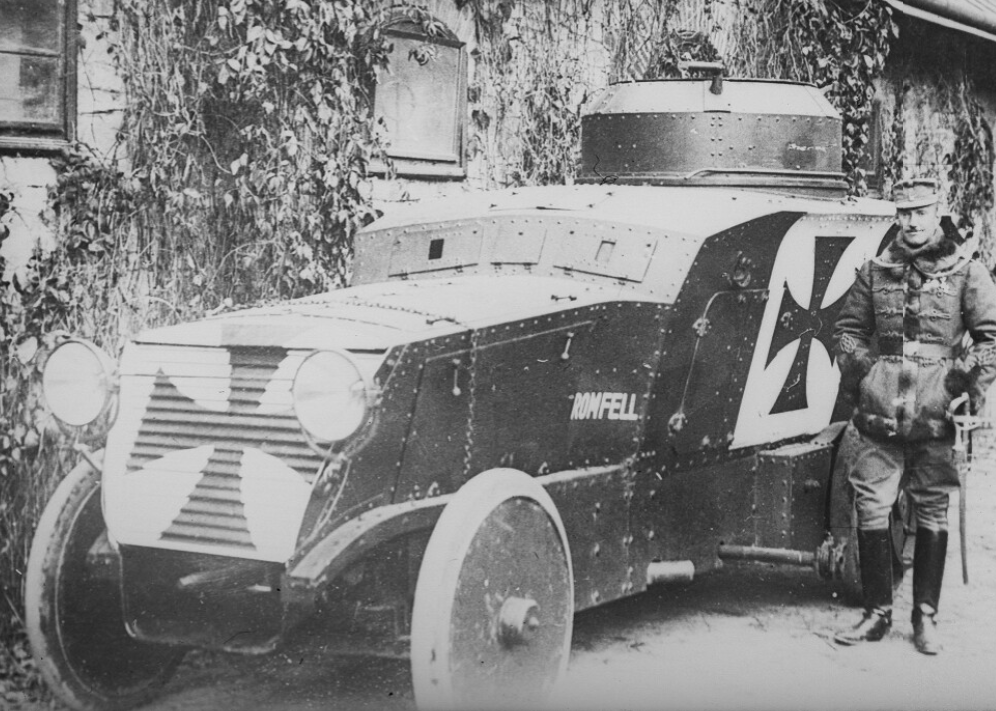
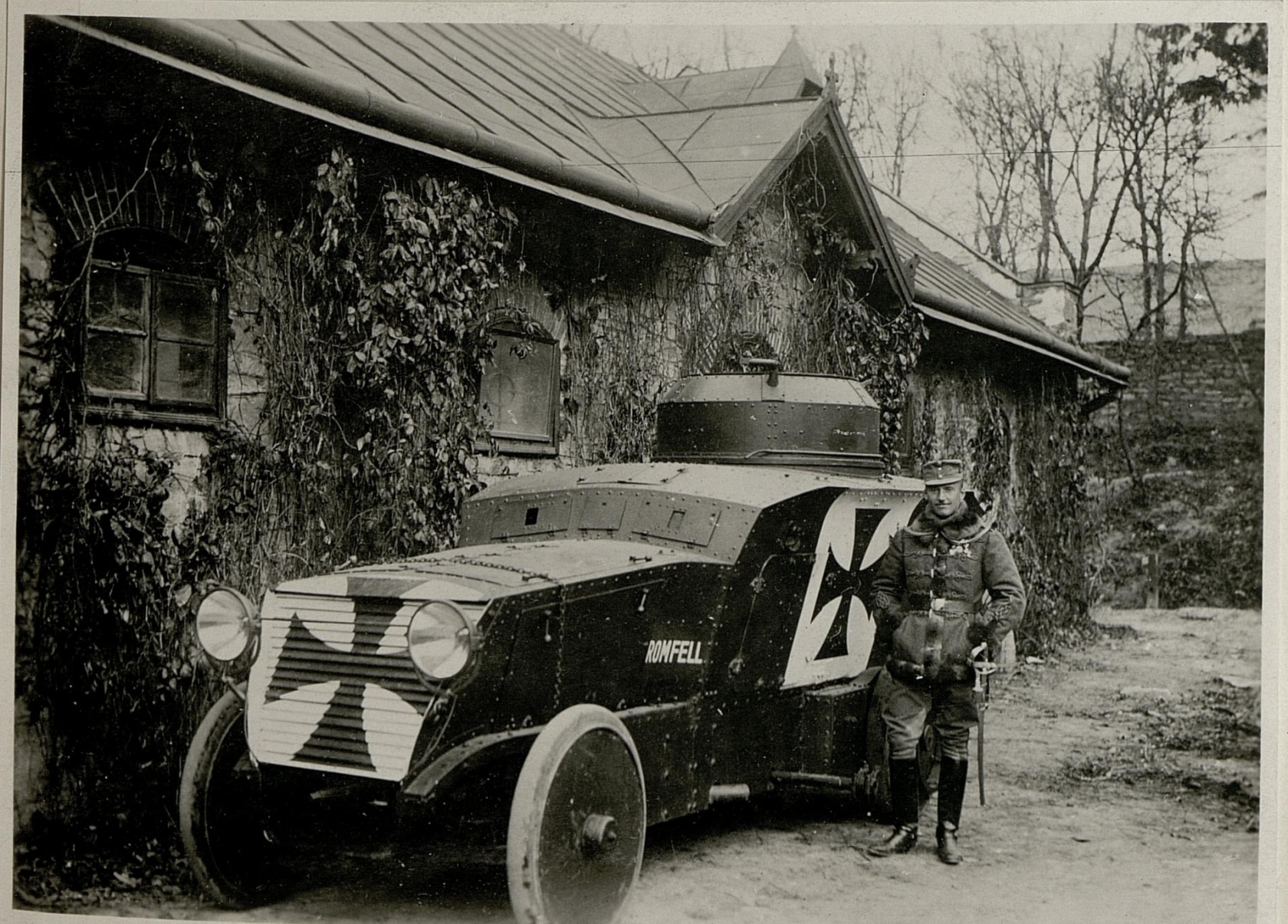
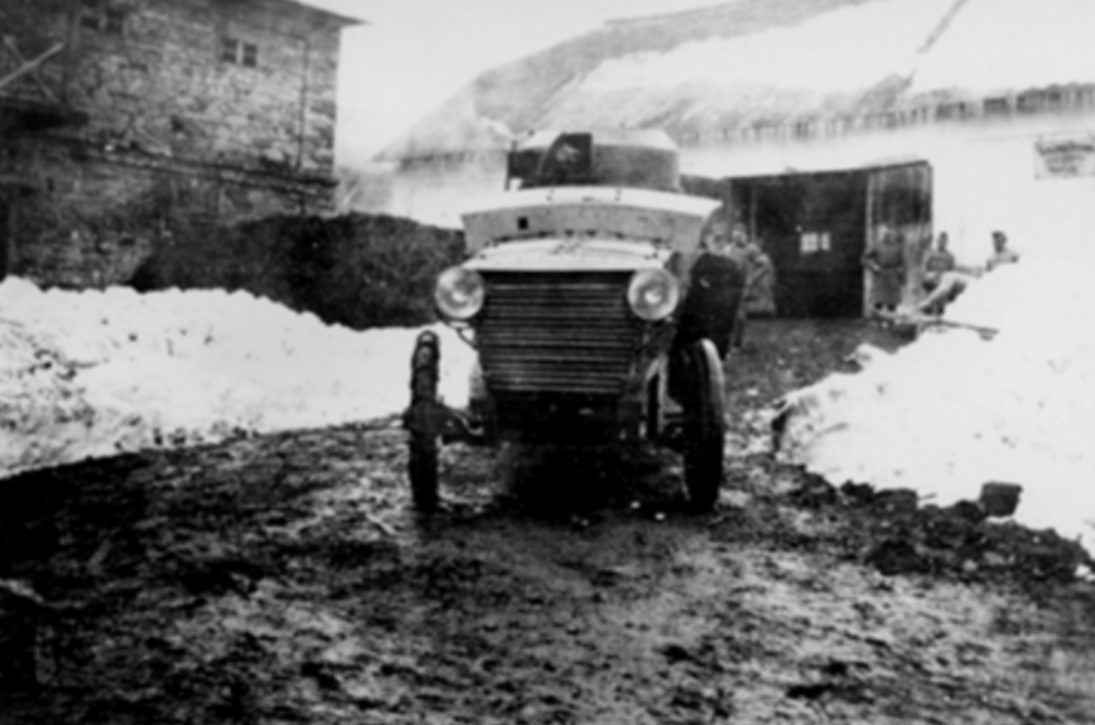
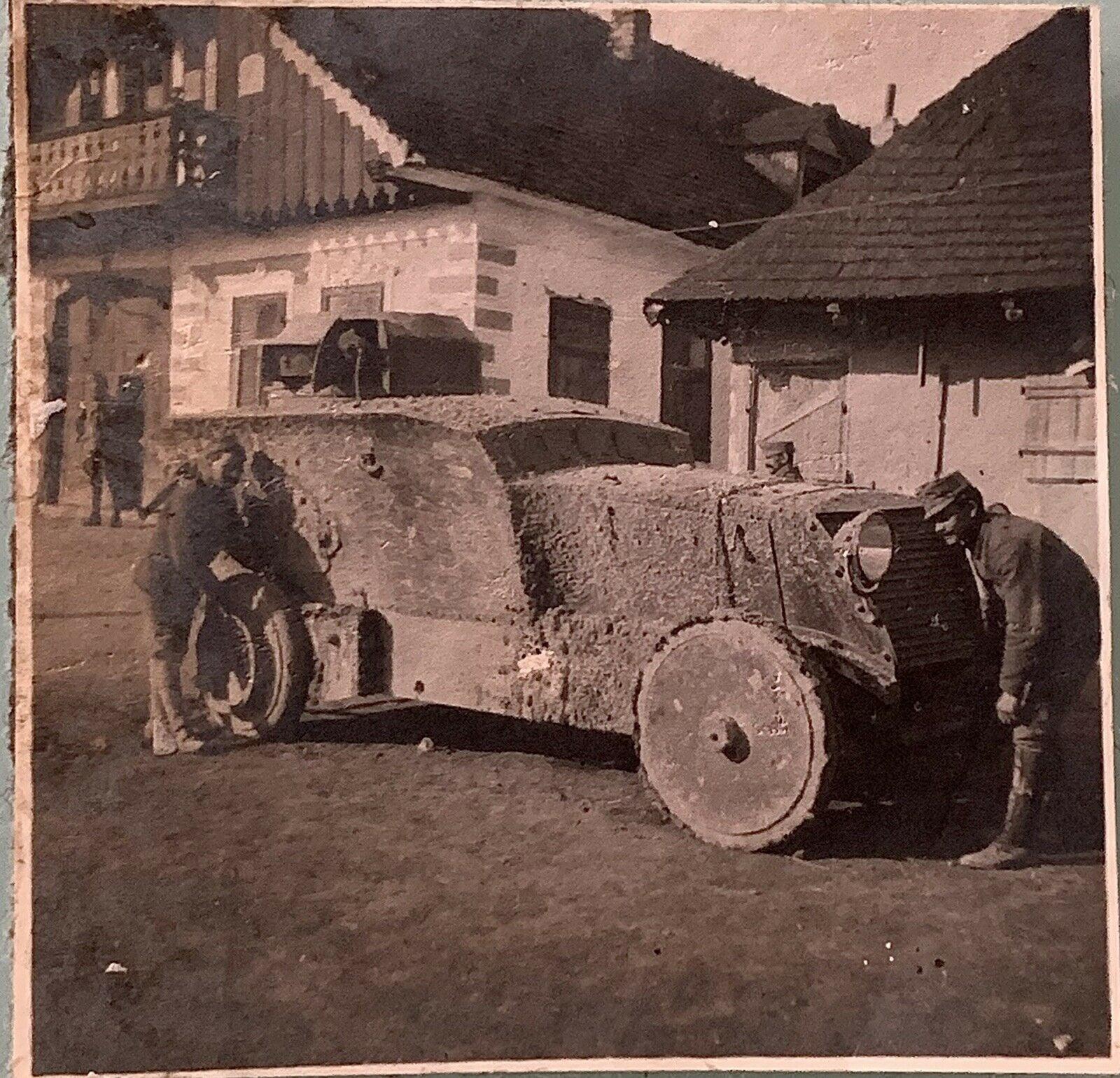
The prototype was completed in the summer of 1915, undergoing a grueling 100 km test drive on July 30. Its most striking feature was its curved, inward-sloping armor, which provided superior protection against small arms fire compared to the flat-sided designs of its contemporaries.
Public Debut: In October 1915, the Romfell was showcased at a massive military parade in Budapest, organized by Infantry General Marenzi to benefit the Red Cross. High-ranking officials, including the Minister of War, Baron Samu Hazay, praised its modern appearance.
Operational Integration: Following an inspection in Vienna, the vehicle was accepted for service and issued to the 7th Army on October 11, 1915. Under the command of Oblt.a.D. Ludwig von Rakosy, it was attached to the 36th Infantry Troops Division (36.I.T.D.) in the vicinity of Buczacz (modern-day Buchach – Ukraine).
The Logistic Failure of the Trailer :
Early field reports highlighted a significant tactical error: the use of a specialized armored trailer. Intended to carry fuel and ammunition, it proved to be a liability in the muddy terrain of the Eastern Front. It lacked sufficient capacity, increased the vehicle’s profile, and severely hindered its ability to reverse or maneuver in tight spaces. Consequently, the trailer concept was abandoned in favor of using an unarmored accompanying truck.
BUDAPEST
BUCZACZ
2. The « Silent » Period and the Reșița Refurbishment (1916–1917) :
The Romfell saw limited action during the Brusilov Offensive in the summer of 1916. By August 11, the Mercedes chassis was mechanically exhausted (« worn-out condition »). It was sent to Car Workshop No.36 in Stryi for repairs, where it received the registration « KN 5965. »
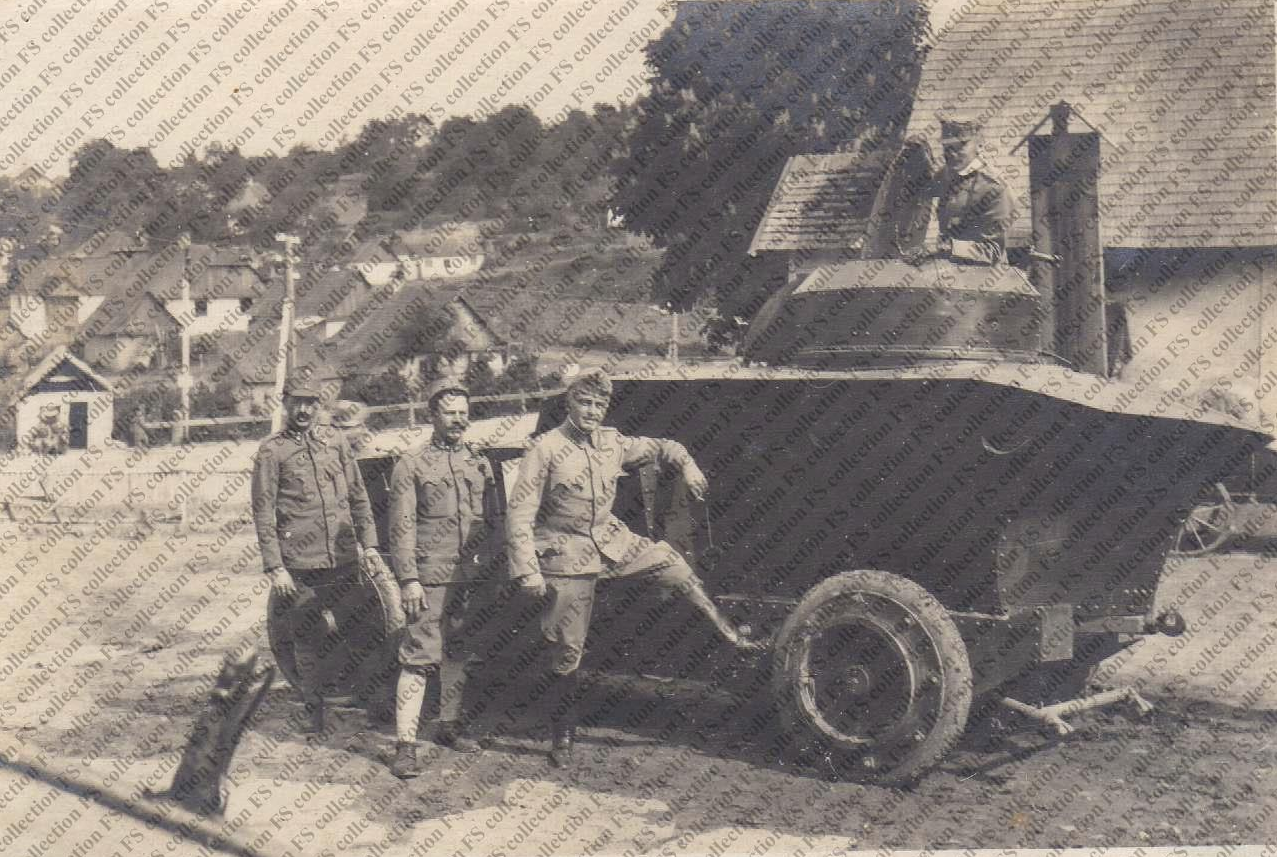
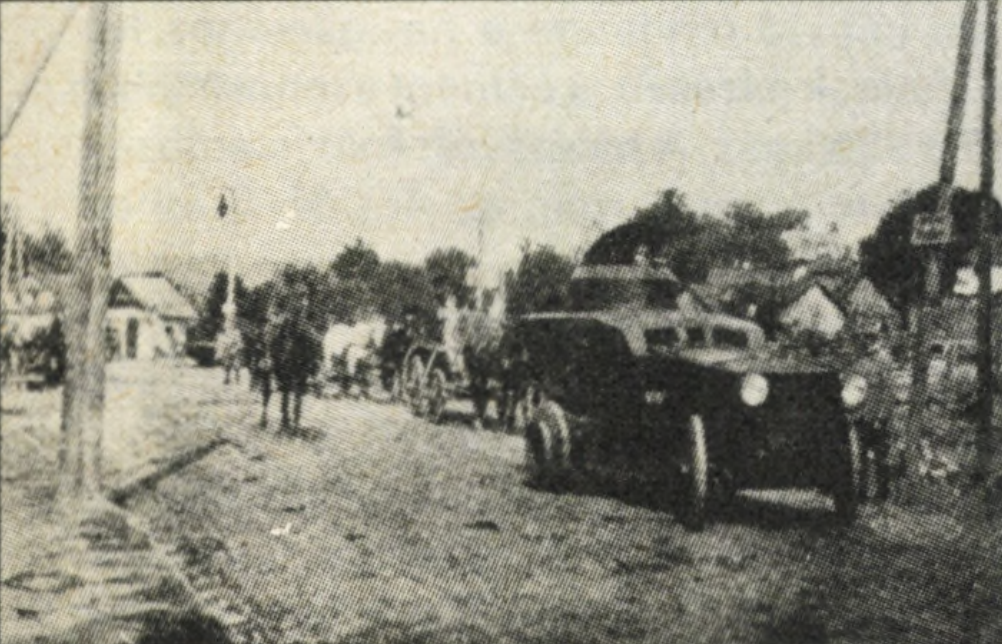
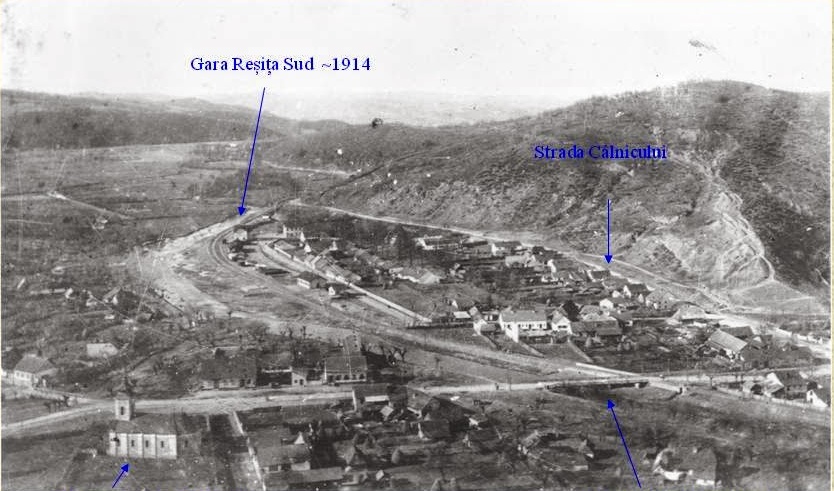
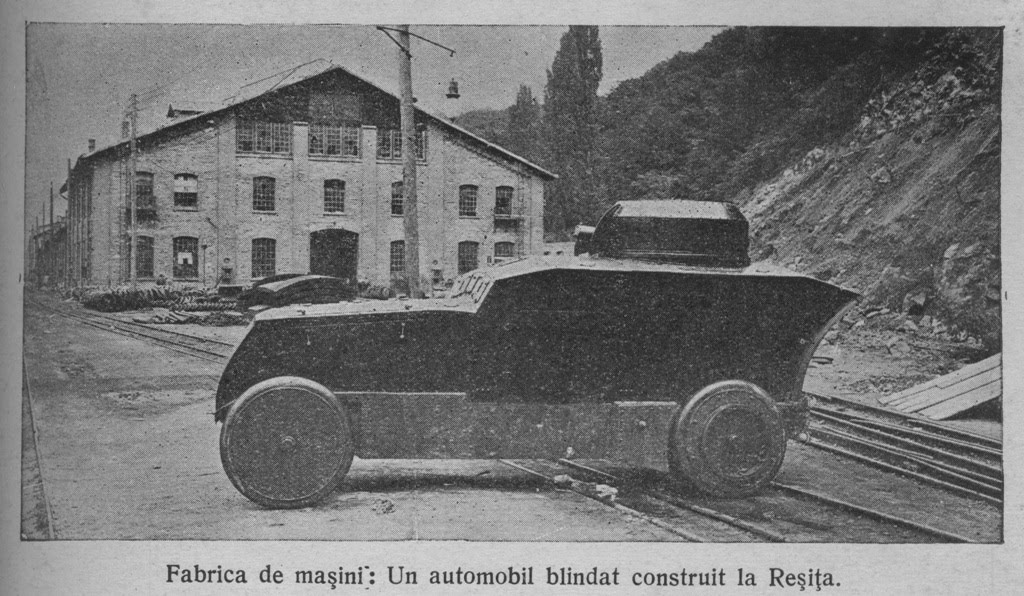
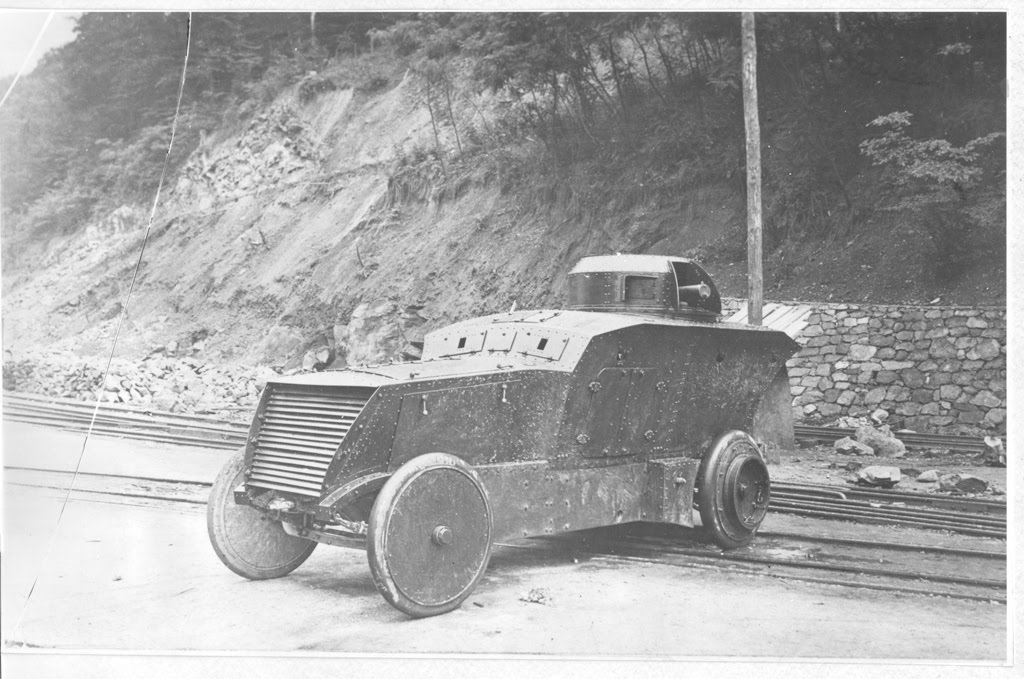
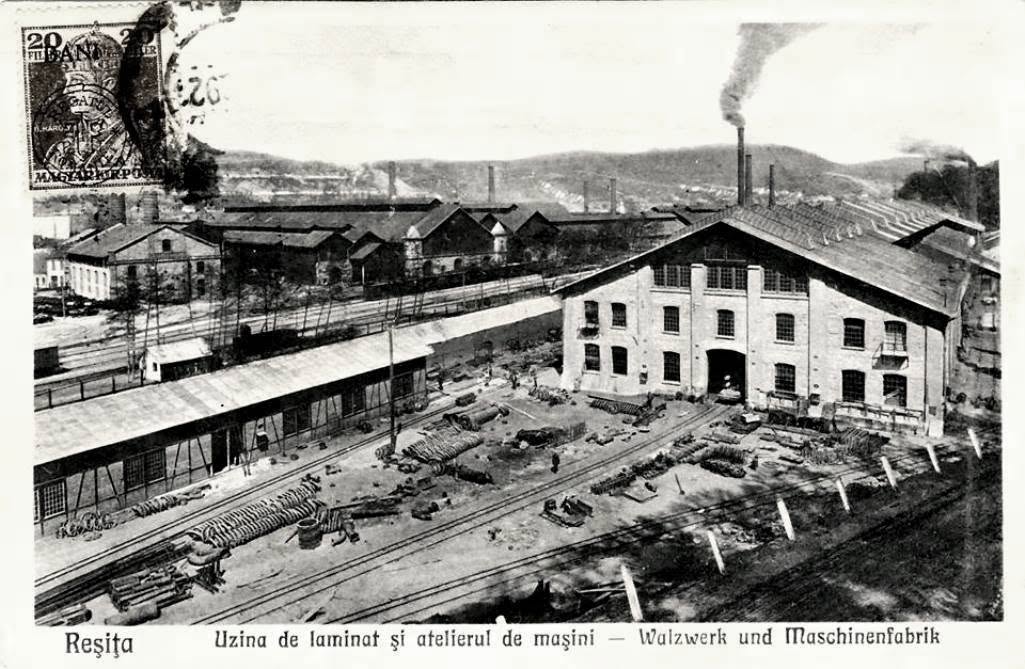
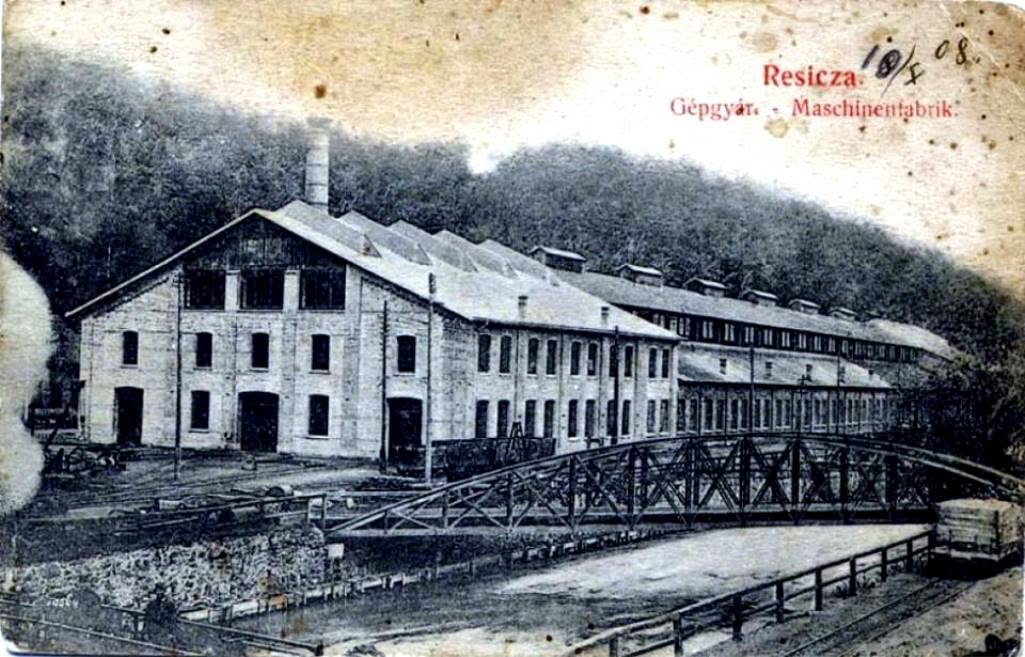
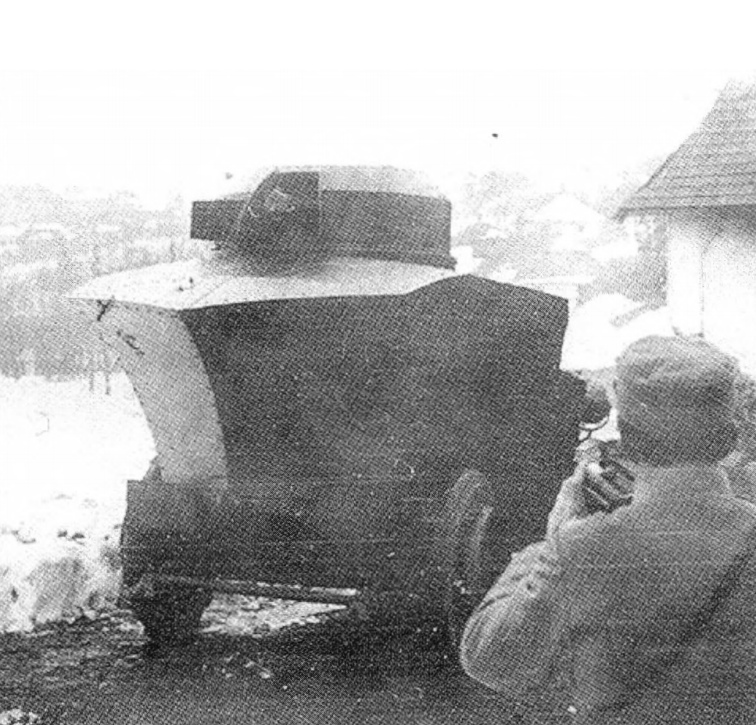
History then loses track of the vehicle for nearly a year. Historical analysis suggests the Romfell was transported to the Reșița Machine Factory in modern-day Romania. Photographs from this era show the Romfell stripped of its headlights and side-mounted exhaust pipes. It is highly probable that the Romfell’s advanced curved armor served as a production sample or engineering reference for the Junovicz series during this period.
3. Technical Rebirth: The FIAT Conversion (1917–1918) :
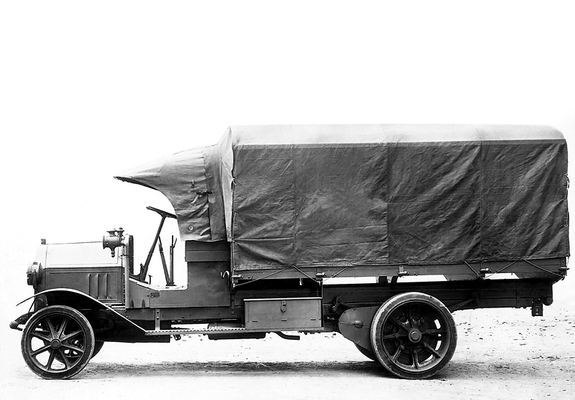
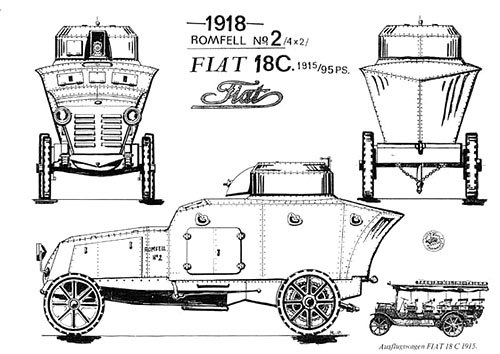
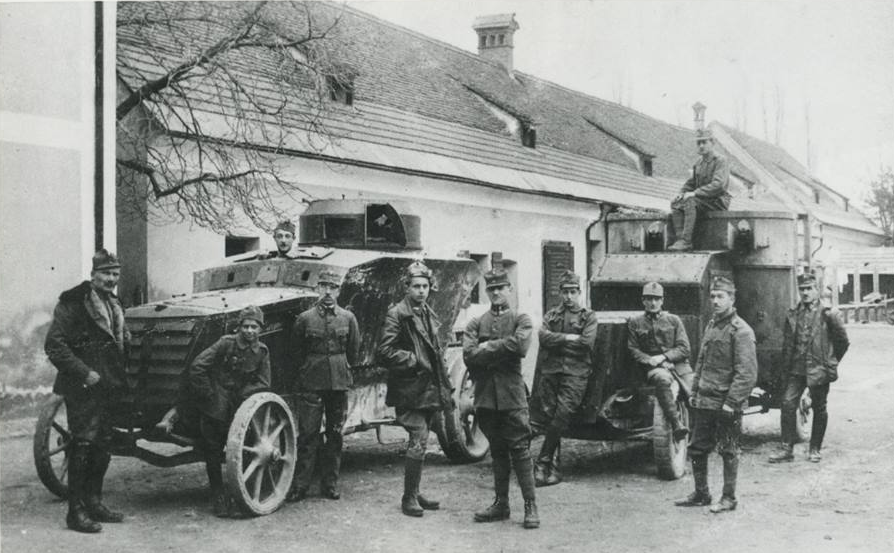
In June 1917, the Romfell reappeared in Ljubljana before being transferred to the 5th Army near Trieste. At Feldautopark Nr.1, engineers performed a radical overhaul. The failing Mercedes chassis was discarded and replaced with a captured Italian FIAT 18BL truck chassis.
Impact of the FIAT Rebuild
This conversion significantly altered the vehicle’s technical profile:
Mass Reduction: The total weight dropped from approximately 5.0 tonnes to 3.51 tonnes. This 1.5-tonne reduction was achieved through the lighter FIAT running gear and the removal of certain armor shrouds.
Performance: Powered by a 44 hp M09 Goliath engine, the lightened vehicle could reach speeds of 35 km/h.
Aesthetic Changes: The radiator slats were modified, and the previously protected wheels were replaced with exposed wooden-spoked wheels, reflecting a shift toward maintenance accessibility over total protection.
In March 1918, the Romfell was integrated into Panzerautozug Nr.1 (Armored Car Platoon No. 1) in Udine, serving alongside a diverse collection of captured equipment, including a Russian Austin 3rd Series and an Italian Lancia 1ZM.
4. The Carinthian Border War (1918–1919) :
The collapse of the Austro-Hungarian Empire in October 1918 plunged the region into a series of violent border disputes between the new Republic of German-Austria and the Kingdom of Yugoslavia. In this chaotic vacuum, the Romfell and its crew, led by Zugsführer Johann Amann, retreated to Carinthia to defend the Klagenfurt region.
Final Combat Record :
Integrated into a volunteer armored car section under Fähnrig Jack, the Romfell became a « fire brigade » asset used to plug gaps in the Austrian lines.
December 1918: Participated in the defense of Völkermarkt and Grafenstein.
April 29, 1919: During a major Yugoslav offensive, the Romfell and an Austin armored car engaged in a fierce breakout from Klagenfurt. While the Austin was damaged by hand grenades at Kreuzerhof, the Romfell continued to provide mobile fire support.
May 4–6, 1919: The vehicle performed its final documented missions in the Eisenkappel sector, clearing roads for infantry and acting as an armored supply transport for frontline machine-gun positions.
5. The Vanishing Act :
Following the mission on May 6, 1919, the Romfell disappears from the historical record. Unlike the Austin armored car, which was photographed in various post-war states, the Romfell’s fate remains speculative. It was likely either scrapped due to the extreme difficulty of maintaining a hybrid Mercedes-FIAT-Austrian vehicle or destroyed during the final stabilization of the border before the 1920 Plebiscite.
3. Technical Rebirth: The FIAT Conversion (1917–1918) :
In June 1917, the Romfell reappeared in Ljubljana before being transferred to the 5th Army near Trieste. At Feldautopark Nr.1, engineers performed a radical overhaul. The failing Mercedes chassis was discarded and replaced with a captured Italian FIAT 18BL truck chassis.
Impact of the FIAT Rebuild
This conversion significantly altered the vehicle’s technical profile:
Mass Reduction: The total weight dropped from approximately 5.0 tonnes to 3.51 tonnes. This 1.5-tonne reduction was achieved through the lighter FIAT running gear and the removal of certain armor shrouds.
Performance: Powered by a 44 hp M09 Goliath engine, the lightened vehicle could reach speeds of 35 km/h.
Aesthetic Changes: The radiator slats were modified, and the previously protected wheels were replaced with exposed wooden-spoked wheels, reflecting a shift toward maintenance accessibility over total protection.
In March 1918, the Romfell was integrated into Panzerautozug Nr.1 (Armored Car Platoon No. 1) in Udine, serving alongside a diverse collection of captured equipment, including a Russian Austin 3rd Series and an Italian Lancia 1ZM.
4. The Carinthian Border War (1918–1919) :
The collapse of the Austro-Hungarian Empire in October 1918 plunged the region into a series of violent border disputes between the new Republic of German-Austria and the Kingdom of Yugoslavia. In this chaotic vacuum, the Romfell and its crew, led by Zugsführer Johann Amann, retreated to Carinthia to defend the Klagenfurt region.
Final Combat Record :
Integrated into a volunteer armored car section under Fähnrig Jack, the Romfell became a « fire brigade » asset used to plug gaps in the Austrian lines.
December 1918: Participated in the defense of Völkermarkt and Grafenstein.
April 29, 1919: During a major Yugoslav offensive, the Romfell and an Austin armored car engaged in a fierce breakout from Klagenfurt. While the Austin was damaged by hand grenades at Kreuzerhof, the Romfell continued to provide mobile fire support.
May 4–6, 1919: The vehicle performed its final documented missions in the Eisenkappel sector, clearing roads for infantry and acting as an armored supply transport for frontline machine-gun positions.
5. The Vanishing Act :
Following the mission on May 6, 1919, the Romfell disappears from the historical record. Unlike the Austin armored car, which was photographed in various post-war states, the Romfell’s fate remains speculative. It was likely either scrapped due to the extreme difficulty of maintaining a hybrid Mercedes-FIAT-Austrian vehicle or destroyed during the final stabilization of the border before the 1920 Plebiscite.
sources:
tankencyclopedia – Leander Jobse
haditechnika
copper state models
vk
yandex